
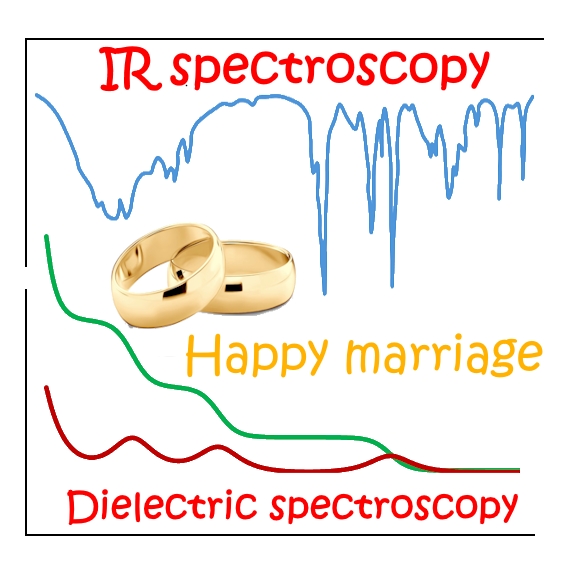
The paper presents our experience in the combined use of vibrational spectroscopy and dielectric methods in the investigation of molecular structure and interactions in hydrogen-bonded systems. Here, we show three selected examples obtained by our research groups. The first example concerns examination of the mixture of propionic acid with triethylamine. It has been found the presence of the pronounced maxima of dielectric permittivity and conductivity at some acid-amine molar ratio. This observation suggests that the mixture has properties of both the ionic and dipolar liquids. In the next work, we have elucidated the mechanism of the dissociation of 1-octanol and 3-octanol associates in solutions and in the pure liquid phase. It has been evidenced that at first dissociate the terminal alcohol molecules. These studies also have shown that the tendency of formation of the cyclic associates increases from 1-octanol to 3-octanol. The last example concerns an examination of 1-hexanol in n-hexane. Our results suggest that in the solutions the most populated species are the cyclic trimers. It is contrary to numerous previous studies claiming that cyclic tetramers are the most abundant species. Of particular importance is the observation that the peak due to the free OH is contributed mainly by the absorption from the monomers. This suggests that the band from the free terminal O-H groups in the linear associates is obscured by a broad absorption from the hydrogen-bonded O-H groups. Based on our results, it is possible to conclude that simultaneous use of vibrational spectroscopy and dielectric methods allows to get deeper insight into molecular structure with higher confidence and to draw conclusions not available from separate application of each method.
- Open Access
- Mini Review
Infrared and Dielectric Spectroscopy—A Useful Marriage for Exploration of Hydrogen-Bonded Systems
Author Information
Received: 03 Feb 2026 | Revised: 20 Feb 2026 | Accepted: 28 Feb 2026 | Published: 29 Jul 2026
Abstract
Graphical Abstract
Keywords
NIR/IR spectroscopy | dipole moment | nonlinear dielectric effect | alcohol | association | hydrogen bonding
References
- 1.
Hunt, P.A.; Ashworth, C.R.; Matthews, R.P. Hydrogen bonding in ionic liquids. Chem. Soc. Rev. 2015, 44, 1257–1288. https://doi.org/10.1039/C4CS00278D.
- 2.
Kannan, P.P.; Karthick, N.K.; Arivazhagan, G. Hydrogen bond interactions in the binary solutions of formamide with methanol: FTIR spectroscopic and theoretical studies. Spectrochim. Acta A Mol. Biomol. Spectrosc. 2020, 229, 117892. https://doi.org/10.1016/j.saa.2019.117892.
- 3.
Karas, L.J.; Wu, C.; Das, R.; et al. Hydrogen bond design principles. WIREs Comput. Mol. Sci. 2020, 10, 1477. https://doi.org/10.1002/wcms.1477.
- 4.
Ozaki, Y.; Huck, C.; Tsuchikawa, S.; et al. Overview of Application of NIR Spectroscopy to Physical Chemistry. In Near-Infrared Spectroscopy: Theory, Spectral Analysis, Instrumentation, and Applications; Springer Nature: Singapore, 2021.
- 5.
Han, L.; Sun, Y.; Wang, S.; et al. Understanding the water structures by near-infrared and Raman spectroscopy. J. Raman Spectrosc. 2022, 53, 1686–1693. https://doi.org/10.1002/jrs.6399.
- 6.
Wójcik, M.J.; Ozaki, Y. Spectroscopy and Computation of Hydrogen-Bonded Systems, 1st Ed.; WILEY-VCH GmbH: Weinheim, Germany, 2023.
- 7.
Wang, Y.; Zhao, Y.; Xu, W.; et al. A Review on the Role of Hydrogen Bonds in Organic Electrode Materials. Batter. Supercaps 2024, 7, e202400440. https://doi.org/10.1002/batt.202400440.
- 8.
Strate, A.; Paschek, D.; Ludwig, R. Hydrogen-Bonding Motifs in Hydroxy-Functionalized Ionic Liquids. Annu. Rev. Phys. Chem. 2025, 76, 589–614. https://doi.org/10.1146/annurev-physchem-082423-020307.
- 9.
Ximenis, P.; Martínez, D.; Rubert, L.; et al. Hydrogen-bonded π-conjugated supramolecular polymers. Chem. Soc. Rev. 2025, 54, 11659–11698. https://doi.org/10.1039/D5CS00909J.
- 10.
Pimentel, G.C.; McClellan, A.L. The Hydrogen Bond; W. H. Freeman Co.: San Francisco, CA, USA, 1960.
- 11.
Schuster, P.; Zundel, G.; Sandorfy, C. The Hydrogen Bond, Recent Developments in Theory and Experiments; North-Holland: Amsterdam, Netherlands, 1976.
- 12.
Jeffrey, G.A. An Introduction to Hydrogen Bonding; Oxford University Press: Oxford, UK, 1997.
- 13.
Debye, P. Polar Molecules; Dover Publications INC.: New York, NY, USA, 1929.
- 14.
Hill, N.E.; Vaughan, W.E.; Price, A.H.; et al. Dielectric Properties and Molecular Behavior; Van Nostrand Reinhold Company: London, UK, 1969.
- 15.
Smyth, C.P. Dielectric Behavior and Structure; International Chemical Series; McGraw-Hill Book Company: New York, NY, USA.; Toronto, Canada; London, UK, 1955.
- 16.
Kaatze, U. Dielectric Spectroscopy of Aqueous Solutions—Hydration Phenomena and Hydrogen-Bonded Networks. J. Mol. Liq. 1993, 56, 95–115. https://doi.org/10.1016/0167-7322(93)80020-V.
- 17.
Schwerdtfeger, S.; Köhler, F.; Pottel, R.; et al. Dielectric Relaxation of Hydrogen Bonded Liquids: Mixtures of Monohydric Alcohols with n-Alkanes. J. Chem. Phys. 2001, 115, 4186–4194. https://doi.org/10.1063/1.1389293.
- 18.
Bennett, E.L.; Calisir, I.; Yang, X.; et al. Correlation of Dielectric Properties with Structure and H-Bonding for Liquids. J. Phys. Chem. C 2023, 127, 18669–18677. https://doi.org/10.1021/acs.jpcc.3c03484.
- 19.
Orzechowski, K.; Burakowski, A. Experimental set-up for measuring the non-linear dielectric effect. Measurement 2019, 131, 219–222. https://doi.org/10.1016/j.measurement.2018.08.071.
- 20.
Małecki, J. Theory of non-linear dielectric effects in liquids. J. Chem. Soc. Faraday Trans. 2 Mol. Chem. Phys. 1976, 72, 104–112.
- 21.
Małecki, J. Non-linear dielectric behavior and chemical equilibria in liquids. Electrochim. Acta 1988, 33, 1235–1241. https://doi.org/10.1016/0013-4686(88)80154-3.
- 22.
Małecki, J.; Nowak, J.; Wojtowicz, A. Rotational tautomeria in 1,2-dichloroethane studied with the nonlinear dielectric method. Acta Phys. Pol. A 1989, 75, 657–666.
- 23.
Małecki, J.; Nowak, J. Intermolecular interactions in benzene solutions of 4-heptyl-3′-cyano-biphenyl studied with non-linear dielectric effects. J. Mol. Liq. 1999, 81, 245–252. https://doi.org/10.1016/S0167-7322(99)00055-0.
- 24.
Małecki, J. Linear and Nonlinear Dielectric Studies of Intermolecular Interactions in Nitroalkane-Benzene Liquid Solutions. II. Molecular Cluster Model. J. Mol. Liq. 1995, 67, 23–31.
- 25.
Małecki, J.; Dutkiewicz, M. Nonlinear dielectric effect study of tetrahydrofuran association in benzene and cyclohexane solutions. J. Solut. Chem. 1999, 28, 101–116.
- 26.
Małecki, J. Study of self-association of 2-methyl-2-butanol based on non-linear dielectric effect. Chem. Phys. Lett. 1998, 297, 29–37. https://doi.org/10.1016/S0009-2614(98)01098-7.
- 27.
Orzechowski, K.; Czarnecki, M.A. Association of 1-hexanol in mixtures with n-hexane: Dielectric, near-infrared and DFT studies. J. Mol. Liq. 2019, 279, 540–547. https://doi.org/10.1016/j.molliq.2019.01.157.
- 28.
Forsyth, S.A.; Pringle, J.M.; MacFarlane, D.R. Ionic liquids—An overview. Aust. J. Chem. 2004, 57, 113–119. https://doi.org/10.1071/CH03231.
- 29.
Amarasekara, A.S. Acidic Ionic Liquids. Chem. Rev. 2016, 116, 6133–6183. https://doi.org/10.1021/acs.chemrev.5b00763.
- 30.
Orzechowski, K.; Pajdowska, M.; Czarnecki, M.A.; et al. Complexation and proton transfer in the binary system propionic acid-triethylamine—Evidence from the composition dependencies of mixture properties. J. Mol. Liq. 2007, 133, 11–16. https://doi.org/10.1016/j.molliq.2006.05.007.
- 31.
Weger, L.G.; Lo, S.C. Spectra-Structure Correlations in the Near-Infrared. In Handbook of Vibrational Spectroscopy; Chalmers, J.M., Griffiths, P.R., Eds.; Wiley: New York, NY, USA, 2002.
- 32.
Czarnecki, M.A.; Morisawa, Y.; Futami, Y.; et al. Advances in Molecular Structure and Interaction Studies Using Near-Infrared Spectroscopy. Chem. Rev. 2015, 115, 9707–9744. https://doi.org/10.1021/cr500013u.
- 33.
Czarnecki, M.A.; Maeda, H.; Ozaki, Y.; et al. Resolution enhancement and band assignments for the first overtone of OH stretching mode of butanols by two-dimensional near-infrared correlation spectroscopy. Part I: Sec-butanol. Appl. Spectrosc. 1998, 52, 994–1000. https://doi.org/10.1366/0003702981944643.
- 34.
Czarnecki, M.A.; Maeda, H.; Ozaki, Y.; et al. Resolution Enhancement and Band Assignments for the First Overtone of OH Stretching Modes of Butanols by Two-Dimensional Near-Infrared Correlation Spectroscopy. 2. Thermal Dynamics of Hydrogen Bonding in n- and tert- Butyl Alcohol in the Pure Liquid States. J. Phys. Chem. A 1998, 102, 9119–9123. https://doi.org/10.1021/jp9823704.
- 35.
Czarnecki, M.A.; Ozaki, Y. The temperature-induced changes in hydrogen bonding of decan-1-ol in the pure liquid phase studied by two-dimensional Fourier transform near-infrared correlation spectroscopy. Phys. Chem. Chem. Phys. 1999, 1, 797–800.
- 36.
Czarnecki, M.A.; Czarnik-Matusewicz, B.; Ozaki, Y.; et al. Resolution enhancement and band assignments for the first overtone of OH(D) stretching modes of butanols by two-dimensional near-infrared correlation spectroscopy. 3. Thermal dynamics of hydrogen bonding in butan-1-(ol-d) and 2-methylpropan-2-(ol-d) in the pure liquid states. J. Phys. Chem. A 2000, 104, 4906–4911. https://doi.org/10.1021/jp991753e.
- 37.
Czarnecki, M.A. Effect of temperature and concentration on self-association of octan-1-ol studied by two-dimensional fourier transform near-infrared correlation spectroscopy. J. Phys. Chem. A 2000, 104, 6356–6361. https://doi.org/10.1021/jp000407q.
- 38.
Iwahashi, M.; Suzuki, M.; Katayama, N.; et al. Molecular self-assembling of butan-1-ol, butan-2-ol, and 2-methylpropan-2-ol in carbon tetrachloride solutions as observed by near-infrared spectroscopic measurements. Appl. Spectrosc. 2000, 54, 268–276. https://doi.org/10.1366/0003702001949203.
- 39.
Czarnecki, M.A.; Orzechowski, K. Effect of temperature and concentration on self-association of octan-3-ol studied by vibrational spectroscopy and dielectric measurements. J. Phys. Chem. A 2003, 107, 1119–1126. https://doi.org/10.1021/jp026384s.
- 40.
Noda, I. Generalized 2-Dimensional Correlation Method Applicable to Infrared, Raman, and Other Types of Spectroscopy. Appl. Spectrosc. 1993, 47, 1329–1336. https://doi.org/10.1366/0003702934067694.
- 41.
Noda, I.; Ozaki, Y. Two Dimensional Correlation Spectroscopy—Applications in Vibrational and Optical Spectroscopy; John Wiley & Sons, Ltd.: England, UK, 2004.
- 42.
Gericke, A.; Gadaleta, S.J.; Brauner, J.W.; et al. Characterization of Biological Samples by Two-Dimensional Infrared Spectroscopy: Simulation of Frequency, Bandwidth, and Intensity Changes. Biospectroscopy 1996, 2, 341–351. https://doi.org/10.1002/(SICI)1520-6343(1996)2:6<341::AID-BSPY1>3.3.CO;2-K.
- 43.
Czarnecki, M.A. Interpretation of two-dimensional correlation spectra: Science or art? Appl. Spectrosc. 1998, 52, 1583–1590. https://doi.org/10.1366/0003702981943086.
- 44.
McClellan, A.L. Tables of Experimental Dipole Moments; W. H. Freeman Co: San Francisco, CA, USA, 1963.
- 45.
Fletcher, A.N.; Heller, C.A. Self-association of alcohols in nonpolar solvents. J. Phys. Chem. 1967, 71, 3742–3756.
- 46.
Forland, G.M.; Libnau, F.O.; Kvalheim, O.M.; et al. Self-association of medium-chain alcohols in n-decane solutions. Appl. Spectrosc. 1996, 50, 1264–1272. https://doi.org/10.1366/0003702963904854.


This work is licensed under a Creative Commons Attribution 4.0 International License.

 Suite 4002 Level 4, 447 Collins Street, Melbourne, Victoria 3000, Australia
 General Inquiries: info@sciltp.com