
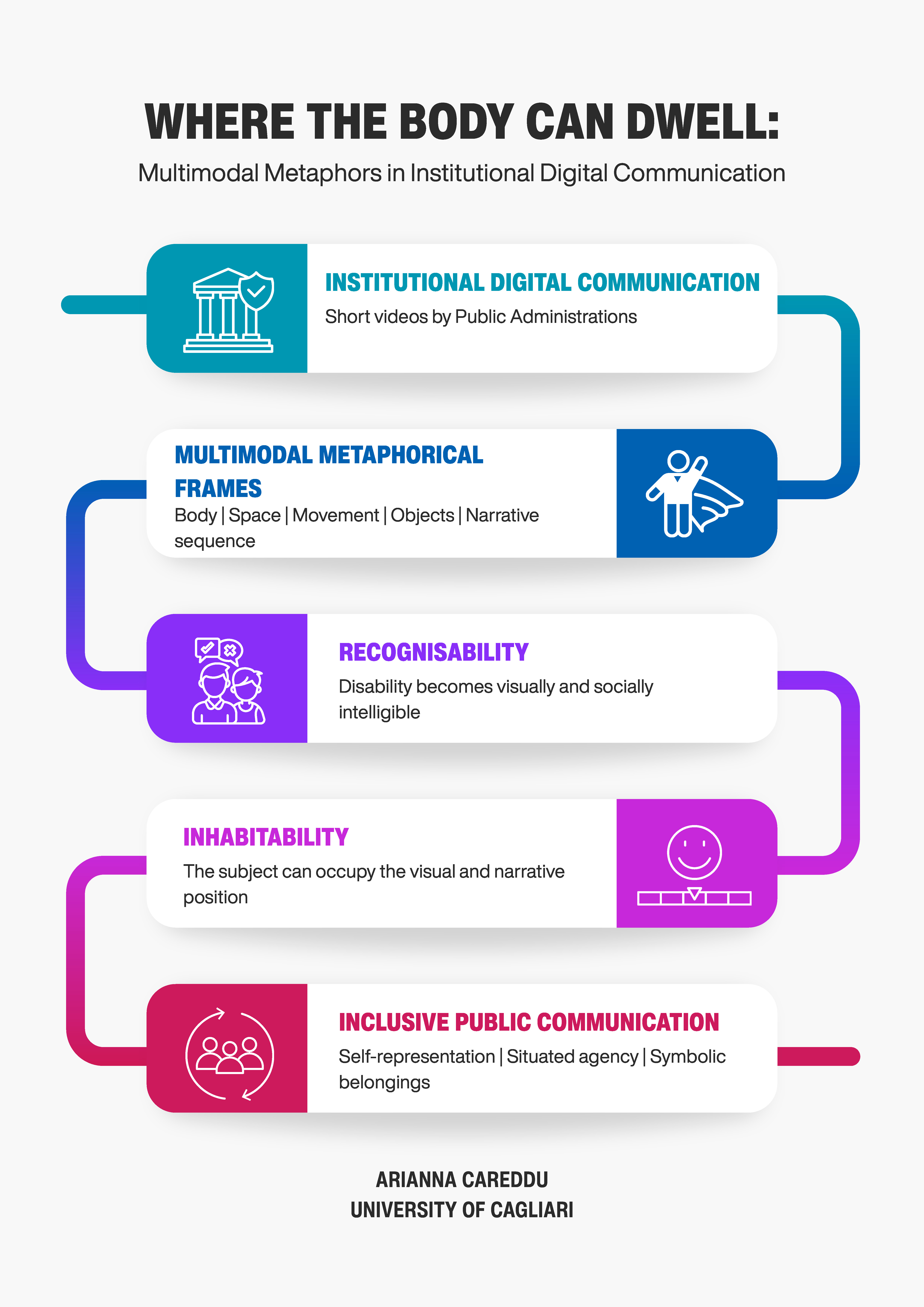
This article examines video-based multimodal metaphors in institutional digital communication, focusing on short videos produced by public administrations to represent motor disability. The article builds on previous empirical research on institutional video communication and develops inhabitability as an analytical criterion for evaluating inclusive public communication. Inhabitability refers to the capacity of a multimodal metaphor to offer represented subjects viable visual and narrative positions for self-representation, situated agency and symbolic belonging. The article presents a theoretical re-reading of institutional videos as public meaning-making devices drawing on multimodal metaphor studies, performativity theory, disability studies and narrative approaches to identity and positioning. The article argues that institutional videos construct recognisable disability positions through recurring multimodal metaphors; that recognisability is often supported by restrictive visual and narrative scripts of heroism, assistance, overcoming or passive inclusion; and that inclusive communication requires metaphors that represented subjects can occupy as resources for self-narration, agency and belonging. Motor disability is treated as a significant case because its public representation is organised through visible bodily markers, movement, accessibility, autonomy, dependence and assistive devices. The article concludes that inhabitability provides a conceptual tool for assessing the inclusive quality of multimodal metaphors in public communication. This piece contributes to the study of metaphor, visual language and institutional digital communication by shifting attention from the recognisability of represented subjects to the symbolic positions made available to them.
- Open Access
- Article
Where the Body Can Dwell: Multimodal Metaphors in Institutional Digital Communication
Author Information
Received: 31 May 2026 | Revised: 19 July 2026 | Accepted: 28 July 2026 | Published: 06 August 2026
Abstract
Graphical Abstract
Keywords
multimodal metaphor | institutional digital communication | motor disability | visual language | public communication | inhabitability
References
Ahmed, S. (2004). The Cultural Politics of Emotion. Routledge.
Arnheim, R. (1969). Visual Thinking. University of California Press.
Austin, J. L. (1962). How to do things with words. Clarendon Press.
Bamberg, M. (2011). Who am I? Narration and its contribution to self and identity. Theory & Psychology, 21(1), 3–24. https://doi.org/10.1177/0959354309355852.
Barnes, C. (1992). Disabling Imagery and the Media: An Exploration of the Principles for Media Representations of Disabled People. Ryburn Publishing.
Barnes, C. (2007). Disability activism and the struggle for change: Disability, policy and politics in the UK. Education, Citizenship and Social Justice, 2(3), 203–221.
Bateman, J. A., & Wildfeuer, J. (2014). A multimodal discourse theory of visual narrative. Journal of Pragmatics, 74, 180–208.
Bateman, J. A., Wildfeuer, J., & Hiippala T. (2026). Multimodality—A Hands-on Guide. De Gruyter.
Bort-Mir, L. (2019). Developing, applying and testing FILMIP: the filmic metaphor identification procedure. [PhD. Thesis, Universitat Jaume I].
Butler, J. (1990). Gender Trouble: Feminism and the Subversion of Identity. Routledge.
Butler, J. (1993). Bodies That Matter: On the Discursive Limits of “Sex”. Routledge.
Danforth, S. (2007). Disability as Metaphor: Examining the Conceptual Framing of Emotional Behavioral Disorder in American Public Education. Educational Studies, 42(1), 8–27.
Davies, B., & Harré, R. (1990). Positioning: The discursive production of selves. Journal for the Theory of Social Behaviour, 20(1), 43–63. https://doi.org/10.1111/j.1468-5914.1990.tb00174.x
El Refaie, E. (2019). Visual metaphor and embodiment in graphic illness narratives. Oxford University Press.
Forceville, C. (1996). Pictorial Metaphor in Advertising. Routledge.
Forceville, C. (2020). Visual and Multimodal Communication: Applying the Relevance Principle. Oxford University Press.
Forceville, C. J. (2006). Non-Verbal and Multimodal Metaphor in a Cognitivist Framework: Agendas for Research. In G. Kristiansen, M. Achard, R. Dirven & F.J. Ruiz de Mendoza Ibáñez (Eds.), Cognitive Linguistics: Current Applications and Future Perspectives (pp. 379–402). Mouton de Gruyter.
Forceville, C. J. (2024). Identifying and Interpreting Visual and Multimodal Metaphor in Commercials and Feature Films. Metaphor and Symbol, 39(1), 40–54.
Forceville, C. J. (2025). Metaphor in Film: Examples and Insights from Students’ Work. Lublin Studies in Modern Languages and Literature, 49, 35–51.
Forceville, C. J., & Urios-Aparisi, E. (eds.) (2009). Multimodal Metaphor. De Gruyter Mouton.
Fricker, M. (2007). Epistemic Injustice: Power and the Ethics of Knowing. Oxford University Press.
Gallagher, S. (2006). How the Body Shapes the Mind. Oxford University Press.
Garland-Thomson, R. (1997). Extraordinary Bodies. Figuring Physical disability in American culture and literature. Columbia University Press.
Garland-Thomson, R. (2005). Disability and Representation. Publications of the Modern Language Association of America, 120(2), 522–527.
Garland-Thomson, R. (2009). Staring: How we look. Oxford University Press.
Hill, S. (2024). Navigating visibility and risk: disabled young women’s self-presentation practices on social media. Journal of Gender Studies, 33(5), 512–523. https://doi.org/10.1080/09589236.2023.2219971.
Hydén, L.-C., & Antelius, E. (2011). Communicative disability and stories: Towards an embodied conception of narratives. Health, 15(6), 588–603. https://doi.org/10.1177/1363459310364158.
Kafer, A. (2013). Feminist, Queer, Crip. Indiana University Press.
Kövecses, Z. (2010). Metaphor: A Practical Introduction (2nd ed.). Oxford University Press.
Mitchell, D.T., & Snyder, S. L. (2000). Narrative Prosthesis: Disability and the Dependencies of Discourse. University of Michigan Press.
Poppi, F. I. M., & Urios-Aparisi, E. (2018). De Corporibus Humanis: Metaphor and Ideology in the Representation of the Human Body in Cinema. Metaphor and Symbol, 33(4), 295–314. https://doi.org/10.1080/10926488.2018.1549838.
Postan, E. (2022). Embodied narratives: Protecting identity interests through ethical governance of bioinformation. Cambridge University Press. https://doi.org/10.1017/9781108652599.
Shakespeare, T. (2013). Disability Rights and Wrongs Revisited (2nd ed.). Routledge.
Smith, B., & Sparkes, A. C. (2008). Narrative and its potential contribution to disability studies. Disability & Society, 23(1), 17–28. https://doi.org/10.1080/09687590701725542.
Somers, M. R. (1994). The narrative constitution of identity: A relational and network approach. Theory and Society, 23(5), 605–649. https://doi.org/10.1007/BF00992905.
Sperber, D., & Wilson, D. (1995). Relevance: Communication and cognition (2nd ed.). Blackwell.
Trevisan, F., & Farinosi, M. (2024). Disabled influencers on Instagram: exploring digital celebrity and marginalised identities. Celebrity Studies, 15(2), 209–230. https://doi.org/10.1080/19392397.2024.2341599.
Vidali, A. (2010). Seeing What We Know: Disability and Theories of Metaphor. Journal of Literary & Cultural Disability Studies, 4(1), 33–54.
Zittoun, T. (2007). The role of symbolic resources in human lives. In J. Valsiner & A. Rosa (Eds.), The Cambridge handbook of sociocultural psychology (pp. 343–361). Cambridge University Press. https://doi.org/10.1017/CBO9780511611162.019.


This work is licensed under a Creative Commons Attribution 4.0 International License.
