
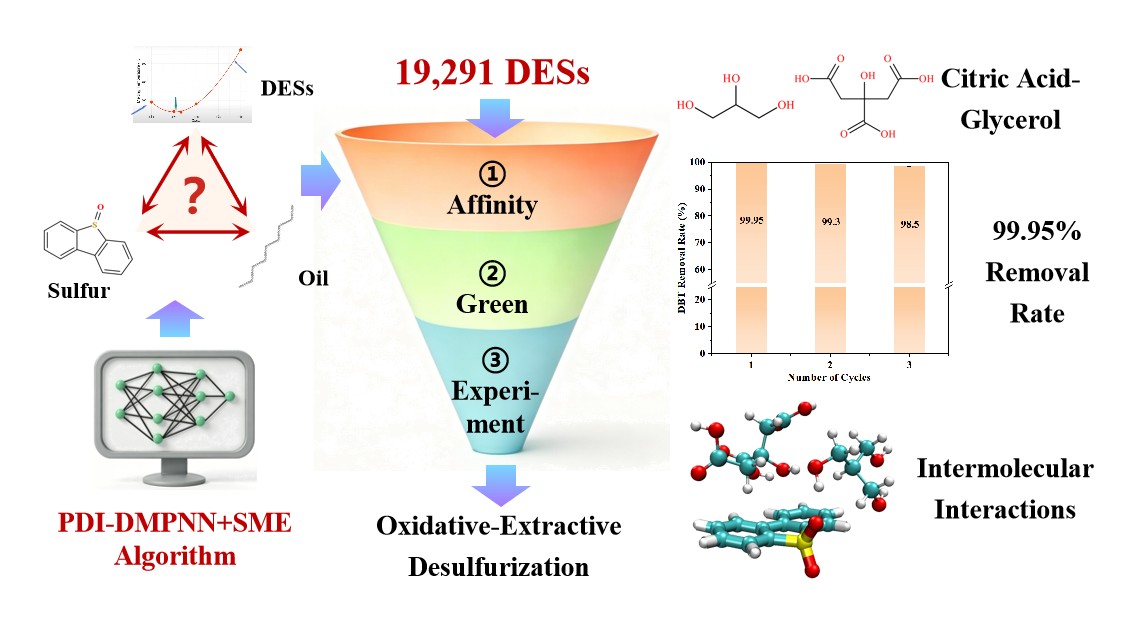
Oxidative-extractive desulfurization (OEDS) represents a highly efficient pathway for removing recalcitrant thiophenic sulfides from liquid fuels. Deep eutectic solvents (DESs) have emerged as promising green extractants due to their tunable multi-site non-covalent interactions and favorable environmental profile. However, exploring the vast chemical space of potential DES formulations demands rational, data-driven methodologies to identify molecular affinities while bypassing costly experimental trial-and-error. Herein, we report a novel hybrid algorithm termed PDI-DMPNN+SME. By coupling solvation free energy predictions with substructural masking, this framework quantitatively decodes the affinity and repulsion aimed at target molecules. The algorithm systematically evaluates both the extraction affinity of candidate DESs toward oxidized thiophenic species and the internal eutectic feasibility between solvent components. Through high-throughput screening of 19,291 binary candidates, an environmentally benign citric acid-glycerol DES system was identified as a promising extractant candidate. Under optimized process conditions, this system achieved a single-stage dibenzothiophene (DBT) removal efficiency of 99.95% in model oil and 93.72% in real diesel, maintaining satisfactory performance (98.50% and 90.80%, respectively) after the tested three consecutive regeneration cycles. Density functional theory (DFT) calculations reveal that the total interaction energy between the citric acid-glycerol system and dibenzothiophene sulfone (DBTO2) reaches −31.24 kcal/mol. Energy decomposition analysis indicates that electrostatic and dispersion interactions contribute comparably to this stabilization, jointly overcoming Pauli repulsion to form a thermodynamically favorable extractant-solute complex. This work establishes an intelligent, green paradigm for the rational design of functional solvents in advanced separation processes.
- Open Access
- Article
Screening High-Efficiency Deep Eutectic Solvents for Oxidative-Extractive Desulfurization via a Machine Learning Framework to Analyze Intermolecular Interactions
- Changqing He 1,2,†,
- Jiahao Xu 1,2,†,
- Anupa Gunawardane 1,2,
- Yang Xue 1,2,
- Xueqian Liu 1,2,
- Lin He 1,2,*,
- Hong Sui 1,2
Author Information
Received: 30 Jul 2026 | Revised: 19 Sep 2026 | Accepted: 21 Sep 2026 | Published: 28 Sep 2026
Abstract
Graphical Abstract
Keywords
desulfurization | deep eutectic solvent | high-throughput screening | machine learning | extractant design
References
- 1.
Tanimu, A.; Alhooshani, K. Advanced hydrodesulfurization catalysts: A review of design and synthesis. Energy Fuels 2019, 33, 2810–2838. https://doi.org/10.1021/acs.energyfuels.9b00354.
- 2.
Macías, M.J.; Ancheyta, J. Simulation of an isothermal hydrodesulfurization small reactor with different catalyst particle shapes. Catal. Today 2004, 98, 243–252. https://doi.org/10.1016/j.cattod.2004.07.038.
- 3.
Cheng, F.; Chen, J.; Gou, X.L. MoS2–Ni Nanocomposites as Catalysts for Hydrodesulfurization of Thiophene and Thiophene Derivatives. Adv. Mater. 2006, 18, 2561–2564. https://doi.org/10.1002/adma.200600912.
- 4.
Lü, H.; Li, P.; Deng, C.; et al. Deep catalytic oxidative desulfurization (ODS) of dibenzothiophene (DBT) with oxalate-based deep eutectic solvents (DESs). Chem. Commun. 2015, 51, 10703–10706. https://doi.org/10.1039/c5cc03324a.
- 5.
Yin, J.; Wang, J.; Li, Z.; et al. Deep desulfurization of fuels based on an oxidation/extraction process with acidic deep eutectic solvents. Green Chem. 2015, 17, 4552–4559. https://doi.org/10.1039/c5gc00709g.
- 6.
El Achkar, T.; Greige-Gerges, H.; Fourmentin, S. Basics and properties of deep eutectic solvents: A review. Environ. Chem. Lett. 2021, 19, 3397–3408. https://doi.org/10.1007/s10311-021-01225-8.
- 7.
Hansen, B.B.; Spittle, S.; Chen, B.; et al. Deep eutectic solvents: A review of fundamentals and applications. Chem. Rev. 2020, 121, 1232–1285. https://doi.org/10.1021/acs.chemrev.0c00385.
- 8.
Hao, L.; Wang, M.; Shan, W.; et al. L-proline-based deep eutectic solvents (DESs) for deep catalytic oxidative desulfurization (ODS) of diesel. J. Hazard. Mater. 2017, 339, 216–222. https://doi.org/10.1016/j.jhazmat.2017.06.050.
- 9.
Lima, F.; Gouvenaux, J.; Branco, L.C.; et al. Towards a sulfur clean fuel: Deep extraction of thiophene and dibenzothiophene using polyethylene glycol-based deep eutectic solvents. Fuel 2018, 234, 414–421. https://doi.org/10.1016/j.fuel.2018.07.043.
- 10.
Li, C.; Li, D.; Zou, S.; et al. Extraction desulfurization process of fuels with ammonium-based deep eutectic solvents. Green Chem. 2013, 15, 2793–2799. https://doi.org/10.1039/c3gc41067f.
- 11.
Li, J.J.; Xiao, H.; Tang, X.D.; et al. Green carboxylic acid-based deep eutectic solvents as solvents for extractive desulfurization. Energy Fuels 2016, 30, 5411–5418. https://doi.org/10.1021/acs.energyfuels.6b00471.
- 12.
Hadj-Kali, M.K.; Mulyono, S.; Hizaddin, H.F.; et al. Removal of Thiophene from Mixtures with n-Heptane by Selective Extraction Using Deep Eutectic Solvents. Ind. Eng. Chem. Res. 2016, 55, 8415–8423. https://doi.org/10.1021/acs.iecr.6b01654.
- 13.
Mao, C.; Zhao, R.; Li, X.; et al. Trifluoromethanesulfonic acid-based DESs as extractants and catalysts for removal of DBT from model oil. RSC Adv. 2017, 7, 12805–12811. https://doi.org/10.1039/c6ra28448e.
- 14.
Li, C.; Zhang, J.; Li, Z.; et al. Extraction desulfurization of fuels with ‘metal ions’ based deep eutectic solvents (MDESs). Green Chem. 2016, 18, 3789–3795. https://doi.org/10.1039/c6gc00366d.
- 15.
López-Flores, F.J.; Ramírez-Márquez, C.; González-Campos, J.B.; et al. Machine learning for predicting and optimizing physicochemical properties of deep eutectic solvents: Review and perspectives. Ind. Eng. Chem. Res. 2025, 64, 3103–3117. https://doi.org/10.1021/acs.iecr.4c03610.
- 16.
Mohan, M.; Jetti, K.D.; Smith, M.D.; et al. Accurate machine learning for predicting the viscosities of deep eutectic solvents. J. Chem. Theory Comput. 2024, 20, 3911–3926. https://doi.org/10.1021/acs.jctc.3c01163.
- 17.
Liu, X.; Chen, J.; Qiu, Y.; et al. Machine learning boosted eutectic solvent design for CO2 capture with experimental validation. AIChE. J. 2025, 71, e18631.
- 18.
Odegova, V.; Lavrinenko, A.; Rakhmanov, T.; et al. DESignSolvents: An open platform for the search and prediction of the physicochemical properties of deep eutectic solvents. Green Chem. 2024, 26, 3958–3967. https://doi.org/10.1039/d3gc04533a.
- 19.
Butler, K.T.; Davies, D.W.; Cartwright, H.; et al. Machine learning for molecular and materials science. Nature 2018, 559, 547–555. https://doi.org/10.1038/s41586-018-0337-2.
- 20.
Omar, K.A.; Sadeghi, R. Database of deep eutectic solvents and their physical properties: A review. J. Mol. Liq. 2023, 384, 121899. https://doi.org/10.1016/j.molliq.2023.121899.
- 21.
Liu, Z.; Lu, T.; Chen, Q. Intermolecular interaction characteristics of the all-carboatomic ring, cyclo [18]carbon: Focusing on molecular adsorption and stacking. Carbon 2021, 171, 514–523. https://doi.org/10.1016/j.carbon.2020.09.048.
- 22.
Murray, J.S.; Politzer, P. The electrostatic potential: An overview. WIREs Comput. Mol. Sci. 2011, 1, 153–163. https://doi.org/10.1002/wcms.19.
- 23.
Vermeire, F.H.; Green, W.H. Transfer learning for solvation free energies: From quantum chemistry to experiments. Chem. Eng. J. 2021, 418, 129307. https://doi.org/10.1016/j.cej.2021.129307.
- 24.
Degen, J.; Wegscheid-Gerlach, C.; Zaliani, A.; et al. On the Art of Compiling and Using ‘Drug-Like’ Chemical Fragment Spaces. ChemMedChem 2008, 3, 1503–1507. https://doi.org/10.1002/cmdc.200800178.
- 25.
Wu, Z.; Wang, J.; Du, H.; et al. Chemistry-intuitive explanation of graph neural networks for molecular property prediction with substructure masking. Nat. Commun. 2023, 14, 2585. https://doi.org/10.1038/s41467-023-38192-3.
- 26.
He, C.; Xue, Y.; Zhou, H.; et al. General applicability for developing interfacial regulation materials: An artificial-intelligence-driven approach based on non-covalent interactions. Chem. Eng. J. 2026, 547, 179552. https://doi.org/10.1016/j.cej.2026.179552.
- 27.
Lu, T.; Chen, F. Multiwfn: A multifunctional wavefunction analyzer. J. Comput. Chem. 2012, 33, 580–592. https://doi.org/10.1002/jcc.22885.
- 28.
Bannwarth, C.; Ehlert, S.; Grimme, S. GFN2-xTB─An Accurate and Broadly Parametrized Self-Consistent Tight-Binding Quantum Chemical Method with Multipole Electrostatics and Density-Dependent Dispersion Contributions. J. Chem. Theory Comput. 2019, 15, 1652–1671. https://doi.org/10.1021/acs.jctc.8b01176.
- 29.
Emamian, S.; Lu, T.; Kruse, H.; et al. Exploring nature and predicting strength of hydrogen bonds: A correlation analysis between atoms-in-molecules descriptors, binding energies, and energy components of symmetry-adapted perturbation theory. J. Comput. Chem. 2019, 40, 2868–2881. https://doi.org/10.1002/jcc.26068.
- 30.
Lu, T.; Chen, Q. Simple, efficient, and universal energy decomposition analysis method based on dispersion-corrected density functional theory. J. Phys. Chem. A 2023, 127, 7023–7035. https://doi.org/10.1021/acs.jpca.3c04374.


This work is licensed under a Creative Commons Attribution 4.0 International License.

 Suite 4002 Level 4, 447 Collins Street, Melbourne, Victoria 3000, Australia
 General Inquiries: info@sciltp.com