
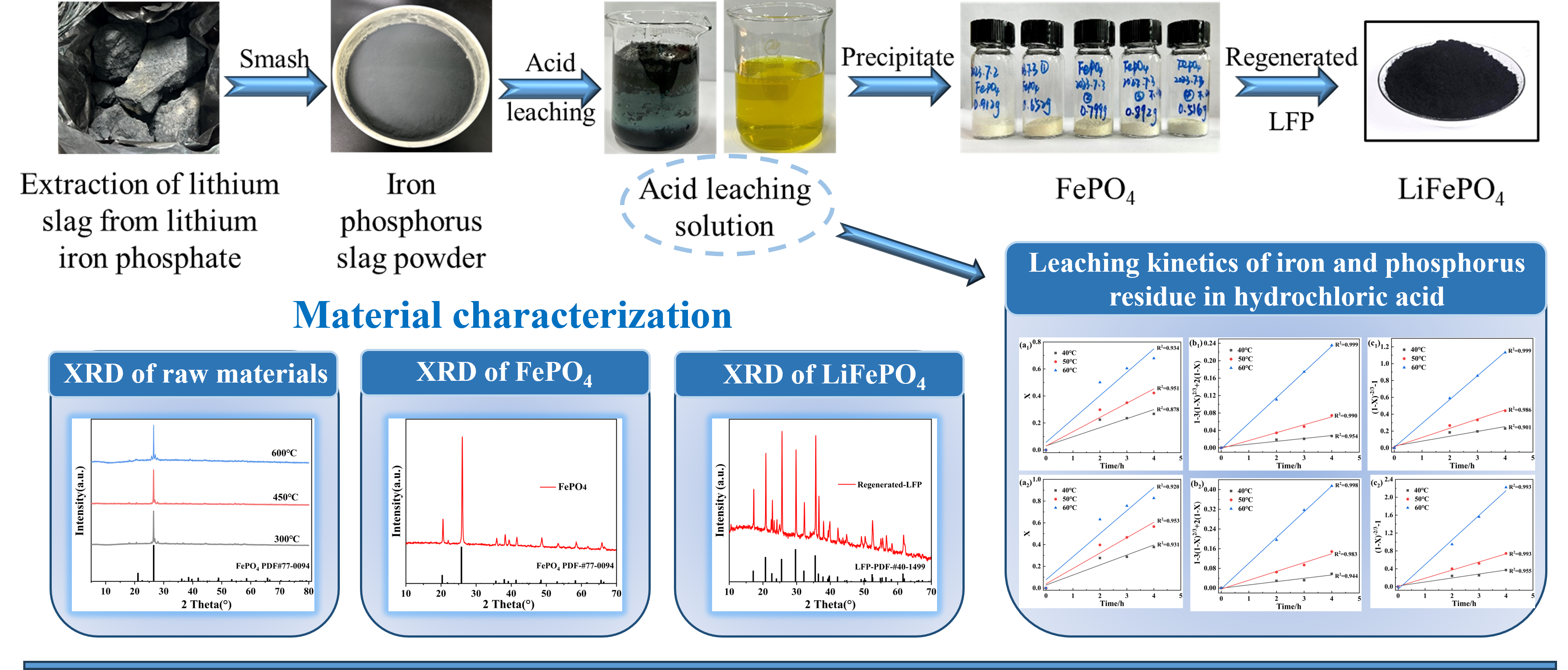
The rapid expansion of lithium iron phosphate (LiFePO4) applications has led to a surge in battery decommissioning, making comprehensive recovery of all components from spent LiFePO4 batteries critical to the advancement of the industry. In this study, iron–phosphorus slag remaining after lithium extraction was recovered through washing, acid leaching, and precipitation. The resulting iron phosphate was characterized by SEM, EDS, and XRD to analyze its crystal structure, morphology, and chemical composition. Under optimized conditions, hydrochloric acid concentration of 7 mol/L, temperature of 70 °C, liquid-to-solid ratio of 15 mL/g, and leaching time of 5 h, the leaching rates of Fe and P exceeded 80%, with corresponding activation energies of 93.62 kJ/mol and 85.40 kJ/mol, respectively. Precipitation yielded iron phosphate with good crystallinity. Recycled and commercial-grade iron phosphate were each converted into lithium iron phosphate via carbothermal reduction and assembled into batteries for performance evaluation. The results demonstrated that precise control of the microstructure and morphology of the recycled material is essential for improving its electrochemical performance. This study provides guidance for the wet-process recovery of iron–phosphorus and LiFePO4 from solid waste residues.
- Open Access
- Article
Mechanism and Condition Optimization of Acid Leaching Recovery of FePO4 from Iron–Phosphorus Slag after Lithium Extraction from LiFePO4
- Shanshan Luo 1,†,
- Yanyun Li 1,†,
- Qingyou Liu 2,
- Min Chen 1,
- Haitao Li 1,
- Xueli Chen 1,
- Haoyu Tan 1,
- Ting Yu 1,
- Liping Ai 1,
- Man Li 1,
- Kai Zheng 1,*
Author Information
Received: 05 Aug 2026 | Revised: 16 Sep 2026 | Accepted: 10 Oct 2026 | Published: 16 Oct 2026
Abstract
Graphical Abstract
Keywords
battery recycling | iron phosphorus slag | iron phosphate | acid leaching | regeneration
References
- 1.
Chen, X.D.; Yang, H.Y.; Wun, J.S.; et al. Life prediction of lithium-ion battery based on a hybrid model. Energy Explor. Exploit. 2020, 38, 1854–1878. https://doi.org/10.1177/0144598720911724.
- 2.
Xu, B.; Oudalov, A.; Ulbig, A.; et al. Modeling of Lithium-Ion Battery Degradation for Cell Life Assessment. IEEE Trans. Smart Grid 2018, 9, 1131–1140. https://doi.org/10.1109/tsg.2016.2578950.
- 3.
Li, X.; Qiao, Y.; Guo, S.; et al. A New Type of Li-Rich Rock-Salt Oxide Li2Ni1/3Ru2/3O3 with Reversible Anionic Redox Chemistry. Adv. Mater. 2019, 31, 1807825. https://doi.org/10.1002/adma.201807825.
- 4.
Zhao, J.; Qu, J.; Qu, X.; et al. Cathode electrolysis for the comprehensive recycling of spent lithium-ion batteries. Green Chem. 2022, 24, 6179–6188. https://doi.org/10.1039/d2gc02118h.
- 5.
Zhang, X.; Li, Z.; Luo, L.; et al. A review on thermal management of lithium-ion batteries for electric vehicles. Energy 2022, 238, 121652. https://doi.org/10.1016/j.energy.2021.121652.
- 6.
Ralls, A.M.; Leong, K.; Clayton, J.; et al. The Role of Lithium-Ion Batteries in the Growing Trend of Electric Vehicles. Materials 2023, 16, 6063. https://doi.org/10.3390/ma16176063.
- 7.
Wang, Y.H.; Wu, J.J.; Hu, G.C.; et al. Recovery of Li and Fe from spent lithium iron phosphate using organic acid leaching system. Trans. Nonferrous Met. Soc. China 2024, 34, 336–346. https://doi.org/10.1016/s1003-6326(23)66402-7.
- 8.
Song, Y.; Xie, B.; Song, S.; et al. Regeneration of LiFePO4 from spent lithium-ion batteries via a facile process featuring acid leaching and hydrothermal synthesis. Green Chem. 2021, 23, 3963–3971. https://doi.org/10.1039/d1gc00483b.
- 9.
Tang, D.; Ji, G.; Wang, J.; et al. A Multifunctional Amino Acid Enables Direct Recycling of Spent LiFePO4 Cathode Material. Adv. Mater. 2024, 36, 2309722. https://doi.org/10.1002/adma.202309722.
- 10.
Chen, B.; Liu, M.; Cao, S.; et al. Direct regeneration and performance of spent LiFePO4 via a green efficient hydrothermal technique. J. Alloys Compd. 2022, 924, 166487. https://doi.org/10.1016/j.jallcom.2022.166487.
- 11.
Tian, X.; Ma, Q.; Xie, J.; et al. Environmental impact and economic assessment of recycling lithium iron phosphate battery cathodes: Comparison of major processes in China. Resour. Conserv. Recycl. 2024, 203, 107449. https://doi.org/10.1016/j.resconrec.2024.107449.
- 12.
Kyaw, A.M.M.; Panomsuwan, G.; Munprom, R. Solid-State Reaction Synthesis and Characterization of Mn-Doped LiFePO4 Cathode Material. In Proceedings of the International Conference on Materials Research and Innovation (ICMARI 2021), Bangkok, Thailand, 15–17 December 2021; Volume 1234, p. 012029. https://doi.org/10.1088/1757-899x/1234/1/012029.
- 13.
Li, X.; Zhou, Q.; Zhang, X.; et al. High Electrochemical Performance Recycling Spent LiFePO4 Materials through the Preoxidation Regeneration Strategy. ACS Sustain. Chem. Eng. 2023, 11, 14457–14466. https://doi.org/10.1021/acssuschemeng.3c03232.
- 14.
He, J. Classification and Application Research of Lithium Electronic Batteries. In Proceedings of the 2023 International Conference on Materials Engineering, New Energy and Chemistry (MENEC 2023), Kuala Lumpur, Malaysia, 13–15 October 2023; p. 03008. https://doi.org/10.1051/matecconf/202338603008.
- 15.
Yue, Y.; Li, S.; Cheng, X.; et al. Effects of Temperature on the Ohmic Internal Resistance and Energy Loss of Lithium-Ion Batteries under Millisecond Pulse Discharge. In Proceedings of the 2022 International Conference on Advanced Electronics, Electrical and Green Energy (AEEGE 2022), Chongqing, China, 19–22 May 2022. https://doi.org/10.1088/1742-6596/2301/1/012014.
- 16.
Yue, P. Introduction of LFP and Ternary Cathode Materials of Lithium Battery. Highlights Sci. Eng. Technol. 2023, 58, 387–394. https://doi.org/10.54097/hset.v58i.10127.
- 17.
Fan, T.; Liang, W.; Guo, W.; et al. Life cycle assessment of electric vehicles’ lithium-ion batteries reused for energy storage. J. Energy Storage 2023, 71, 108126. https://doi.org/10.1016/j.est.2023.108126.
- 18.
Zhao, T.; Li, W.; Traversy, M.; et al. A review on the recycling of spent lithium iron phosphate batteries. J. Environ. Manag. 2024, 351, 119670. https://doi.org/10.1016/j.jenvman.2023.119670.
- 19.
Liu, Y.; Zhang, C.; Hao, Z.; et al. Study on the Life Cycle Assessment of Automotive Power Batteries Considering Multi-Cycle Utilization. Energies 2023, 16, 6859. https://doi.org/10.3390/en16196859.
- 20.
Hu, H.; Yang, G.; Chen, C.; et al. Ultra-Selective and Capacious Lithium Extraction from Geothermal Brines via β−Diketone Functionalized Brush-Shaped Polymer. Adv. Funct. Mater. 2025, 35, e13012. https://doi.org/10.1002/adfm.202513012.
- 21.
Liu, G.; Chen, Z.; Liu, T.; et al. Interlayer Dual-Sieving Engineering of Al-Intercalated MoS2 for Ultrafast and Selective Lithium Recovery from High-Sodium Lithium-Bearing Brine. Adv. Mater. 2026, 38, e73654. https://doi.org/10.1002/adma.73654.
- 22.
Jiang, Z.; Zhu, P.; Yang, Y.; et al. Sustainable recovery of lithium from spent LiFePO4 via proton circulation. Chem. Eng. J. 2023, 466, 143186. https://doi.org/10.1016/j.cej.2023.143186.
- 23.
Feng, Y.; Xie, Y.; Yang, L.; et al. Precise recovery of highly-purified iron phosphate from complex lithium extraction slag leach solution: Theory guiding experiment. Sep. Purif. Technol. 2024, 347, 127605. https://doi.org/10.1016/j.seppur.2024.127605.
- 24.
Gao, M.; Sun, F.; Peng, W.; et al. Green and efficient method for the realization of full-component recovery of LiFePO4 black powder. Green Chem. 2024, 26, 7377–7383. https://doi.org/10.1039/d4gc01444h.
- 25.
Jing, C.; Tran, T.T.; Lee, M.S. A Review on the Recovery of Lithium and Iron from Spent Lithium Iron Phosphate Batteries. Miner. Process. Extr. Metall. Rev. 2024, 45, 892–903. https://doi.org/10.1080/08827508.2024.2305382.
- 26.
Jing, Q.; Zhang, J.; Liu, Y.; et al. Direct Regeneration of Spent LiFePO4 Cathode Material by a Green and Efficient One-Step Hydrothermal Method. ACS Sustain. Chem. Eng. 2020, 8, 17622–17628. https://doi.org/10.1021/acssuschemeng.0c07166.
- 27.
Li, Z.; Liu, D.; Xiong, J.; et al. Selective recovery of lithium and iron phosphate/carbon from spent lithium iron phosphate cathode material by anionic membrane slurry electrolysis. Waste Manag. 2020, 107, 1–8. https://doi.org/10.1016/j.wasman.2020.03.017.
- 28.
Yadav, P.; Jie, C.J.; Tan, S.; et al. Recycling of cathode from spent lithium iron phosphate batteries. J. Hazard. Mater. 2020, 399, 123068. https://doi.org/10.1016/j.jhazmat.2020.123068.
- 29.
Song, X.; Cao, Y.; Zhang, Y.; et al. Preparation and characterization of nanoscale flaky iron phosphate from phosphating slag. In Proceedings of the IOP Conference Series: Materials Science and Engineering, 6th Annual International Conference on Material Science and Engineering (ICMSE2018), Suzhou, China, 22–24 June 2018; Volume 397, p. 012001. https://doi.org/10.1088/1757-899x/397/1/012001.
- 30.
Tu, T.; Yu, X.; Liu, Q. Efficient recovery of phosphorus and iron from the lithium extraction slag by the leaching precipitation method. Can. Metall. Q. 2025, 64, 644–652. https://doi.org/10.1080/00084433.2024.2357856.
- 31.
Huang, L.; Zhang, C.-Z.; Tan, J.; et al. Recycling FePO4·2H2O from waste LiFePO4 powders and formation mechanisms of the impurities during precipitation process. Chin. J. Inorg. Chem. 2023, 39, 357–366.
- 32.
Bian, D.; Sun, Y.; Li, S.; et al. A novel process to recycle spent LiFePO4 for synthesizing LiFePO4/C hierarchical microflowers. Electrochim. Acta 2016, 190, 134–140. https://doi.org/10.1016/j.electacta.2015.12.114.
- 33.
Asakai, T.; Hioki, A. Comparison of three electrochemical end-point detection methods to assay potassium dichromate by coulometric titration. Accredit. Qual. Assur. 2012, 17, 45–52. https://doi.org/10.1007/s00769-011-0834-6.
- 34.
Kadowaki, Y.; Yanagihara, Y.; Inagawa, A.; et al. Quantitative Reduction of Iron under Nitrogen Atmosphere for Potassium Dichromate Titration. ISIJ Int. 2024, 64, 1416–1426. https://doi.org/10.2355/isijinternational.isijint-2024-066.
- 35.
Hu, H.; Tang, Y.; Ying, H.; et al. The effect of copper on iron reduction and its application to the determination of total iron content in iron and copper ores by potassium dichromate titration. Talanta 2014, 125, 425–431. https://doi.org/10.1016/j.talanta.2014.03.008.
- 36.
Qiu, X.; Zhang, B.; Xu, Y.; et al. Enabling the sustainable recycling of LiFePO4 from spent lithium-ion batteries. Green Chem. 2022, 24, 2506–2515. https://doi.org/10.1039/d1gc04784a.
- 37.
Chang, X.; Fan, M.; Gu, C.F.; et al. Selective Extraction of Transition Metals from Spent LiNixCoyMn1−x−yO2 Cathode via Regulation of Coordination Environment. Angew. Chem. Int. Ed. 2022, 61, e202202558. https://doi.org/10.1002/anie.202202558.
- 38.
Zhang, Y.; Wang, B.; Wang, F.; et al. A green recyclable process for selective recovery of Li and Fe from spent lithium iron phosphate batteries by synergistic effect of deep eutectic solvent and oxygen. Sep. Purif. Technol. 2025, 354, 128764. https://doi.org/10.1016/j.seppur.2024.128764.
- 39.
Fan, E.; Li, L.; Zhang, X.; et al. Selective Recovery of Li and Fe from Spent Lithium-Ion Batteries by an Environmentally Friendly Mechanochemical Approach. ACS Sustain. Chem. Eng. 2018, 6, 11029–11035. https://doi.org/10.1021/acssuschemeng.8b02503.
- 40.
Zhang, L.; Brow, R.K. A Raman Study of Iron–Phosphate Crystalline Compounds and Glasses. J. Am. Ceram. Soc. 2011, 94, 3123–3130. https://doi.org/10.1111/j.1551-2916.2011.04486.x.
- 41.
Frost, R.L.; Xi, Y.; Scholz, R.; et al. Infrared and Raman spectroscopic characterization of the phosphate mineral kosnarite KZr2(PO4)3 in comparison with other pegmatitic phosphates. Transit. Met. Chem. 2012, 37, 777–782. https://doi.org/10.1007/s11243-012-9652-x.


This work is licensed under a Creative Commons Attribution 4.0 International License.

 Suite 4002 Level 4, 447 Collins Street, Melbourne, Victoria 3000, Australia
 General Inquiries: info@sciltp.com