
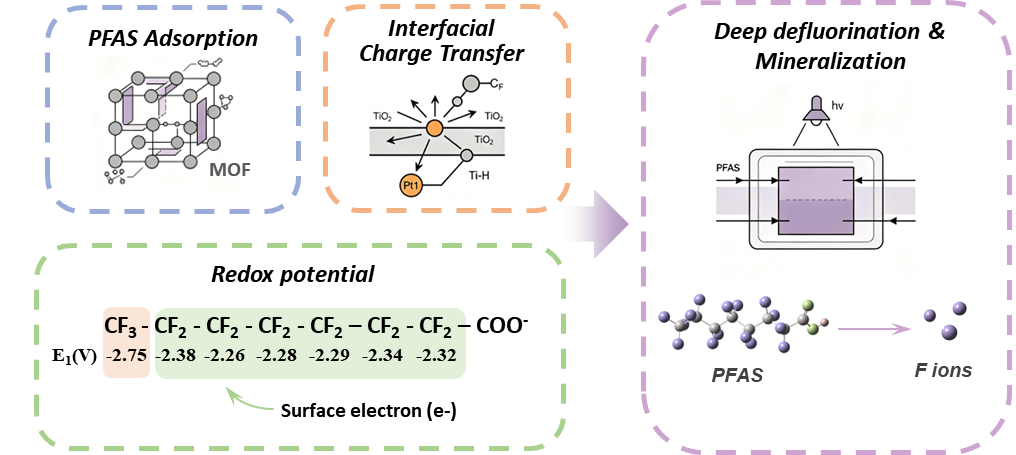
Per- and polyfluoroalkyl substances (PFAS) pose severe threats to ecosystems and human health due to their extreme persistence, bioaccumulation, and toxicity. Their ultra-strong C–F bonds render them recalcitrant to conventional water treatment technologies, spurring growing interest in photocatalytic degradation as a promising alternative. This review establishes a photocatalytic PFAS treatment framework that focuses on defluorination. We systematically compare the contributions of various reactive species to PFAS defluorination and evaluate the primary degradation pathways based on their defluorination efficiencies and the toxicities of the resulting intermediates. Furthermore, key influencing factors and integrated design strategies are summarized to enhance defluorination performance. This review provides a roadmap for developing photocatalytic technologies capable of truly destroying per- and polyfluoroalkyl substances.
- Open Access
- Review
Photocatalytic Defluorination of Per- and Polyfluoroalkyl Substances: From Mechanistic Insights to Rational Design
- Jiaxi Hu 1,
- Chuanzhe Wang 1,
- Haoying Wang 1,
- Wenjie Guo 1,
- Zhenchao Long 1,
- Qixin Zhou 1,2,
- Yan Guo 3 and
- Yongfa Zhu 1,*
Author Information
Received: 28 April 2026 | Revised: 12 September 2026 | Accepted: 13 October 2026 | Published: 29 October 2026
Abstract
Graphical Abstract
Keywords
References
- 1.
Tokranov, A.K.; Ransom, K.M.; Bexfield, L.M.; et al. Predictions of groundwater PFAS occurrence at drinking water supply depths in the United States. Science 2024, 386, 748–755.
- 2.
Park, B.; Kang, H.; Zahasky, C. Statistical mapping of PFOA and PFOS in groundwater throughout the contiguous United States. Environ. Sci. Technol. 2024, 58, 19843–19850.
- 3.
Tang, Z.W.; Shahul Hamid, F.; Yusoff, I.; et al. A review of PFAS research in Asia and occurrence of PFOA and PFOS in groundwater, surface water and coastal water in Asia. Groundwater Sust. Dev. 2023, 22, 100947.
- 4.
Evich, M.G.; Davis, M.J.B.; McCord, J.P.; et al. Per- and polyfluoroalkyl substances in the environment. Science 2022, 375, eabg9065.
- 5.
Lorpaiboon, W.; Ho, J. High-level quantum chemical prediction of C–F bond dissociation energies of perfluoroalkyl substances. J. Phys. Chem. A 2023, 127, 7943–7953.
- 6.
Costanza, J.; Arshadi, M.; Abriola, L.M.; et al. Accumulation of PFOA and PFOS at the air–water interface. Environ. Sci. Technol. Lett. 2019, 6, 487–491.
- 7.
Gruber, K. Cancer incidence associated with PFAS contamination of drinking water in the USA. Lancet. Oncol. 2025, 26, 160.
- 8.
Zahm, S.; Bonde, J.P.; Chiu, W.A.; et al. Carcinogenicity of perfluorooctanoic acid and perfluorooctanesulfonic acid. Lancet Oncol. 2024, 25, 16–17.
- 9.
O’Hagan, D. Understanding organofluorine chemistry. An introduction to the C–F bond. Chem. Soc. Rev. 2008, 37, 308–319.
- 10.
Li, F.; Duan, J.; Tian, S.; et al. Short-chain per- and polyfluoroalkyl substances in aquatic systems: Occurrence, impacts and treatment. Chem. Eng. J. 2020, 380, 122506.
- 11.
Ilić, N.; Tan, K.; Mayr, F.; et al. Trace adsorptive removal of PFAS from water by optimizing the UiO-66 MOF interface. Adv. Mater. 2025, 37, 2413120.
- 12.
Sarkar, B. Electrochemical reduction of PFAS. Nat. Chem. 2026, 18, 443–444.
- 13.
Chen, Z.; Wang, X.; Feng, H.; et al. Electrochemical advanced oxidation of perfluorooctanoic acid: Mechanisms and process optimization with kinetic modeling. Environ. Sci. Technol. 2022, 56, 14409–14417.
- 14.
Huang, S.; Jaffe, P.R. Defluorination of perfluorooctanoic acid (PFOA) and perfluorooctane Sulfonate (PFOS) by acidimicrobium sp. Strain A6. Environ. Sci. Technol. 2019, 53, 11410–11419.
- 15.
Li, H.; Song, X.; Shan, X.; et al. Photochemical degradation of PFAS: Mechanistic insights and design strategies for homogeneous and heterogeneous systems. Small 2025, 21, e06040.
- 16.
Kim, H.H.; Choi, J.S.; Jung, B.; et al. A review of photocatalytic decomposition of per- and polyfluoroalkyl substances in aqueous solution. J. Environ. Manag. 2025, 389, 126142.
- 17.
Cao, C.S.; Wang, J.; Yang, L.; et al. A review on the advancement in photocatalytic degradation of poly/perfluoroalkyl substances in water: Insights into the mechanisms and structure-function relationship. Scie. Total Environ. 2024, 946, 174137.
- 18.
Biswas, S.; Yamijala, S.; Wong, B. Degradation of per- and polyfluoroalkyl substances with hydrated electrons: A new mechanism from first-principles calculations. Environ. Sci. Technol. 2022, 56, 8167 8175.
- 19.
Hasegawa, T. Physicochemical Nature of Perfluoroalkyl Compounds Induced by Fluorine. Chem. Rec. 2017, 17, 903–917.
- 20.
Amador, C.K.; Vyas, S.; Strathmann, T.J. Kinetic model for predicting perfluoroalkyl acid degradation during UV-Sulfite treatment. Environ. Sci. Technol. 2024, 58, 6425–6434.
- 21.
Gu, Y.; Dong, W.; Luo, C.; et al. Efficient reductive decomposition of perfluorooctanesulfonate in a high photon flux UV/Sulfite system. Environ. Sci. Technol. 2016, 50, 10554–10561.
- 22.
Qu, Y.; Zhang, C.; Li, F.; et al. Photo-reductive defluorination of perfluorooctanoic acid in water. Water Res. 2010, 44, 2939–2947.
- 23.
Chen, Z.; Teng, Y.; Mi, N.; et al. Highly efficient hydrated electron utilization and reductive destruction of perfluoroalkyl substances induced by intermolecular interaction. Environ. Sci. Technol. 2021, 55, 3996–4006.
- 24.
Chen, Z.; Dong, R.; Wang, X.; et al. Efficient decomposition of perfluoroalkyl substances by low concentration indole: New insights into the molecular mechanisms. Environ. Sci. Technol. 2024, 58, 3530–3539.
- 25.
Park, H.; Vecitis, C.D.; Cheng, J.; et al. Reductive degradation of perfluoroalkyl compounds with aquated electrons generated from iodide photolysis at 254 nm. Photoch. Photobio. Sci. 2011, 10, 1945–1953.
- 26.
Bentel, M.J.; Yu, Y.; Xu, L.; et al. Defluorination of per- and polyfluoroalkyl substances (PFASs) with hydrated electrons: Structural dependence and implications to PFAS remediation and management. Environ. Sci. Technol. 2019, 53, 3718–3728.
- 27.
Maza, W.A.; Breslin, V.M.; Owrutsky, J.C.; et al. Nanosecond transient absorption of hydrated electrons and reduction of linear perfluoroalkyl acids and sulfonates. Environ. Sci. Technol. Lett. 2021, 8, 525–530.
- 28.
Reductive defluorination of aqueous perfluorinated alkyl surfactants effects of ionic headgroup and chain length. J. Phys. Chem. A 2009, 113, 690–696.
- 29.
Buxton, G.V.; Greenstock, C.L.; Helman, W.P.; et al. Critical review of rate constants for reactions of hydrated electrons, hydrogen atoms and hydroxyl radicals (OH/O−) in aqueous solution. J. Phys. Chem. Ref. Data 1988, 17, 513–886.
- 30.
Qi, Y.; Yang, Y.; Yu, X.; et al. Unveiling the contribution of hydrogen radicals to per- and polyfluoroalkyl substances (PFASs) defluorination: Applicability and degradation mechanisms. Environ. Sci. Technol. 2025, 59, 1875–1886.
- 31.
Kim, J.; Kim, T.; Park, H.; et al. Kinetics and proposed mechanisms of hexafluoropropylene oxide dimer acid (GenX) degradation via vacuum-UV (VUV) photolysis and VUV/sulfite processes. J. Hazard. Mater. 2024, 463, 132864.
- 32.
Trojanowicz, M.; Bartosiewicz, I.; Bojanowska-Czajka, A.; et al. Application of ionizing radiation in decomposition of perfluorooctane sulfonate (PFOS) in aqueous solutions. Chem. Eng. J. 2020, 379, 122303.
- 33.
Arima, Y.; Okayasu, Y.; Yoshioka, D.; et al. Multiphoton-driven photocatalytic defluorination of persistent perfluoroalkyl substances and polymers by visible light. Angew.Chem. Int. Ed. 2024, 63, e202408687.
- 34.
Chen, Z.; Zhang, S.; Wang, X.; et al. Amine-functionalized A-center sphalerite for selective and efficient destruction of perfluorooctanoic acid. Environ. Sci. Technol. 2023, 57, 10438–10447.
- 35.
Weon, S.; Suh, M.J.; Chu, C.; et al. Site-selective loading of single-atom Pt on TiO2 for photocatalytic oxidation and reductive hydrodefluorination. ACS EST Eng. 2021, 1, 512–522.
- 36.
Kobayashi, Y. Basics and perspectives of visible and near-UV light-induced defluorination of perfluoroalkylsubstances by semiconductor nanocrystals. ChemPhotoChem 2026, 10, e202600002.
- 37.
Kanao, S.; Yamaguchi, M.; Toyota, Y.; et al. Photocatalytic defluorination of perfluoroalkyl substances by surface-engineered ZnO nanocrystals. Chem. Sci. 2025, 16, 23055–23063.
- 38.
Zhang, H.; Chen, J.X.; Qu, J.P.; et al. Photocatalytic low-temperature defluorination of PFASs. Nature 2024, 635, 610–617.
- 39.
MacKenzie, I.A.; Wang, L.; Onuska, N.P.R.; et al. Discovery and characterization of an acridine radical photoreductant. Nature 2020, 580, 76–80.
- 40.
Liu, X.; Sau, A.; Green, A.R.; et al. Photocatalytic C–F bond activation in small molecules and polyfluoroalkyl substances. Nature 2024, 637, 601–607.
- 41.
Song, Z.; Tang, H.; Wang, N.; et al. Reductive defluorination of perfluorooctanoic acid by hydrated electrons in a sulfite-mediated UV photochemical system. J. Hazard. Mater. 2013, 262, 332–338.
- 42.
Javed, H.; Metz, J.; Eraslan, T.C.; et al. Discerning the relevance of superoxide in PFOA degradation. Environ. Sci. Technol. Lett. 2020, 7, 653–658.
- 43.
Vecitis, C.D.; Park, H.; Cheng, J.; et al. Kinetics and Mechanism of the Sonolytic Conversion of the Aqueous Perfluorinated Surfactants, Perfluorooctanoate (PFOA), and Perfluorooctane Sulfonate (PFOS) into Inorganic Products. J. Phys. Chem. A 2008, 112, 4261–4270.
- 44.
Li, H.; Hu, Z.; Yu, H. Photocatalytic degradation of PFOA by hydrangea-like BiOCl with high oxygen vacancies co-mediated under superoxide radicals and holes. J. Environ. Chem. Eng. 2023, 11, 110590.
- 45.
Li, X.; Zhang, P.; Jin, L.; et al. Efficient photocatalytic decomposition of perfluorooctanoic acid by indium oxide and its mechanism. Environ. Sci. Technol. 2012, 46, 5528–5534.
- 46.
Sahu, S.P.; Qanbarzadeh, M.; Ateia, M.; et al. Rapid degradation and mineralization of perfluorooctanoic acid by a new petitjeanite Bi3O(OH)(PO4)2 microparticle ultraviolet photocatalyst. Environ. Sci. Technol. Lett. 2018, 5, 533–538.
- 47.
Hori, H.; Hayakawa, E.; Einaga, H.; et al. Decomposition of environmentally persistent perfluorooctanoic acid in water by photochemical approaches. Environ. Sci. Technol. 2004, 38, 6118–6124.
- 48.
Hori, H.; Yamamoto, A.; Hayakawa, E.; et al. Efficient reductive decomposition of perfluorooctanesulfonate in a high-photon-flux UV/sulfite system. Environ. Sci. Technol. 2005, 39, 2383–2388.
- 49.
Bao, Y.; Deng, S.; Jiang, X.; et al. Degradation of PFOA substitute: GenX (HFPO–DA ammonium salt): Oxidation with UV/Persulfate or reduction with UV/Sulfite? Environ. Sci. Technol. 2018, 52, 11728 11734.
- 50.
Phan Thi, L.A.; Do, H.T.; Lee, Y.C.; et al. Photochemical decomposition of perfluorooctanoic acids in aqueous carbonate solution with UV irradiation. Chem. Eng. J. 2013, 221, 258–263.
- 51.
Yuan, Y.; Feng, L.; Xie, N.; et al. Rapid photochemical decomposition of perfluorooctanoic acid mediated by a comprehensive effect of nitrogen dioxide radicals and Fe3+/Fe2+ redox cycle. J. Hazard. Mater. 2020, 388, 121730.
- 52.
Chen, C.; Lu, Y.; Liang, J.; et al. Roles of nitrogen dioxide radical (•NO2) in the transformation of aniline by sulfate radical and hydroxyl radical systems with the presence of nitrite. Chem. Eng. J. 2023, 451, 138755.
- 53.
Ochiai, T.; Iizuka, Y.; Nakata, K.; et al. Efficient decomposition of perfluorocarboxylic acids in aqueous suspensions of a TiO2 photocatalyst with medium-pressure ultraviolet lamp irradiation under atmospheric pressure. Ind. Eng. Chem. Res. 2011, 50, 10943–10947.
- 54.
Zhou, X.; Zhong, Y.; Bai, R.; et al. Singlet oxygen-mediated photocatalytic removal of perfluoroalkyl substances by sulfur vacancy-engineered ZnIn2S4. Adv. Funct. Mat. 2025, 36, e19763.
- 55.
Rayaroth, M.P.; Aravind, U.K.; Boczkaj, G.; et al. Singlet oxygen in the removal of organic pollutants: An updated review on the degradation pathways based on mass spectrometry and DFT calculations. Chemosphere 2023, 345, 140203.
- 56.
Liu, Z.; Tan, C.; Zhao, Y.; et al. Singlet oxygen in biochar-based catalysts-activated persulfate process: From generation to detection and selectivity removing emerging contaminants. Chem. Eng. J. 2024, 485, 149724.
- 57.
Hsieh, Y.C.; Yang, M.H.; Chu, P.F.; et al. Acid-activated hexagonal boron nitride efficiently accelerates the photocatalytic decomposition of perfluoroalkyl substances: The mediation of chlorine radical. Chem. Eng. J. 2025, 523, 168617.
- 58.
Liu, F.; Guan, X.; Xiao, F. Photodegradation of per- and polyfluoroalkyl substances in water: A review of fundamentals and applications. J. Hazard. Mater. 2022, 439, 129580.
- 59.
Liu, Z.; Bentel, M.J.; Yu, Y.; et al. Near-quantitative defluorination of perfluorinated and fluorotelomer carboxylates and sulfonates with integrated oxidation and reduction. Environ. Sci. Technol. 2021, 55, 7052–7062.
- 60.
Ren, Z.; Bergmann, U.; Leiviskä, T. Reductive degradation of perfluorooctanoic acid in complex water matrices by using the UV/sulfite process. Water Res. 2021, 205, 117676.
- 61.
Bentel, M.J.; Liu, Z.; Yu, Y.; et al. Enhanced degradation of perfluorocarboxylic acids (PFCAs) by UV/Sulfite treatment: Reaction mechanisms and system efficiencies at pH 12. Environ. Sci. Technol. Lett. 2020, 7, 351–357.
- 62.
Liu, Z.; Chen, Z.; Gao, J.; et al. Accelerated degradation of perfluorosulfonates and perfluorocarboxylates by UV/Sulfite + iodide: Reaction mechanisms and system efficiencies. Environ. Sci. Technol. 2022, 56, 3699–3709.
- 63.
Cui, J.; Gao, P.; Deng, Y. Destruction of per- and polyfluoroalkyl substances (PFAS) with advanced reduction processes (ARPs): A critical review. Environ. Sci. Technol. 2020, 54, 3752–3766.
- 64.
Li, Z.; Zhang, P.; Shao, T.; et al. In2O3 nanoporous nanosphere: A highly efficient photocatalyst for decomposition of perfluorooctanoic acid. Appl. Catal. B Environ. 2012, 125, 350–357.
- 65.
Xu, T.; Zhu, Y.; Duan, J.; et al. Enhanced photocatalytic degradation of perfluorooctanoic acid using carbon-modified bismuth phosphate composite: Effectiveness, material synergy and roles of carbon. Chem. Eng. J. 2020, 395, 124991.
- 66.
Zhu, Y.; Xu, T.; Zhao, D.; et al. Adsorption and solid-phase photocatalytic degradation of perfluorooctane sulfonate in water using gallium-doped carbon-modified titanate nanotubes. Chem. Eng. J. 2021, 421, 129676.
- 67.
Lai, Y.; Wang, Y.; Zhang, S.; et al. Kinetics and mechanism analysis of advanced oxidation degradation of PFOA/PFOS by UV/Fe3+ and persulfate: A DFT study. Chemosphere 2024, 357, 141951.
- 68.
Zhang, Y.; Guan, Z.; Liao, X.; et al. Defluorination of perfluorooctanoic acid and perfluorooctane sulfonic acid by heterogeneous catalytic system of Fe-Al2O3/O3: Synergistic oxidation effects and defluorination mechanism. Sci. Total Environ. 2024, 915, 169675.
- 69.
Song, Z.; Dong, X.; Wang, N.; et al. Efficient photocatalytic defluorination of perfluorooctanoic acid over BiOCl nanosheets via a hole direct oxidation mechanism. Chem. Eng. J. 2017, 317, 925–934.
- 70.
Liu, X.; Wei, W.; Xu, J.; et al. Photochemical decomposition of perfluorochemicals in contaminated water. Water Res. 2020, 186, 116311.
- 71.
Gomez-Ruiz, B.; Ribao, P.; Diban, N.; et al. Photocatalytic degradation and mineralization of perfluorooctanoic acid (PFOA) using a composite TiO2-rGO catalyst. J. Hazard. Mater. 2018, 344, 950–957.
- 72.
Yang, L.; He, L.Y.; Xue, J.M.; et al. Persulfate-based degradation of perfluorooctanoic acid (PFOA) and perfluorooctane sulfonate (PFOS) in aqueous solution: Review on influences, mechanisms and prospective. J. Hazard. Mater. 2020, 393, 122405.
- 73.
Jiang, Z.; Archirel, P.; Hu, C.; et al. The O•−/electron tandem path for complete mineralization of trifluoroacetate and perfluorocarboxylic acids. Nat. Water 2026, 4, 621–629.
- 74.
Guan, Y.; Liu, Z.; Yang, N.; et al. Near-complete destruction of PFAS in aqueous film-forming foam by integrated photo-electrochemical processes. Nat. Water 2024, 2, 443–452.
- 75.
Tan, X.; Chen, G.; Xing, D.; et al. Indium-modified Ga2O3 hierarchical nanosheets as efficient photocatalysts for the degradation of perfluorooctanoic acid. Environ. Sci. Nano 2020, 7, 2229–2239.
- 76.
Fu, J.; Liu, Y.; Chen, Y.; et al. Electrophotocatalysis for reductive defluorination of PTFE and PFASs. Angew. Chem. Int. Ed. 2025, 64, e202422043.
- 77.
Guan, Y.; Jain, A.; Xu, X.; et al. Photo-electrochemical reduction of PFAS in complex water matrices. Nat. Commun. 2026, 17, 4550.
- 78.
Panchangam, S.C.; Lin, A.Y.; Shaik, K.L.; et al. Decomposition of perfluorocarboxylic acids (PFCAs) by heterogeneous photocatalysis in acidic aqueous medium. Chemosphere 2009, 77, 242–248.
- 79.
Fan, Z.; Nadagouda, M.N.; Niu, X.Z.; et al. Micelle-mediated hydrated electron capture enables efficient C–F bond activation and PFAS mineralization. Environ. Sci. Technol. 2025, 59, 16764–16774.
- 80.
Kim, D.H.; Kwak, Y.; Lee, S.G.; et al. PVDF-pyrolyzed fluorine-doped TiO2 for synergistic adsorption-Eenhanced PFOA photocatalysis. EcoMat 2026, 8, e70053.
- 81.
Song, Z.; Dong, X.; Fang, J.; et al. Improved photocatalytic degradation of perfluorooctanoic acid on oxygen vacancies-tunable bismuth oxychloride nanosheets prepared by a facile hydrolysis. J. Hazard. Mater. 2019, 377, 371–380.
- 82.
Liu, X.; Duan, X.; Bao, T.; et al. High-performance photocatalytic decomposition of PFOA by BiOX/TiO2 heterojunctions: Self-induced inner electric fields and band alignment. J. Hazard. Mater. 2022, 430, 128195.
- 83.
Wang, J.; Cao, C.S.; Wang, J.; et al. Insights into highly efficient photodegradation of poly/perfluoroalkyl substances by In-MOF/BiOF heterojunctions: Built-in electric field and strong surface adsorption. Appl. Catal. B Environ. 2022, 304, 121013.
- 84.
Liu, F.; Li, H.; Gao, Z.; et al. Steering charge transfer in CuInS2/BiOCl composites to enable sunlight-driven C–F bond cleavage of PFAS in water. Nat. Water 2026, 4, 334–347.
- 85.
Zhu, Y.; Leary, R.N.; Xu, T.; et al. Photocatalytic degradation of PFAS under field water matrix conditions using an adsorptive photocatalyst. Water Res. X 2026, 30, 100485.
- 86.
Chong, M.; Zhou, Q.; Xu, J.; et al. Complete defluorination of PFASs via photocatalytic reduction in water. Nat. Commun. 2026, 17, 3081.
- 87.
Hu, J.; Guo, Y.; Zhou, Q.; et al. Photocatalytic defluorination of perfluorooctanoic acid by twisted linear polymer radicals. J. Am. Chem. Soc. 2026, 148, 20364–20373.
- 88.
Gu, M.; Liu, L.; Yu, G.; et al. Deeper defluorination and mineralization of a novel PFECA (C7 HFPO-TA) in vacuum UV/Sulfite: Unique mechanism of H/OCF3 exchange. Environ. Sci. Technol. 2023, 57, 15288–15297.
- 89.
Chen, M.J.; Lo, S.L.; Lee, Y.C.; et al. Decomposition of perfluorooctanoic acid by ultraviolet light irradiation with Pb-modified titanium dioxide. J. Hazard. Mater. 2016, 303, 111–118.
- 90.
Li, X.; Ma, J.; Liu, G.; et al. Efficient reductive dechlorination of monochloroacetic acid by Sulfite/UV process. Environ. Sci. Technol. 2012, 46, 7342–7349.
- 91.
Bao, Y.; Huang, J.; Cagnetta, G.; et al. Removal of F–53B as PFOS alternative in chrome plating wastewater by UV/Sulfite reduction. Water Res. 2019, 163, 114907.
- 92.
Sun, Z.; Zhang, C.; Chen, P.; et al. Impact of humic acid on the photoreductive degradation of perfluorooctane sulfonate (PFOS) by UV/Iodide process. Water Res. 2017, 127, 50–58.
- 93.
Lee, Y.; Lo, S.; Kuo, J.; et al. Decomposition of perfluorooctanoic acid by microwaveactivated persulfate: Effects of temperature, pH, and chloride ions. Front. Environ. Sci. Eng. 2011, 6, 17–25.
- 94.
Li, F.; Wei, Z.; He, K.; et al. A concentrate-and-destroy technique for degradation of perfluorooctanoic acid in water using a new adsorptive photocatalyst. Water Res. 2020, 185, 116219.
- 95.
Li, M.; Yu, Z.; Liu, Q.; et al. Photocatalytic decomposition of perfluorooctanoic acid by noble metallic nanoparticles modified TiO2. Chem. Eng. J. 2016, 286, 232–238.
- 96.
Singh, A.; Soundappan, T. Multifaceted advances in TiO2-based photocatalysts for PFAS degradation: A critical review of mechanisms, modifications, and challenges. Mater. Adv. 2026, 7, 3101–3146.
- 97.
Tang, H.; Zhang, W.; Meng, Y.; et al. A direct Z-scheme heterojunction with boosted transportation of photogenerated charge carriers for highly efficient photodegradation of PFOA: Reaction kinetics and mechanism. Appl. Catal. B: Environ. 2021, 285, 119851.
- 98.
Deng, X.; Fang, N.; Kuang, Z.; et al. H-BN/Fe2O3 heterojunction catalyst: Efficient photocatalytic degradation of PFOA. Sep. Purif. Technol. 2026, 394, 137407.
- 99.
Wang, J.; Cao, C.; Zhang, Y.; et al. Underneath mechanisms into the super effective degradation of PFOA by BiOF nanosheets with tunable oxygen vacancies on exposed (101) facets. Appl. Catal. B: Environ. 2021, 286, 119911.
- 100.
Li, Z.; Zhang, P.; Shao, T.; et al. Different nanostructured In2O3 for photocatalytic decomposition of perfluorooctanoic acid (PFOA. J. Hazard. Mater. 2013, 260, 40–46.
- 101.
Glass, S.; Kannan, H.; Bangala, J.; et al. Iron doping of hBN enhances the photocatalytic oxidative defluorination of perfluorooctanoic acid. ACS Appl. Mater. Inter. 2025, 17, 22803–22811.
- 102.
Huang, D.; Vera, G.A.; Chu, C.; et al. Single-atom Pt catalyst for effective C–F bond activation via hydrodefluorination. ACS Catal. 2018, 8, 9353–9358.
- 103.
Zhu, C.; Xu, J.; Song, S.; et al. TiO2 quantum dots loaded sulfonated graphene aerogel for effective adsorption-photocatalysis of PFOA. Sci. Total Environ. 2020, 698, 134275.
- 104.
Wang, B.; Chen, Y.; Samba, J.; et al. Surface hydrophobicity of boron nitride promotes PFOA photocatalytic degradation. Chem. Eng. J. 2024, 483, 149134.
- 105.
Wen, Y.; Kirchon, A.; Day, G.S.; et al. Photocatalytic degradation of perfluorooctanoic acid (PFOA) by metal organic framework MIL-177-HT: New insights into the role of specific surface area, charge separation and dimensionality. Sep. Purif. Technol. 2025, 354, 128877.
- 106.
Zango, Z.U.; Ibnaouf, K.H.; Haruna, A.; et al. Toward sustainable PFAS elimination: Engineering TiO2 photocatalysts for complete mineralization and defluorination. J. Sci.: Adv. Mater. Dev. 2025, 10, 101041.
- 107.
Wu, Y.; Li, Y.; Tian, A.; et al. Selective removal of perfluorooctanoic acid using molecularly imprinted polymer-modified TiO2 nanotube arrays. Inter. J. Photoenergy 2016, 2016, 1–10.
- 108.
Wang, Z.; Jin, X.; Hong, R.; et al. New indole derivative heterogeneous system for the synergistic reduction and oxidation of various per-/polyfluoroalkyl substances: Insights into the degradation/defluorination mechanism. Environ. Sci. Technol. 2023, 57, 21459–21469.
- 109.
Eom, S.; Kim, T.; Kim, M.K.; et al. GenX degradation mechanism using 2-hydroxyphenyl acetic acid and cetyl trimethyl ammonium bromide under UV-LED irradiation through micelle formation. J. Environ. Manage 2025, 376, 124403.
- 110.
Liu, F.; Xue, H.; Kang, T.; et al. Efficient photodegradation of perfluoroalkyl substances under visible light by hexagonal ZnIn2S4 nanosheets. J. Environ. Sci. 2025, 148, 116–125.
- 111.
Liu, J.; Guo, C.; Wu, N.; et al. Efficient photocatalytic degradation of PFOA in N-doped In2O3/simulated sunlight irradiation system and its mechanism. Chem. Eng. J. 2022, 435, 134627.
- 112.
Li, T.; Wang, C.; Wang, T.; et al. Highly efficient photocatalytic degradation toward perfluorooctanoic acid by bromine doped BiOI with high exposure of (001) facet. Appl. Catal. B Environ. 2020, 268, 118442.
- 113.
Toyota, Y.; Sanada, Y.; Day, M.L.; et al. Copper-doped zinc sulfide nanocrystals for near-ultraviolet and visible-light driven decomposition of perfluoroalkyl compounds. ACS Appl. Nano Mater. 2026, 9, 6679–6690.
- 114.
Wang, J.; Wang, Y.; Cao, C.; et al. Decomposition of highly persistent perfluorooctanoic acid by hollow Bi/BiOI1-xFx: Synergistic effects of surface plasmon resonance and modified band structures. J. Hazard. Mater. 2021, 402, 123459.
- 115.
Bhardwaj, K.; Verma, P.K.; Nayak, S.K.; et al. Mechanistic insights into plasmon-driven hot electron transfer from silver nanoclusters to PFAS: Interplay of size and electronic structure. Nanoscale 2025, 17, 26775–26786.
- 116.
Wen, Y.; Renteria-Gomez, A.; Day, G.S.; et al. Integrated photocatalytic reduction and oxidation of perfluorooctanoic acid by metal-organic frameworks: Key insights into the degradation mechanisms. J. Am. Chem. Soc. 2022, 144, 11840–11850.
- 117.
Junker, A.L.; Christensen, F.M.S.; Bai, L.; et al. Emerging investigator series: Photocatalytic treatment of PFAS in a single-step ultrafiltration membrane reactor. Environ. Sci.: Water Res. Technol. 2024, 10, 2062–2074.
- 118.
Matthews, R.K.; Day, M.L.; Rahman, T.M.; et al. Development of a continuous flow photoreactor for photocatalytic pollutant degradation. Colloids Surf. A Physicochem. Eng. Asp. 2026, 735, 139354.
- 119.
Thind, S.S.; Ryane, B.A.; Hayden, J.B.; et al. Bias enhanced electro-photocatalysis on TiO2 nanoporous materials for decomposition of forever chemicals in saltwater. Environ. Sci.: Adv. 2025, 4, 1024–1034.
- 120.
Moreira, R.; Esfahani, B.; Zeidabadi, F.A.; et al. Hybrid graphenic and iron oxide photocatalysts for the decomposition of synthetic chemicals. Commun. Eng. 2024, 3, 114.
- 121.
Zhang, C.; Tang, T.; Knappe, D.R.U. Oxidation of per- and polyfluoroalkyl ether acids and other per- and polyfluoroalkyl substances by sulfate and hydroxyl radicals: Kinetic insights from experiments and models. Environ. Sci. Technol. 2023, 57, 18970–18980.
- 122.
Xin, X.; Kim, J.; Ashley, D.C.; et al. Degradation and Defluorination of Per- and Polyfluoroalkyl Substances by Direct Photolysis at 222 nm. ACS ES&T Water 2023, 3, 2776–2785.
- 123.
Alhamdan, E.Z.; Spicer, D.; Cates, E.L. Factors affecting vacuum ultraviolet (185 nm) emission intensities in low-pressure mercury lamp photoreactors for photolytic destruction of water contaminants. J. Wat. Proc. Eng. 2025, 75, 107909.
- 124.
Liu, C.S.; Higgins, C.P.; Wang, F.; et al. Effect of temperature on oxidative transformation of perfluorooctanoic acid (PFOA) by persulfate activation in water. Sep. Purif. Technol. 2012, 91, 46–51.


This work is licensed under a Creative Commons Attribution 4.0 International License.
