
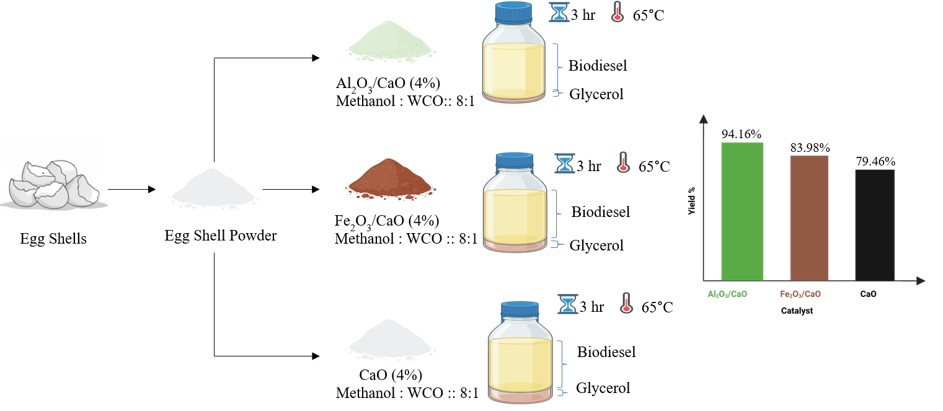
The sustainability of biodiesel production from multiple fry leftover domestic oil (MFO) derived feedstocks is hindered by cost of catalyst, reusability and stability. This study, eggshell derived CaO and wet impregnated Al2O3-CaO and Fe2O3-CaO catalyst were synthesised by calcination at high temperature. These heterogeneous catalysts were utilised for the production of biodiesel from multiple fried waste domestic cooking oil. Structural and surface characterization was done by ATR-FTIR, XRD, SEM-EDS and BET analysis. Fatty acid methyl ester (FAME) was separately synthesised for each catalyst under the same non-optimised conditions and the formation of FAME was also confirmed by gas chromatography. The XRD result shows the presence of well-defined peak of CaO as the major crystalline phase in all catalyst which confirms the structural stability of CaO during modification. However, when aluminium and iron oxides are wet impregnated, peak broadening, peak shift and minor peak variations occur. This suggests the dispersion of Al2O3 and Fe2O3 on surface of CaO and formation of interfacial bonds. Identical reaction conditions were followed for each catalyst with Al2O3-CaO exhibiting the best catalytic property. The FAME yield for each catalyst was Al2O3-CaO (94.16 ± 0.69%), Fe2O3-CaO (83.98 ± 0.89%) and unmodified CaO (79.46 ± 0.65%). The superior activity of Al2O3-CaO and Fe2O3-CaO is due to favourable surface stabilisation by preserving the structural integrity and accessibility of basic sites instead of surface area enhancement. Resultantly, catalytic efficiency of the CaO derived from eggshells can be improved through simple modification with metal oxides. This indicates the feasibility and cost-effective process for the biodiesel production by using burned oil after multiple frying, without using catalyst with homogeneous property.
- Open Access
- Article
Evaluation of Structural Modification in Eggshell Derived CaO Catalysts Induced by Aluminium-Ferric Oxide Incorporation for Biodiesel Production under Non-Optimized Conditions
- Ravi Yadav,
- Komal Priya,
- Shreyashee Naveria,
- Amisha Kushwaha and
- Abha Mishra *
Author Information
Received: 15 July 2026 | Revised: 20 October 2026 | Accepted: 28 October 2026 | Published: 16 November 2026
Abstract
Graphical Abstract
Keywords
wet impregnation | homogeneous | heterogeneous catalyst | CaO | FAME
References
- 1.
Ahmed, R.A.; Huddersman, K. Short Review of Biodiesel Production by the Esterification/Transesterification of Wastewater Containing Fats Oils and Grease (FOGs). In Energy and Sustainable Futures: Proceedings of the 3rd ICESF, 2022; Nixon, J.D., Al-Habaibeh, A., Vukovic, V. et al., eds.; Springer Nature Switzerland: Cham, Switzerland, 2023; pp. 285–299. https://doi.org/10.1007/978-3-031-30960-1_27.
- 2.
Beghetto, V. Waste Cooking Oils into High-Value Products: Where Is the Industry Going? Polymers 2025, 17, 887. https://doi.org/10.3390/polym17070887.
- 3.
Khan, M.A.; Sheikh, N.A.; Jadoon, K.Z.; et al. Utilization of locally sourced waste fats for biodiesel production: Experimental characterization and environmental life cycle assessment. Biomass Bioenergy 2025, 194, 107692. https://doi.org/10.1016/j.biombioe.2025.107692.
- 4.
Chai, M.; Tu, Q.; Lu, M.; et al. Esterification pretreatment of free fatty acid in biodiesel production, from laboratory to industry. Fuel Process. Technol. 2014, 125, 106–113. https://doi.org/10.1016/j.fuproc.2014.03.025.
- 5.
Vural Gürsel, I.; Noël, T.; Wang, Q.; et al. Separation/recycling methods for homogeneous transition metal catalysts in continuous flow. Green Chem. 2015, 17, 2012–2026. https://doi.org/10.1039/c4gc02160f.
- 6.
Vicente, G.; Martínez, M.; Aracil, J. Integrated biodiesel production: A comparison of different homogeneous catalysts systems. Bioresour. Technol. 2004, 92, 297–305. https://doi.org/10.1016/j.biortech.2003.08.014.
- 7.
Colombo, K.; Ender, L.; Barros, A.A.C. The study of biodiesel production using CaO as a heterogeneous catalytic reaction. Egypt. J. Pet. 2017, 26, 341–349. https://doi.org/10.1016/j.ejpe.2016.05.006.
- 8.
Tang, Y.; Xu, J.; Zhang, J.; et al. Biodiesel production from vegetable oil by using modified CaO as solid basic catalysts. J. Clean. Prod. 2013, 42, 198–203. https://doi.org/10.1016/j.jclepro.2012.11.001.
- 9.
Ayodeji, A.A.; Modupe, O.E.; Rasheed, B.; et al. Data on CaO and eggshell catalysts used for biodiesel production. Data Brief 2018, 19, 1466–1473. https://doi.org/10.1016/j.dib.2018.06.028.
- 10.
Sierra-Cantor, J.F.; Parra-Santiago, J.J.; Guerrero-Fajardo, C.A. Leaching and reusing analysis of calcium–zinc mixed oxides as heterogeneous catalysts in the biodiesel production from refined palm oil. Int. J. Environ. Sci. Technol. 2019, 16, 643–654. https://doi.org/10.1007/s13762-018-1710-2.
- 11.
Mahesh, S.E.; Ramanathan, A.; Begum, K.M.M.S.; et al. Biodiesel production from waste cooking oil using KBr impregnated CaO as catalyst. Energy Convers. Manag. 2015, 91, 442–450. https://doi.org/10.1016/j.enconman.2014.12.031.
- 12.
Kaur, M.; Ali, A. Lithium ion impregnated calcium oxide as nano catalyst for the biodiesel production from karanja and jatropha oils. Renew. Energy 2011, 36, 2866–2871. https://doi.org/10.1016/j.renene.2011.04.014.
- 13.
Kumar, D.; Ali, A. Transesterification of Low-Quality Triglycerides over a Zn/CaO Heterogeneous Catalyst: Kinetics and Reusability Studies. Energy Fuels 2013, 27, 3758–3768. https://doi.org/10.1021/ef400594t.
- 14.
Kaur, N.; Ali, A. Kinetics and reusability of Zr/CaO as heterogeneous catalyst for the ethanolysis and methanolysis of Jatropha curcas oil. Fuel Process. Technol. 2014, 119, 173–184. https://doi.org/10.1016/j.fuproc.2013.11.002.
- 15.
McVicker, G. Surface area stabilization of Ir/Al2O3 catalysts by CaO, SrO, and BaO under oxygen atmospheres: Implications on the mechanism of catalyst sintering and redispersion. J. Catal. 1978, 54, 129–142. https://doi.org/10.1016/0021-9517(78)90036-2.
- 16.
Liu, Q.; Xin, R.; Li, C.; et al. Application of red mud as a basic catalyst for biodiesel production. J. Environ. Sci. 2013, 25, 823–829. https://doi.org/10.1016/s1001-0742(12)60067-9.
- 17.
Dias, A.P.S.; Ramos, M. On the storage stability of CaO biodiesel catalyst. Hydration and carbonation poisoning. J. Environ. Chem. Eng. 2021, 9, 104917. https://doi.org/10.1016/j.jece.2020.104917.
- 18.
Wei, Z.; Xu, C.; Li, B. Application of waste eggshell as low-cost solid catalyst for biodiesel production. Bioresour. Technol. 2009, 100, 2883–2885. https://doi.org/10.1016/j.biortech.2008.12.039.
- 19.
El-Sherif, A.A.; Hamad, A.M.; Shams-Eldin, E.; et al. Power of recycling waste cooking oil into biodiesel via green CaO-based eggshells/Ag heterogeneous nanocatalyst. Renew. Energy 2023, 202, 1412–1423. https://doi.org/10.1016/j.renene.2022.12.041.
- 20.
Macheli, L.; Leteba, G.M.; George, S.L.; et al. Enhancing waste eggshell-derived CaO catalysts for biodiesel production through synergistic oxide modification: A comprehensive catalytic and kinetic study. RSC Adv. 2026, 16, 5990–6001. https://doi.org/10.1039/d5ra06382e.
- 21.
Rahman, W.U.; Khan, R.I.A.; Ahmad, S.; et al. Valorizing waste palm oil towards biodiesel production using calcareous eggshell based heterogeneous catalyst. Bioresour. Technol. Rep. 2023, 23, 101584. https://doi.org/10.1016/j.biteb.2023.101584.
- 22.
Falowo, O.A.; Ojediran, O.J.; Moses, O.; et al. A bifunctional catalyst from waste eggshells and its application in biodiesel synthesis from waste cooking oil. Results Eng. 2024, 23, 102613. https://doi.org/10.1016/j.rineng.2024.102613.
- 23.
Kouzu, M.; Hidaka, J.S. Transesterification of vegetable oil into biodiesel catalyzed by CaO: A review. Fuel 2012, 93, 1–12. https://doi.org/10.1016/j.fuel.2011.09.015.
- 24.
Erchamo, Y.S.; Mamo, T.T.; Workneh, G.A.; et al. Improved biodiesel production from waste cooking oil with mixed methanol–ethanol using enhanced eggshell-derived CaO nano-catalyst. Sci. Rep. 2021, 11, 6708. https://doi.org/10.1038/s41598-021-86062-z.
- 25.
Gupta, A.R.; Rathod, V.K. Waste cooking oil and waste chicken eggshells derived solid base catalyst for the biodiesel production: Optimization and kinetics. Waste Manag. 2018, 79, 169–178. https://doi.org/10.1016/j.wasman.2018.07.022.
- 26.
Zabeti, M.; Daud, W.M.A.W.; Aroua, M.K. Optimization of the activity of CaO/Al2O3 catalyst for biodiesel production using response surface methodology. Appl. Catal. A Gen. 2009, 366, 154–159. https://doi.org/10.1016/j.apcata.2009.06.047.
- 27.
Abusweireh, R.S.; Rajamohan, N.; Vasseghian, Y. Enhanced production of biodiesel using nanomaterials: A detailed review on the mechanism and influencing factors. Fuel 2022, 319, 123862. https://doi.org/10.1016/j.fuel.2022.123862.
- 28.
Abati, S.M.; Bamisaye, A.; Adaramaja, A.A.; et al. Biodiesel production from spent vegetable oil with Al2O3 and Fe2O3-biobased heterogenous nanocatalysts: Comparative and optimization studies. Fuel 2024, 364, 130847. https://doi.org/10.1016/j.fuel.2023.130847.
- 29.
Chanthon, N.; Munbupphachart, N.; Ngaosuwan, K.; et al. Metal loading on CaO/Al2O3 pellet catalyst as a booster for transesterification in biodiesel production. Renew. Energy 2023, 218, 119336. https://doi.org/10.1016/j.renene.2023.119336.
- 30.
Ezzah-Mahmudah, S.; Lokman, I.M.; Saiman, M.I.; et al. Synthesis and characterization of Fe2O3/CaO derived from Anadara granosa for methyl ester production. Energy Convers. Manag. 2016, 126, 124–131. https://doi.org/10.1016/j.enconman.2016.07.072.
- 31.
Lu, J.; Khot, S.; Wool, R.P. New sheet molding compound resins from soybean oil. I. Synthesis and characterization. Polymer 2005, 46, 71–80. https://doi.org/10.1016/j.polymer.2004.10.060.
- 32.
Chavan, S.B.; Kumbhar, R.R.; Madhu, D.; et al. Synthesis of biodiesel from Jatropha curcas oil using waste eggshell and study of its fuel properties. RSC Adv. 2015, 5, 63596–63604. https://doi.org/10.1039/c5ra06937h.
- 33.
Dissanayake, T.T.; Crawford-Clark, S.; Bowen, B.J.; et al. Comparison of Methods for the Preparation of Fatty Acid Methyl Esters for the Analysis of Omega-3 Rich Oils by Gas Chromatography. J. Am. Oil Chem. Soc. 2025, 102, 1351–1361. https://doi.org/10.1002/aocs.12974.
- 34.
Kouzu, M.; Kasuno, T.; Tajika, M.; et al. Calcium oxide as a solid base catalyst for transesterification of soybean oil and its application to biodiesel production. Fuel 2008, 87, 2798–2806. https://doi.org/10.1016/j.fuel.2007.10.019.
- 35.
Abu-Ghazala, A.H.; Abdelhady, H.H.; Mazhar, A.A.; et al. Exceptional room temperature catalytic transesterification of waste cooking oil to biodiesel using environmentally-benign K2CO3/γ-Al2O3 nano-catalyst. Chem. Eng. J. 2023, 474, 145784. https://doi.org/10.1016/j.cej.2023.145784.
- 36.
Pasupulety, N.; Gunda, K.; Liu, Y.; et al. Production of biodiesel from soybean oil on CaO/Al2O3 solid base catalysts. Appl. Catal. A Gen. 2013, 452, 189–202. https://doi.org/10.1016/j.apcata.2012.10.006.
- 37.
Wu, S.F.; Li, Q.H.; Kim, J.N.; et al. Properties of a Nano CaO/Al2O3 CO2 Sorbent. Ind. Eng. Chem. Res. 2008, 47, 180–184. https://doi.org/10.1021/ie0704748.
- 38.
Liu, X.; He, H.; Wang, Y.; et al. Transesterification of soybean oil to biodiesel using CaO as a solid base catalyst. Fuel 2008, 87, 216–221. https://doi.org/10.1016/j.fuel.2007.04.013.
- 39.
Tian, Y.; Pan, X.; Yu, H.; et al. Formation mechanism of calcium aluminate compounds based on high-temperature solid-state reaction. J. Alloys Compd. 2016, 670, 96–104. https://doi.org/10.1016/j.jallcom.2016.02.059.
- 40.
Antunes, I.; Ruivo, L.C.M.; Tarelho, L.A.C.; et al. Solid state synthesis of Ca2Fe2O5 by reactive firing of calcite and siderite. Ceram. Int. 2022, 48, 34025–34032. https://doi.org/10.1016/j.ceramint.2022.08.002.
- 41.
Widayat, W.; Darmawan, T.; Hadiyanto, H.; et al. Preparation of Heterogeneous CaO Catalysts for Biodiesel Production. J. Phys. Conf. Ser. 2017, 877, 012018. https://doi.org/10.1088/1742-6596/877/1/012018.
- 42.
Marinković, D.M.; Avramović, J.M.; Stanković, M.V.; et al. Synthesis and characterization of spherically-shaped CaO/γ-Al2O3 catalyst and its application in biodiesel production. Energy Convers. Manag. 2017, 144, 399–413. https://doi.org/10.1016/j.enconman.2017.04.079.
- 43.
Shi, M.; Zhang, P.; Fan, M.; et al. Influence of crystal of Fe2O3 in magnetism and activity of nanoparticle CaO@Fe2O3 for biodiesel production. Fuel 2017, 197, 343–347. https://doi.org/10.1016/j.fuel.2017.02.060.
- 44.
Kocík, J.; Hájek, M.; Troppová, I. The factors influencing stability of Ca–Al mixed oxides as a possible catalyst for biodiesel production. Fuel Process. Technol. 2015, 134, 297–302. https://doi.org/10.1016/j.fuproc.2015.02.013.
- 45.
Mohd Kamal, N.; Wan Abu Bakar, W.A.; Ali, R. Catalytic optimization and physicochemical studies over Zn/Ca/Al2O3 catalyst for transesterification of low grade cooking oil. Energy Convers. Manag. 2017, 137, 113–120. https://doi.org/10.1016/j.enconman.2017.01.037.
- 46.
Saupsor, J.; Wongsakulphasatch, S.; Kim-Lohsoontorn, P.; et al. Fe2O3/CaO-Al2O3 multifunctional catalyst for hydrogen production by sorption-enhanced chemical looping reforming of ethanol. Biomass Convers. Biorefin. 2023, 13, 8651–8668. https://doi.org/10.1007/s13399-020-00947-z.
- 47.
Witoon, T.; Bumrungsalee, S.; Vathavanichkul, P.; et al. Biodiesel production from transesterification of palm oil with methanol over CaO supported on bimodal meso-macroporous silica catalyst. Bioresour. Technol. 2014, 156, 329–334. https://doi.org/10.1016/j.biortech.2014.01.076.
- 48.
Torres, A.; Fuentes, B.; Rodríguez, K.E.; et al. Analysis of the Content of Fatty Acid Methyl Esters in Biodiesel by Fourier-Transform Infrared Spectroscopy: Method and Comparison with Gas Chromatography. J. Am. Oil Chem. Soc. 2020, 97, 651–661. https://doi.org/10.1002/aocs.12350.
- 49.
Hu, M.; Pu, J.; Qian, E.W.; et al. Biodiesel Production Using MgO–CaO Catalysts via Transesterification of Soybean Oil: Effect of MgO Addition and Insights of Catalyst Deactivation. BioEnergy Res. 2023, 16, 2398–2410. https://doi.org/10.1007/s12155-023-10580-z.
- 50.
Moradi, G.; Mohadesi, M.; Rezaei, R.; et al. Biodiesel Production using CaO/γ-Al2O3 Catalyst Synthesized by Sol-Gel Method. Can. J. Chem. Eng. 2015, 93, 1531–1538. https://doi.org/10.1002/cjce.22258.
- 51.
Kingkam, W.; Nuchdang, S.; Phalakornkule, C.; et al. Synergistic effect of La2O3-Al2O3 based catalysts for efficient biodiesel production. J. Ind. Eng. Chem. 2025, 143, 197–212. https://doi.org/10.1016/j.jiec.2024.08.023.
- 52.
Taufiq-Yap, Y.H.; Lee, H.V.; Hussein, M.Z.; et al. Calcium-based mixed oxide catalysts for methanolysis of Jatropha curcas oil to biodiesel. Biomass Bioenergy 2011, 35, 827–834. https://doi.org/10.1016/j.biombioe.2010.11.011.
- 53.
Pandit, P.R.; Fulekar, M.H. Biodiesel production from microalgal biomass using CaO catalyst synthesized from natural waste material. Renew. Energy 2019, 136, 837–845. https://doi.org/10.1016/j.renene.2019.01.047.
- 54.
Sulaiman, N.F.; Ramly, N.I.; Abd Mubin, M.H.; et al. Transition metal oxide (NiO, CuO, ZnO)-doped calcium oxide catalysts derived from eggshells for the transesterification of refined waste cooking oil. RSC Adv. 2021, 11, 21781–21795. https://doi.org/10.1039/d1ra02076e.
- 55.
Oueda, N.; Bonzi-Coulibaly, Y.L.; Ouédraogo, I.W.K. Deactivation Processes, Regeneration Conditions and Reusability Performance of CaO or MgO Based Catalysts Used for Biodiesel Production—A Review. Mater. Sci. Appl. 2017, 8, 94–122. https://doi.org/10.4236/msa.2017.81007.
- 56.
Li, H.; Wang, Y.; Ma, X.; et al. A novel magnetic CaO-based catalyst synthesis and characterization: Enhancing the catalytic activity and stability of CaO for biodiesel production. Chem. Eng. J. 2020, 391, 123549. https://doi.org/10.1016/j.cej.2019.123549.
- 57.
Helwani, Z.; Ramli, M.; Saputra, E.; et al. Impregnation of CaO from Eggshell Waste with Magnetite as a Solid Catalyst (Fe3O4/CaO) for Transesterification of Palm Oil Off-Grade. Catalysts 2020, 10, 164. https://doi.org/10.3390/catal10020164.
- 58.
Ali, M.A.; Al-Hydary, I.A.; Al-Hattab, T.A. Nano-Magnetic Catalyst CaO-Fe3O4 for Biodiesel Production from Date Palm Seed Oil. Bull. Chem. React. Eng. Catal. 2017, 12, 460–468. https://doi.org/10.9767/bcrec.12.3.923.460-468.
- 59.
Wahyudi, A.; Kurniawan, W.; Hinode, H. Utilization of Modified Red Mud as a Heterogeneous Base Catalyst for Transesterification of Canola Oil. J. Chem. Eng. Jpn. 2017, 50, 561–567. https://doi.org/10.1252/jcej.16we337.
- 60.
Liu, K.; Wei, G.; Zhu, Y.; et al. A clean route of biodiesel production using red mud-based potassium catalyst. J. Environ. Chem. Eng. 2023, 11, 111015. https://doi.org/10.1016/j.jece.2023.111015.
- 61.
Noiroj, K.; Intarapong, P.; Luengnaruemitchai, A.; et al. A comparative study of KOH/Al2O3 and KOH/NaY catalysts for biodiesel production via transesterification from palm oil. Renew. Energy 2009, 34, 1145–1150. https://doi.org/10.1016/j.renene.2008.06.015.
- 62.
Roschat, W.; Siritanon, T.; Yoosuk, B.; et al. Rice husk-derived sodium silicate as a highly efficient and low-cost basic heterogeneous catalyst for biodiesel production. Energy Convers. Manag. 2016, 119, 453–462. https://doi.org/10.1016/j.enconman.2016.04.071.
- 63.
Maseko, N.N.; Enke, D.; Owolawi, P.A.; et al. Usage of Silica Xerogel from African Sugarcane Leaves as a Catalyst in Biodiesel Production through Transesterification. ACS Omega 2025, 10, 28032–28042. https://doi.org/10.1021/acsomega.5c01971.
- 64.
Buasri, A.; Chaiyut, N.; Loryuenyong, V.; et al. Calcium Oxide Derived from Waste Shells of Mussel, Cockle, and Scallop as the Heterogeneous Catalyst for Biodiesel Production. Sci. World J. 2013, 2013, 460923. https://doi.org/10.1155/2013/460923.
- 65.
Fayyazi, E.; Ghobadian, B.; van de Bovenkamp, H.H.; et al. Optimization of Biodiesel Production over Chicken Eggshell-Derived CaO Catalyst in a Continuous Centrifugal Contactor Separator. Ind. Eng. Chem. Res. 2018, 57, 12742–12755. https://doi.org/10.1021/acs.iecr.8b02678.
- 66.
Prameswari, J.; Widayat, W.; Buchori, L.; et al. Novel iron sand-derived α-Fe2O3/CaO2 bifunctional catalyst for waste cooking oil-based biodiesel production. Environ. Sci. Pollut. Res. 2023, 30, 98832–98847. https://doi.org/10.1007/s11356-022-21942-z.
- 67.
Echaroj, S.; Pannucharoenwong, N.; Duanguppama, K.; et al. High throughput biodiesel production from waste cooking oil over metal oxide binded with Fe2O3. Energy Rep. 2023, 9, 205–215. https://doi.org/10.1016/j.egyr.2023.05.271.
- 68.
Shao, L.; Xu, J.; Saxén, H.; et al. A numerical study on process intensification of hydrogen reduction of iron oxide pellets in a shaft furnace. Fuel 2023, 348, 128375. https://doi.org/10.1016/j.fuel.2023.128375.
- 69.
Sharifi, M.; Tangestaninejad, S.; Moghadam, M.; et al. Metal-organic frameworks-derived CaO/ZnO composites as stable catalysts for biodiesel production from soybean oil at room temperature. Sci. Rep. 2025, 15, 3610. https://doi.org/10.1038/s41598-025-87393-x.
- 70.
Zhang, Y.; Niu, S.; Han, K.; et al. Synthesis of the SrO–CaO–Al2O3 trimetallic oxide catalyst for transesterification to produce biodiesel. Renew. Energy 2021, 168, 981–990. https://doi.org/10.1016/j.renene.2020.12.132.
- 71.
Sivaprakash, G.; Mohanrasu, K.; Ravindran, B.; et al. Integrated approach: Al2O3-CaO nanocatalytic biodiesel production and antibacterial potential silver nanoparticle synthesis from Pedalium murex extract. J. King Saud Univ. Sci. 2020, 32, 1503–1509. https://doi.org/10.1016/j.jksus.2019.12.004.
- 72.
Enguilo Gonzaga, V.; Romero, R.; Gómez-Espinosa, R.M.; et al. Biodiesel Production from Waste Cooking Oil Catalyzed by a Bifunctional Catalyst. ACS Omega 2021, 6, 24092–24105. https://doi.org/10.1021/acsomega.1c03586.


This work is licensed under a Creative Commons Attribution 4.0 International License.
