
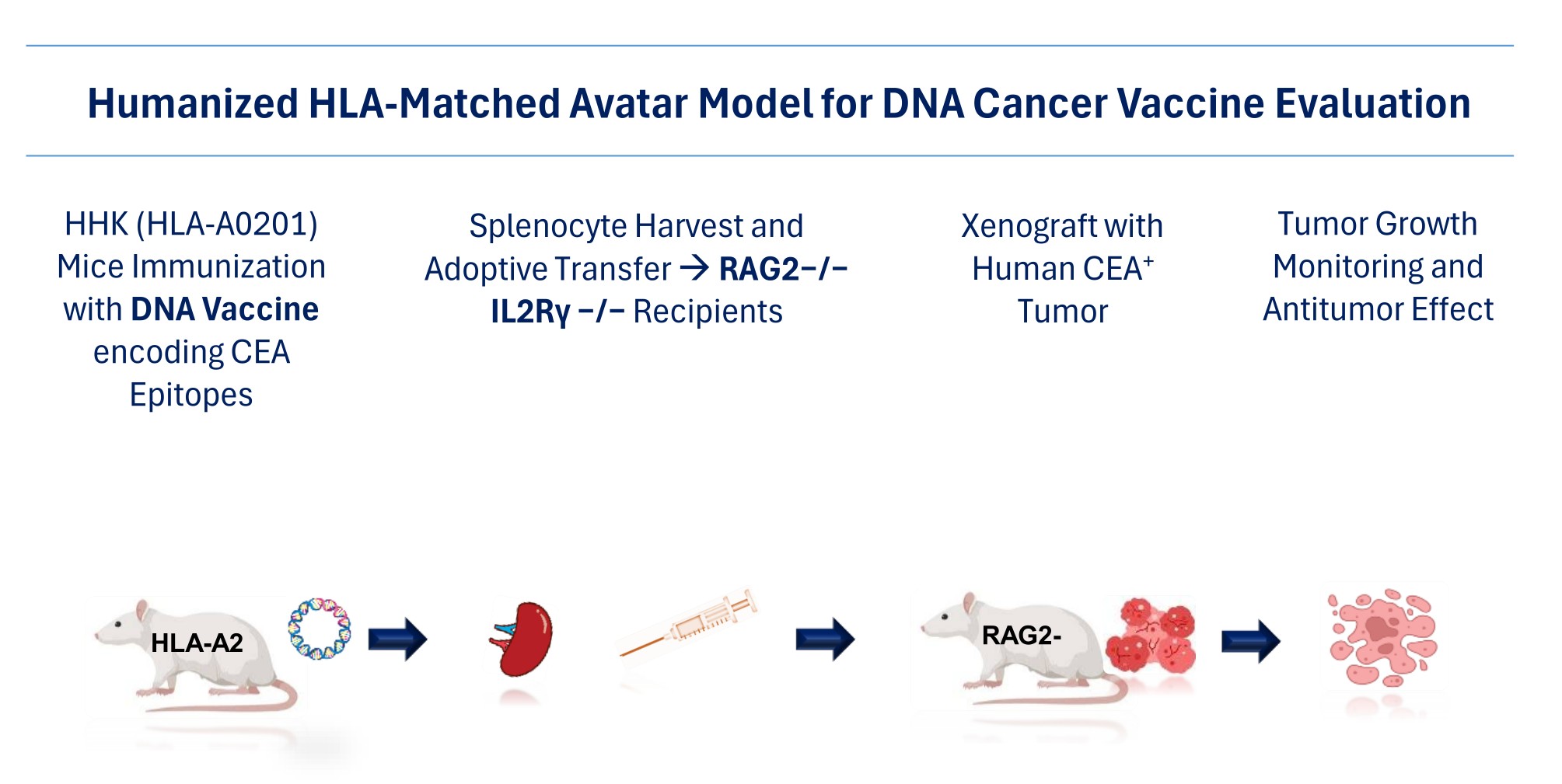
Building on seminal studies which utilized RAG2-deficient mice engrafted with human tumors and reconstituted with human PBMCs to investigate antitumor immunity, the field still lacks robust preclinical systems that faithfully recapitulate human HLA-restricted T cell responses. Here, we describe a humanized murine platform—the HLA-matched Immuno-avatar model—engineered to evaluate DNA-based cancer vaccines delivered by electroporation. The model is based on the adoptive transfer of splenocytes from immunocompetent, vaccinated HLA-A0201 transgenic (HHK) donors into immunodeficient RAG2−/− IL-2Rγ−/− recipients, which are subsequently xenografted with a human colon carcinoma cell line and treated with a DNA vaccine encoding HLA-restricted epitopes of carcinoembryonic antigen (CEA). Transfer of splenocytes from CEA-vaccinated donors induced a robust and statistically significant antitumor effect in recipient mice. This humanized, HLA-matched, and functionally immunocompetent platform provides a flexible and translationally relevant system for the preclinical evaluation of both off-the-shelf and personalized cancer vaccines targeting evolving tumor antigen repertoires.
- Open Access
- Article
A Humanized HLA-Matched Avatar Model for Preclinical Evaluation of DNA Cancer Vaccines
- Erika Salvatori 1,
- Lucia Lione 1,
- Melanie Paccagnella 1,
- Eleonora Pinto 1,
- Mariantonina Greco 1,
- Emanuele Marra 1,
- Giuseppe Roscilli 1,
- Gennaro Ciliberto 1,
- Luigi Aurisicchio 1,2,
- Antonella Conforti 1,2,*
Author Information
Received: 05 Jun 2026 | Revised: 29 Jul 2026 | Accepted: 03 Sep 2026 | Published: 23 Sep 2026
Abstract
Graphical Abstract
Keywords
References
- 1.
Hanahan, D. Hallmarks of cancer: New dimensions. Cancer Discov. 2022, 12, 31–46.
- 2.
Havel, J.J.; Chowell, D.; Chan, T.A. The evolving landscape of biomarkers for checkpoint inhibitor immunotherapy. Nat. Rev. Cancer 2019, 19, 133–150.
- 3.
Day, C.P.; Merlino, G.; Van Dyke, T. Preclinical mouse cancer models: A maze of opportunities and challenges. Cell 2015, 163, 39–53.
- 4.
Binnewies, M.; Roberts, E.W.; Kersten, K.; et al. Understanding the tumor immune microenvironment (TIME) for effective therapy. Nat. Med. 2018, 24, 541–550.
- 5.
Joyce, J.A.; Fearon, D.T. T cell exclusion, immune privilege, and the tumor microenvironment. Science 2015, 348, 74–80.
- 6.
Melero, I.; Sanmamed, M.F.; Chester, C.; et al. Defining the optimal murine models to investigate immune checkpoint blockers and their combination with other immunotherapies. Ann. Oncol. 2016, 27, 1190–1198.
- 7.
Hidalgo, M.; Amant, F.; Biankin, A.V.; et al. Patient-derived xenograft models: An emerging platform for translational cancer research. Cancer Discov. 2014, 4, 998–1013.
- 8.
Brandenburg, A.; Heine, A.; Brossart, P. Next-generation cancer vaccines and emerging immunotherapy combinations. Trends Cancer 2024, 10, 749–769.
- 9.
Ott, P.A.; Hu, Z.; Keskin, D.B.; et al. An immunogenic personal neoantigen vaccine for patients with melanoma. Nature 2017, 547, 217–221.
- 10.
Sahin, U.; Türeci, Ö. Personalized vaccines for cancer immunotherapy. Science 2018, 359, 1355–1360.
- 11.
Hance, K.W.; Zeytin, H.E.; Greiner, J.W. Mouse models expressing human carcinoembryonic antigen (CEA) as a transgene: Evaluation of CEA-based cancer vaccines. Mutat. Res. 2005, 576, 132–154.
- 12.
Gameiro, S.R.; Jammeh, M.L.; Hodge, J.W. Cancer vaccines targeting carcinoembryonic antigen: State-of-the-art and future promise. Expert Rev. Vaccines 2013, 12, 617–629.
- 13.
Conforti, A.; Peruzzi, D.; Giannetti, P.; et al. A novel mouse model for evaluation and prediction of HLA-A2-restricted CEA cancer vaccine responses. J. Immunother. 2009, 32, 744–754.
- 14.
Turriziani, M.; Fantini, M.; Benvenuto, M.; et al. Carcinoembryonic antigen (CEA)-based cancer vaccines: Recent patents and antitumor effects from experimental models to clinical trials. Recent Pat Anticancer. Drug Discov. 2012, 7, 265–296.
- 15.
Facciabene, A.; Aurisicchio, L.; Elia, L.; et al. Vectors encoding carcinoembryonic antigen fused to the B subunit of heat-labile enterotoxin elicit antigen-specific immune responses and antitumor effects. Vaccine 2008, 26, 47–58.
- 16.
Aurisicchio, L.; Roscilli, G.; Marra, E.; et al. Superior immunologic and therapeutic efficacy of a xenogeneic genetic cancer vaccine targeting carcinoembryonic antigen. Hum. Gene Ther. 2015, 26, 386–398.
- 17.
Kisakova, D.N.; Belyakov, I.M.; Kisakova, L.A.; et al. The use of electroporation to deliver DNA-based vaccines. Expert Rev. Vaccines 2024, 23, 102–123.
- 18.
Mennuni, C.; Calvaruso, F.; Facciabene, A.; et al. Efficient induction of T-cell responses to carcinoembryonic antigen by a heterologous prime-boost regimen using DNA and adenovirus vectors carrying a codon-optimized cDNA. Int. J. Cancer 2005, 117, 444–455.
- 19.
Rongvaux, A.; Willinger, T.; Takizawa, H.; et al. Human hemato‑lymphoid system mice: Current use and future potential for medicine. Annu. Rev. Immunol. 2014, 32, 563–599.
- 20.
Morton, J.J.; Bird, G.; Refaeli, Y.; et al. Humanized Mouse Xenograft Models: Narrowing the Tumor-Microenvironment Gap. Cancer Res. 2016, 76, 6153–6158.
- 21.
Walsh, N.C.; Kenney, L.L.; Jangalwe, S.; et al. Humanized mouse models of clinical disease. Annu. Rev. Pathol. 2017, 12, 187–215.
- 22.
Billerbeck, E.; Barry, W.T.; Mu, K.; et al. Development of human CD4+ T cells in humanized mice. J. Clin. Investig. 2011, 117, 3076–3086.
- 23.
Shultz, L.D.; Brehm, M.A.; Garcia‑Martinez, J.V.; et al. Humanized mice for immune system investigation: Progress, promise and challenges. Nat. Rev. Immunol. 2012, 12, 786–798.
- 24.
Boyman, O.; Sprent, J. The role of interleukin‑2 during homeostasis and activation of the immune system. Nat. Rev. Immunol. 2012, 12, 180–190.
- 25.
Liao, W.; Lin, J.‑X.; Leonard, W.J. Interleukin‑2 at the crossroads of effector responses, tolerance, and immunotherapy. Immunity 2013, 38, 13–25.
- 26.
Alcantar-Orozco EM; Gornall H; Baldan V; et al. Potential limitations of the NSG humanized mouse as a model system to optimize engineered human T cell therapy for cancer. Hum Gene Ther Methods. 2013, 24, 310–320.
- 27.
Rosenberg, S.A.; Restifo, N.P. Adoptive cell transfer as personalized immunotherapy for human cancer. Science 2015, 348, 62–68.
- 28.
Krishna, S.; Lowery, F.J.; Copeland, A.R.; et al. Stem-like CD8 T cells mediate response of adoptive cell immunotherapy against human cancer. Science 2020, 370, 1328–1334.
- 29.
Kryczek, I.; Wei, S.; Szeliga, W.; et al. Endogenous IL-17 contributes to reduced tumor growth and metastasis. Blood 2009, 114, 357–359.
- 30.
Trinchieri, G. Interleukin-12 and the regulation of innate resistance and adaptive immunity. Nat. Rev. Immunol. 2003, 3, 133–146.
- 31.
Waldmann, T.A. Interleukin-15 (dys)regulation of lymphoid homeostasis: Implications for therapy of autoimmunity and cancer. J. Exp. Med. 2020, 217, e20191062.
- 32.
Corrales, L.; Glickman, L.H.; McWhirter, S.M.; et al. Direct activation of STING in the tumor microenvironment leads to potent and systemic tumor regression. Cell Rep. 2015, 11, 1018–1030.
- 33.
Sivick, K.E.; Desbien, A.L.; Glickman, L.H.; et al. Magnitude of therapeutic STING activation determines CD8⁺ T‑cell–mediated anti‑tumor immunity. J Immunol. 2017, 198, 1579–1590.
- 34.
Melero, I.; Castanon, E.; Alvarez, M.; et al. Intratumoural administration and tumour tissue targeting of cancer immunotherapies. Nat. Rev. Clin. Oncol. 2021, 18, 558–576.
- 35.
Aurisicchio, L.; Salvatori, E.; Lione, L.; et al. Poly-specific neoantigen-targeted cancer vaccines delay patient derived tumor growth. J. Exp. Clin. Cancer Res. 2019, 38, 78.
- 36.
Jameson, S.C.; Lee, Y.J.; Hogquist, K.A. Innate memory T cells. Nat. Rev. Immunol. 2015, 15, 135–145.
- 37.
Sefik, E.; Xiao, T.; Chiorazzi, M.; et al. Engineering Mice to Study Human Immunity. Annu Rev Immunol. 2025, 43, 451–487.
- 38.
Brehm, M.A.; Kenney, L.L.; Wiles, M.V.; et al. Lack of acute xenogeneic graft-versus-host disease, but retention of T-cell function following engraftment of human peripheral blood mononuclear cells in NSG mice deficient in MHC class I and II expression. FASEB J. 2019, 33, 3137–3151.


This work is licensed under a Creative Commons Attribution 4.0 International License.

 Suite 4002 Level 4, 447 Collins Street, Melbourne, Victoria 3000, Australia
 General Inquiries: info@sciltp.com