
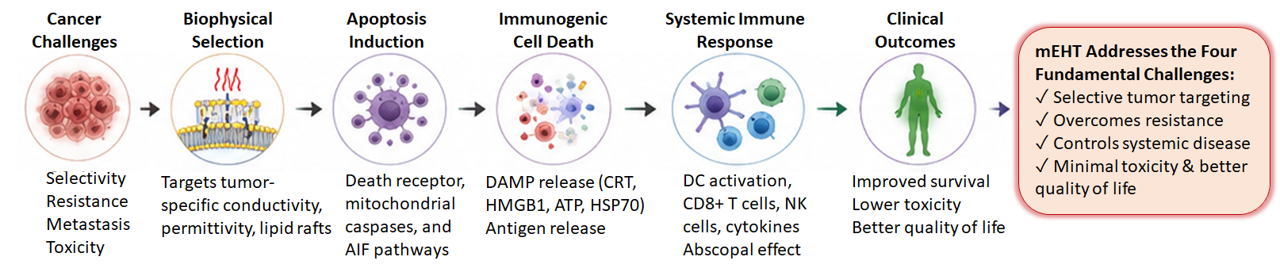
Loco-regional hyperthermia is one of the oldest concepts in oncology, yet its modern adoption has been constrained by two persistent problems: the inability to confine heat selectively to malignant tissue and the risk that indiscriminate warming increases tumor perfusion and promotes dissemination. Modulated electro-hyperthermia (mEHT), delivered as a capacitively coupled, amplitude-modulated 13.56 MHz radiofrequency current, was developed specifically to resolve these problems by exploiting the biophysical differences between cancer cells and their healthy hosts rather than relying on bulk temperature elevation. This narrative review organizes the available preclinical and clinical evidence around a single explanatory scaffold: a one-to-one correspondence between four fundamental, widely recognized challenges of contemporary oncotherapy and the specific mechanisms by which mEHT addresses each. The four challenges are poor tumor selectivity, the capacity of tumors to adapt and evade immune surveillance, the insufficiency of local control when survival depends on systemic disease, and the toxicity that erodes quality of life. We argue that mEHT addresses these, respectively, through biophysical self-focusing on the malignant membrane; multi-pathway apoptosis that overwhelms chaperone buffering and exposes damage-associated molecular patterns; immunogenic cell death that primes a systemic, abscopal antitumor response; and a benign adverse-event profile that preserves quality of life. We then trace the translational arc from in silico and in vitro mechanisms, through in vivo validation, to controlled clinical studies, including a phase III randomized trial in locally advanced cervical cancer and a meta-analysis in glioblastoma, and conclude with the limitations and the trial agenda needed to consolidate mEHT’s role as an adjuvant modality. Underlying the whole account is a set of conceptual reorientations: away from attacking the tumor’s strongest capability and toward its vulnerabilities; away from static hallmarks and toward biological processes; away from the tumor as target and toward the patient who bears it; away from a temperature-and-heat dogma and toward an alliance with the immune system and homeostasis; and away from temperature and toward an energy-based dose. We propose that mEHT is best understood as an expression of these reorientations, and that tumor shrinkage, while welcome, is not the goal; survival time and quality of life are.
- Open Access
- Review
Modulated Electro-Hyperthermia in Oncology: Biophysical Selectivity, Immunogenic Cell Death and Clinical Evidence: A Narrative Review of Mechanisms and Their Translational Status
- Andras Szasz 1,2
Author Information
Received: 02 Jul 2026 | Revised: 18 Aug 2026 | Accepted: 20 Aug 2026 | Published: 09 Sep 2026
Abstract
Graphical Abstract
Keywords
modulated electro-hyperthermia | oncothermia | immunogenic cell death | abscopal effect | lipid rafts | hyperthermia | radiosensitization | translational oncology
References
- 1.
Freddie, B.; Laversanne, M.; Sung, H.; et al. Global Cancer Statistics 2022: GLOBOCAN Estimates of Incidence and Mortality Worldwide for 36 Cancers in 185 Countries. CA A Cancer J. Clin. 2024, 74, 229–263. https://doi.org/10.3322/caac.21834.
- 2.
Vincze, G.; Szigeti, G.; Andocs, G.; et al. Nanoheating without Artificial Nanoparticles. Biol. Med. 2015, 7, 1000249. https://doi.org/10.4172/0974-8369.1000249.
- 3.
Minnaar, C.A.; Szigeti, G.P.; Szasz, A. The Synergy of Thermal and Non-Thermal Effects in Hyperthermic Oncology. Cancers 2024, 16, 3908. https://doi.org/10.3390/cancers16233908.
- 4.
Szasz, O.; Szasz, A. Modulated Electro-Hyperthermia, (mEHT) from LAB to Clinic. Oncothermia J. 2018, 23, 24–61.
- 5.
Dobšíček Trefná, H.; Crezee, J.; Schmidt, M.; et al. Quality Assurance Guidelines for Superficial Hyperthermia Clinical Trials. Strahlenther. Onkol. 2017, 193, 351–366. https://doi.org/10.1007/s00066-017-1106-0.
- 6.
Szasz, A. Bioelectromagnetism for Cancer Treatment—Modulated Electro-Hyperthermia. Curr. Oncol. 2025, 32, 158. https://doi.org/10.3390/curroncol32030158.
- 7.
Szasz, O. Bioelectromagnetic Paradigm of Cancer Treatment—Modulated Electro-Hyperthermia (mEHT). Open J. Biophys. 2019, 9, 98–109. https://doi.org/10.4236/ojbiphy.2019.92008.
- 8.
Fernández-Aranzamendi, E.G.; Castillo-Araníbar, P.R.; San Román Castillo, E.G.; et al. Dielectric Characterization of Ex-Vivo Breast Tissues: Differentiation of Tumor Types through Permittivity Measurements. Cancers 2024, 16, 793. https://doi.org/10.3390/cancers16040793.
- 9.
Le Berre, T.O.; Marchalot, J.; Frénéa-Robin, M.; et al. Measurement and Comparison of Dielectric Properties of Human Pancreatic Tumours, Healthy Tissues and Porcine Tissues Ex Vivo between 1Hz and 1MHz. Bioelectrochemistry 2025, 161, 108821. https://doi.org/10.1016/j.bioelechem.2024.108821.
- 10.
Szasz, A. Therapeutic Basis of Electromagnetic Resonances and Signal-Modulation. Open J. Biophys. 2021, 11, 314–350. https://doi.org/10.4236/ojbiphy.2021.113011.
- 11.
Cole, K.S. Membranes, Ions and Impulses; University of California Press: Los Angeles, CA, USA, 1968.
- 12.
Sasaki, K.; Porter, E.; Rashed, E.A.; et al. Measurement and Image-Based Estimation of Dielectric Properties of Biological Tissues—Past, Present, and Future. Phys. Med. Biol. 2022, 67, 14TR01. https://doi.org/10.1088/1361-6560/ac7b64.
- 13.
Limitation of Radiation from Industrial, Scientific and Medical (ISM) Equipment. Available online: https://www.itu.int/dms_pubrec/itu-r/rec/sm/R-REC-SM.1056-1-200704-I!!PDF-E.pdf (accessed on 1 July 2026).
- 14.
Agus, D.B.; Alexander, J.F.; Arap, W.; et al. A Physical Sciences Network Characterization of Non-Tumorigenic and Metastatic Cells. Sci. Rep. 2013, 3, 1449. https://doi.org/10.1038/srep01449.
- 15.
Codini, M.; Garcia-Gil, M.; Albi, E. Cholesterol and Sphingolipid Enriched Lipid Rafts as Therapeutic Targets in Cancer. Int. J. Mol. Sci. 2021, 22, 726. https://doi.org/10.3390/ijms22020726.
- 16.
Zhang, S.; Zhu, N.; Li, H.F.; et al. The Lipid Rafts in Cancer Stem Cell: A Target to Eradicate Cancer. Stem Cell Res. Ther. 2022, 13, 432. https://doi.org/10.1186/s13287-022-03111-8.
- 17.
Warda, M.; Tekin, S.; Gamal, M.; et al. Lipid Rafts: Novel Therapeutic Targets for Metabolic, Neurodegenerative, Oncological, and Cardiovascular Diseases. Lipids Health Dis. 2025, 24, 147. https://doi.org/10.1186/s12944-025-02563-0.
- 18.
Roussakow, S. Redefining Hyperthermia: A Not Temperature-Dependent Solution of the Temperature Problem. Oncothermia J. 2018, 22, 116–150.
- 19.
Yang, X.; Gao, M.; Xu, R.; et al. Hyperthermia Combined with Immune Checkpoint Inhibitor Therapy in the Treatment of Primary and Metastatic Tumors. Front. Immunol. 2022, 13, 969447. https://doi.org/10.3389/fimmu.2022.969447.
- 20.
Szasz, A. On the Thermal Distribution in Oncological Hyperthermia Treatments. Open J. Biophys. 2024, 14, 239–263.
- 21.
Meggyeshazi, N. Studies on Modulated Electrohyperthermia Induced Tumor Cell Death in a Colorectal Carcinoma Model. Ph.D. Thesis, Pathological Sciences Doctoral School, Semmelweis University, Budapest, Hungary, 2015. https://doi.org/10.14753/se.2015.1802.
- 22.
Szasz, A.M.; Lorant, G.; Szasz, A.; et al. The Immunogenic Connection of Thermal and Nonthermal Molecular Effects in Modulated Electro-Hyperthermia. Open J. Biophys. 2023, 13, 103–142. https://doi.org/10.4236/ojbiphy.2023.134007.
- 23.
Szasz, A. Time-Fractal Modulation—Possible Modulation Effects in Human Therapy. Open J. Biophys. 2022, 12, 38–87. https://doi.org/10.4236/ojbiphy.2022.121003.
- 24.
Szasz, A.; Szasz, O. Time-Fractal Modulation of Modulated Electro-Hyperthermia (mEHT). In Challenges and Solutions of Oncological Hyperthermia; Cambridge Scholars Publishing: Newcastle upon Tyne, UK, 2020; pp. 377–415.
- 25.
Meggyeshazi, N.; Andocs, G.; Spisak, S.; et al. Early changes in mRNA and Protein Expression Related to Cancer Treatment by Modulated Electrohyperthermia. Conf. Pap. Sci. 2013, 1, 249563. https://doi.org/10.1155/2013/249563.
- 26.
Andocs, G.; Meggyeshazi, N.; Okamoto, Y.; et al. Oncothermia Treatment Induced Immunogenic Cancer Cell Death. Oncothermia J. 2013, 9, 28–37.
- 27.
Szasz, A.; Szasz, O.; Szasz, N. Physical Background and Technical Realizations of Hyperthermia. In Hyperthermia in Cancer Treatment: A Primer; Springer: New York, NY, USA, 2006; pp. 27–59.
- 28.
Szasz, A.; Arkosy, P.; Arrojo, E. Guidelines for Local Hyperthermia Treatment in Oncology. In Challenges and Solutions of Oncological Hyperthermia; Cambridge Scholars Publishing: Newcastle upon Tyne, UK, 2020; pp. 32–71.
- 29.
Abreu, M.M.; Chocron, A.F.; Smadja, D.M. From Cold to Hot: Mechanisms of Hyperthermia in Modulating Tumor Immunology for Enhanced Immunotherapy. Front. Immunol. 2025, 16, 1487296. https://doi.org/10.3389/fimmu.2025.1487296.
- 30.
Li, X.; Liu, K.; Xing, L.; et al. A Review of Tumor Treating Fields (TTFields): Advancements in Clinical Applications and Mechanistic Insights. Radiol. Oncol. 2023, 57, 279–291. https://doi.org/10.2478/raon-2023-0044.
- 31.
Moser, J.C.; Salvador, E.; Deniz, K.; et al. The Mechanisms of Action of Tumor Treating Fields. Cancer Res. 2022, 82, 3650–3658. https://doi.org/10.1158/0008-5472.can-22-0887.
- 32.
Xiao, T.; Zheng, H.; Zu, K.; et al. Tumor-Treating Fields in Cancer Therapy: Advances of Cellular and Molecular Mechanisms. Clin. Transl. Oncol. 2025, 27, 1–14. https://doi.org/10.1007/s12094-024-03551-z.
- 33.
Szigeti, G.; Szasz, O.; Hegyi, G. Connections between Warburg’s and Szentgyorgyi’s Approach about the Causes of Cancer. J. Neoplasm 2017, 1, 1–13.
- 34.
Farina, L.; Ruvio, G.; Shatwan, R.; et al. Histology-Validated Dielectric Characterisation of Lung Carcinoma Tissue for Microwave Thermal Ablation Applications. Cancers 2023, 15, 3738. https://doi.org/10.3390/cancers15143738.
- 35.
Papp, E.; Vancsik, T.S.; Kiss, E.; et al. Energy Absorption by the Membrane Rafts in the Modulated Electro-Hyperthermia (mEHT). Open J. Biophys. 2017, 7, 216–229. https://doi.org/10.4236/ojbiphy.2017.74016.
- 36.
Andocs, G.; Rehman, M.; Zhao, Q.; et al. Nanoheating without Artificial Nanoparticles Part II. Experimental Support of the Nanoheating Concept of the Modulated Electro-Hyperthermia Method, Using U937 Cell Suspension Model. Biol. Med. 2015, 7, 1000247. https://doi.org/10.4172/0974-8369.1000247.
- 37.
Szasz, A. Electromagnetic Effects in Nanoscale Range. In Cellular Response to Physical Stress and Therapeutic Applications; Nova Science Publishers, Inc.: Hauppauge, NY, USA, 2013; pp. 55–81.
- 38.
Meggyeshazi, N.; Andocs, G.; Balogh, L.; et al. DNA Fragmentation-Driven Tumor Cell Degradation Induced by Modulated Electro-Hyperthermia. Virchows Arch 2011, 459, S204–S205.
- 39.
Vancsik, T.S.; Máthé, D.; Horváth, I.; et al. Modulated Electro-Hyperthermia Facilitates NK-Cell Infiltration and Growth Arrest of Human A2058 Melanoma in a Xenograft Model. Front. Oncol. 2021, 11, 590764. https://doi.org/10.3389/fonc.2021.590764.
- 40.
Besztercei, B.Z.; Vancsik, T.S.; Benedek, A.; et al. Stress-Induced, p53-Mediated Tumor Growth Inhibition of Melanoma by Modulated Electrohyperthermia in Mouse Models without Major Immunogenic Effects. Int. J. Mol. Sci. 2019, 20, 4019. https://doi.org/10.3390/ijms20164019.
- 41.
Meggyeshazi, N.; Andocs, G.; Balogh, L.; et al. DNA Fragmentation and Caspase-Independent Programmed Cell Death by Modulated Electrohyperthermia. Strahlenther. Onkol. 2014, 190, 815–822. https://doi.org/10.1007/s00066-014-0617-1.
- 42.
Danics, L.; Schvarcz, C.A.S.; Viana, P.; et al. Exhaustion of Protective Heat Shock Response Induces Significant Tumor Damage by Apoptosis after Modulated Electro-Hyperthermia Treatment of Triple Negative Breast Cancer Isografts in Mice. Cancers 2020, 12, 2581. https://doi.org/10.3390/cancers12092581.
- 43.
Minnaar, C.A.; Szasz, A. Forcing the Antitumor Effects of HSPs Using a Modulated Electric Field. Cells 2022, 11, 1838. https://doi.org/10.3390/cells11111838.
- 44.
Barjij, I.; Meliani, M. Immunogenic Cell Death as a Target for Combination Therapies in Solid Tumors: A Systematic Review toward a New Paradigm in Immuno-Oncology. Cureus 2025, 17, e85776.
- 45.
Krenacs, T.; Meggyeshazi, N.; Forika, G.; et al. Modulated Electro-Hyperthermia-Induced Tumor Damage Mechanisms Revealed in Cancer Models. Int. J. Mol. Sci. 2020, 21, 6270. https://doi.org/10.3390/ijms21176270.
- 46.
Arimoto, K.I.; Miyauchi, S.; Liu, M.; et al. Emerging Role of Immunogenic Cell Death in Cancer Immunotherapy. Front. Immunol. 2024, 15, 1390263. https://doi.org/10.3389/fimmu.2024.1390263.
- 47.
Qin, W.; Akutsu, Y.; Andocs, G.; et al. Modulated Electro-Hyperthermia Enhances Dendritic Cell Therapy through an Abscopal Effect in Mice. Oncol. Rep. 2014, 32, 2373–2379. https://doi.org/10.3892/or.2014.3500.
- 48.
Tsang, Y.W.; Huang, C.C.; Yang, K.L.; et al. Improving Immunological Tumor Microenvironment Using Electro-Hyperthermia Followed by Dendritic Cell Immunotherapy. BMC Cancer 2015, 15, 708. https://doi.org/10.1186/s12885-015-1690-2.
- 49.
Nelson, B.E.; Adashek, J.J.; Lin, S.H.; et al. The Abscopal Effect in Patients with Cancer Receiving Immunotherapy. Med 2023, 4, 233–244. https://doi.org/10.1016/j.medj.2023.02.003.
- 50.
Minnaar, C.A.; Kotzen, J.A.; Ayeni, O.A.; et al. The Effect of Modulated Electro-Hyperthermia on Local Disease Control in HIV-Positive and -Negative Cervical Cancer Women in South Africa: Early Results from a Phase III Randomized Controlled Trial. PLoS ONE 2019, 14, e0217894. https://doi.org/10.1371/journal.pone.0217894.
- 51.
Minnaar, C.A.; Kotzen, J.A.; Ayeni, O.A.; et al. Potentiation of the Abscopal Effect by Modulated Electro-Hyperthermia in Locally Advanced Cervical Cancer Patients. Front. Oncol. 2020, 10, 376. https://doi.org/10.3389/fonc.2020.00376.
- 52.
Trommer, M.; Rühle, A.; Lamrani, A.; et al. Radiotherapy-Induced Abscopal Effects in Immune Checkpoint Inhibitor-Refractory Metastatic Disease: Results from a Large Multicenter Real-World Cohort Study. OncoImmunology 2026, 15, 2610529. https://doi.org/10.1080/2162402x.2025.2610529.
- 53.
Demaria, S.; Formenti, S.C. The Abscopal Effect 67 Years Later: From a Side Story to Center Stage. Br. J. Radiol. 2020, 93, 20200042. https://doi.org/10.1259/bjr.20200042.
- 54.
Wismeth, C.; Dudel, C.; Pascher, C.; et al. Transcranial Electro-Hyperthermia Combined with Alkylating Chemotherapy in Patients with Relapsed High-Grade Gliomas—Phase I Clinical Results. J. Neuro-Oncol. 2010, 98, 395–405. https://doi.org/10.1007/s11060-009-0093-0.
- 55.
Kim, K.; Kim, J.H.; Kim, S.; et al. Modulated Electro‑Hyperthermia with Weekly Paclitaxel or Cisplatin in Patients with Recurrent or Persistent Epithelial Ovarian, Fallopian Tube or Primary Peritoneal Carcinoma: The KGOG 3030 Trial. Exp. Ther. Med. 2021, 22, 787. https://doi.org/10.3892/etm.2021.10219.
- 56.
Minnaar, C.A.; Kotzen, J.A.; Naidoo, T.; et al. Analysis of the Effects of mEHT on the Treatment-Related Toxicity and Quality of Life of HIV-Positive Cervical Cancer Patients. Int. J. Hyperth. 2020, 37, 263–272. https://doi.org/10.1080/02656736.2020.1737253.
- 57.
Ou, J.; Zhu, X.; Lu, Y.; et al. The Safety and Pharmacokinetics of High Dose Intravenous Ascorbic Acid Synergy with Modulated Electrohyperthermia in Chinese Patients with Stage III-IV Non-Small Cell Lung Cancer. Eur. J. Pharm. Sci. 2017, 109, 412–418. https://doi.org/10.1016/j.ejps.2017.08.011.
- 58.
Lee, S.Y.; Lee, D.H.; Cho, D.H. Modulated Electrohyperthermia in Locally Advanced Cervical Cancer: Results of an Observational Study of 95 Patients. Medicine 2023, 102, e32727. https://doi.org/10.1097/md.0000000000032727.
- 59.
Minnaar, C.A.; Maposa, I.; Kotzen, J.A.; et al. Effects of Modulated Electro-Hyperthermia (mEHT) on Two and Three Year Survival of Locally Advanced Cervical Cancer Patients. Cancers 2022, 14, 656. https://doi.org/10.3390/cancers14030656.
- 60.
Kim, J.H.; Shin, J.Y.; Lee, S.Y. Treatment of Pelvic and Spinal Bone Metastases: Radiotherapy and Hyperthermia Alone vs. in Combination. Cancers 2024, 16, 1604. https://doi.org/10.3390/cancers16081604.
- 61.
Fiorentini, G.; Sarti, D.; Milandri, C.; et al. Modulated Electrohyperthermia in Integrative Cancer Treatment for Relapsed Malignant Glioblastoma and Astrocytoma: Retrospective Multicenter Controlled Study. Integr. Cancer Ther. 2019, 18, 1534735418812691. https://doi.org/10.1177/1534735418812691.
- 62.
Lee, S.Y.; Lee, N.R.; Cho, D.H.; et al. Treatment Outcome Analysis of Chemotherapy Combined with Modulated Electro-Hyperthermia Compared with Chemotherapy Alone for Recurrent Cervical Cancer, Following Irradiation. Oncol. Lett. 2017, 14, 73–78. https://doi.org/10.3892/ol.2017.6117.
- 63.
Minnaar, C.A.; Kotzen, J.A. Modulated Electro-Hyperthermia Improves 5yr Disease Free Survival Rates of Cervical Cancer. In Proceedings of the ESTRO 2024, Glasgow, UK, 3–7 May 2024.
- 64.
Ou, J.; Zhu, X.; Chen, P.; et al. A Randomized Phase II Trial of Best Supportive Care with or without Hyperthermia and Vitamin C for Heavily Pretreated, Advanced, Refractory Non-Small-Cell Lung Cancer. J. Adv. Res. 2020, 24, 175–182. https://doi.org/10.1016/j.jare.2020.03.004.
- 65.
Pang, C.L.K.; Zhang, X.; Wang, Z.; et al. Local Modulated Electro-Hyperthermia in Combination with Traditional Chinese Medicine vs. Intraperitoneal Chemoinfusion for the Treatment of Peritoneal Carcinomatosis with Malignant Ascites: A Phase II Randomized Trial. Mol. Clin. Oncol. 2017, 6, 723–732. https://doi.org/10.3892/mco.2017.1221.
- 66.
Fiorentini, G.; Sarti, D.; Casadei, V.; et al. Modulated Electro-Hyperthermia as Palliative Treatment for Pancreatic Cancer: A Retrospective Observational Study on 106 Patients. Integr. Cancer Ther. 2019, 18, 1534735419878505. https://doi.org/10.1177/1534735419878505.
- 67.
Fiorentini, G.; Sarti, D.; Ranieri, G.; et al. Modulated Electro-Hyperthermia in Stage III and IV Pancreatic Cancer: Results of an Observational Study on 158 Patients. World J. Clin. Oncol. 2021, 12, 1064–1071. https://doi.org/10.5306/wjco.v12.i11.1064.
- 68.
Fiorentini, G.; Sarti, D.; Mambrini, A.; et al. Hyperthermia Combined with Chemotherapy vs. Chemotherapy in Patients with Advanced Pancreatic Cancer: A Multicenter Retrospective Observational Comparative Study. World J. Clin. Oncol. 2023, 14, 215–226. https://doi.org/10.5306/wjco.v14.i6.215.
- 69.
Arrojo, E.; Suarez, B.; Arribas, D.; et al. Modulated Electro-Hyperthermia (mEHT) in Monotherapy for Painful Bone Metastases. A New Promising Indication? Oncothermia J. 2020, 29, 60–73.
- 70.
Roussakow, S.V. Clinical and Economic Evaluation of Modulated Electrohyperthermia Concurrent to Dose-Dense Temozolomide 21/28 Days Regimen in the Treatment of Recurrent Glioblastoma: A Retrospective Analysis of a Two-Centre German Cohort Trial with Systematic Comparison and Effect-to-Treatment Analysis. BMJ Open 2017, 7, e017387. https://doi.org/10.1136/bmjopen-2017-017387.
- 71.
Van Gool, S.W.; Makalowski, J.; Feyen, O.; et al. The Induction of Immunogenic Cell Death (ICD) during Maintenance Chemotherapy and Subsequent Multimodal Immunotherapy for Glioblastoma (GBM). Austin Oncol. Case Rep. 2018, 3, 1–8.
- 72.
Schirrmacher, V.; Van Gool, S.; Stuecker, W. Individualized Multimodal Immunotherapy (IMI): Scientific Rationale and Clinical Experience from a Single Institution. Biomedicines 2024, 12, 754. https://doi.org/10.3390/biomedicines12040754.
- 73.
Van Gool, S.W.; Makalowski, J.; Van de Vliet, P.; et al. Individualized Multimodal Immunotherapy for Adults with IDH1 Wild-Type GBM: A Single Institute Experience. Cancers 2023, 15, 1194. https://doi.org/10.3390/cancers15041194.
- 74.
Van Gool, S.W.; Makalowski, J.; Bitar, M.; et al. Synergy between TMZ and Individualized Multimodal Immunotherapy to Improve Overall Survival of IDH1 Wild-Type MGMT Promoter-Unmethylated GBM Patients. Genes Immun. 2022, 23, 255–259. https://doi.org/10.1038/s41435-022-00162-y.
- 75.
Van Gool, S.W.; Makalowski, J.; Fiore, S.; et al. Randomized Controlled Immunotherapy Clinical Trials for GBM Challenged. Cancers 2021, 13, 32. https://doi.org/10.3390/cancers13010032.
- 76.
Van Gool, S.; Makalowski, J.; Bonner, E.; et al. Addition of Multimodal Immunotherapy to Combination Treatment Strategies for Children with DIPG: A Single Institution Experience. Medicines 2020, 7, 29. https://doi.org/10.3390/medicines7050029.
- 77.
Van Gool, S.W.; Makalowski, J.; Domogalla, M.P.; et al. Personalised Medicine in Glioblastoma Multiforme. In Challenges and Solutions of Oncological Hyperthermia; Cambridge Scholars Publishing: Newcastle upon Tyne, UK, 2020; pp. 126–158.
- 78.
Van Gool, S.; Makalowski, J.; Marko, M. Hyperthermia as Part of Multimodal Immunotherapy for Patients with GBM. Oncothermia J. 2019, 27, 122–137.
- 79.
Douwes, F.; Douwes, O.; Migeod, F.; et al. Hyperthermia in Combination with ACNU Chemotherapy in the Treatment of Recurrent Glioblastoma. Available online: https://cdn.prod.website-files.com/68bfe04a09c5bf1caeb2881e/698cf6ea7bf1bf2b496f7ab8_hyperthermia_in_combination_with_ACNU_chemotherapy_in_the_treatment_of_recurrent_glioblastoma.pdf (accessed on 25 May 2026).
- 80.
Hager, E.; Dziambor, H.; App, E.; et al. The Treatment of Patients with High-Grade Malignant Gliomas with RF-Hyperthermia. In Proceedings of the American Society of Clinical Oncology (ASCO), Chicago, IL, USA, 31 May–3 June 2003; p. 118.
- 81.
Birkenmeier, J.; Hager, E. Glioblastoma Multiforme Grad IV: Regionale Tiefenhyperthermie, Antiangiogenese Mit Thalidomid, Hochdosis-Ascorbinsäureinfusionen Und Komplementäre Therapie. Dtsch. Z. Onkol. 2006, 38, 133–135. https://doi.org/10.1055/s-2006-952050.
- 82.
Roussakow, S.V. Systematic Review of Brain Glioma and Lung Cancer Trials with Modulated Electro-Hyperthermia, with Meta-Analysis and Economic Evaluation (Level II Evidence). Oncothermia J. 2017, 20, 170–216.
- 83.
Sallabanda, M.; Arrojo Álvarez, E.E.A.; Aguilar, B.; et al. Reirradiation of Large or Multifocal High-Grade Gliomas with Gyroscopic Radiosurgery in Combination with Modulated Electro-Hyperthermia. Cureus 2025, 17, e83511. https://doi.org/10.7759/cureus.83511.
- 84.
Szasz, A.; Szentmartoni, G.; Garay, T. Breast Cancer Series Treated with Modulated Electro-Hyperthermia (mEHT)—A Single Centre Experience. In Challenges and Solutions of Oncological Hyperthermia; Cambridge Scholars Publishing: Newcastle upon Tyne, UK, 2020; pp. 105–109.
- 85.
Parmar, G.; Rurak, E.; Elderfield, M. 8-Year Observational Study on Naturopathic Treatment with Modulated Electro-Hyperthermia (mEHT): A Single-Centre Experience. In Challenges and Solutions of Oncological Hyperthermia; Cambridge Scholars Publishing: Newcastle upon Tyne, UK, 2020; pp. 227–266.
- 86.
Pesti, L.; Dankovics, Z.; Lorencz, P.; et al. Treatment of Advanced Cervical Cancer with Complex Chemoradio—Hyperthermia. Conf. Pap. Med. 2013, 2013, 192435. https://doi.org/10.1155/2013/192435.
- 87.
Lee, S.Y.; Kim, J.H.; Han, Y.H.; et al. The Effect of Modulated Electro-Hyperthermia on Temperature and Blood Flow in Human Cervical Carcinoma. Int. J. Hyperth. 2018, 34, 953–960. https://doi.org/10.1080/02656736.2018.1423709.
- 88.
Kleef, R.; Dank, M.; Herold, M.; et al. Comparison of the Effectiveness of Integrative Immunomodulatory Treatments and Conventional Therapies on the Survival of Selected Gastrointestinal Cancer Patients. Sci. Rep. 2023, 13, 20360. https://doi.org/10.1038/s41598-023-47802-5.
- 89.
Migeod, F. Resultate Einer Kombinierten Thermochemotherapie Mit Oncothermie Und Dem Modifizierten chronoFLIM-Regime. Oncothermia J. 2011, 4, 15–16.
- 90.
You, S.H.; Kim, S. Feasibility of Modulated Electro-Hyperthermia in Preoperative Treatment for Locally-Advanced Rectal Cancer: Early Phase 2 Clinical Results. Neoplasma 2020, 67, 677–683. https://doi.org/10.4149/neo_2020_190623n538.
- 91.
Ranieri, G.; Laface, C.; Laforgia, M.; et al. Bevacizumab Plus FOLFOX-4 Combined with Deep Electro-Hyperthermia as First-Line Therapy in Metastatic Colon Cancer: A Pilot Study. Front. Oncol. 2020, 10, 590707. https://doi.org/10.3389/fonc.2020.590707.
- 92.
Izadi-Najafabadi, S.; McQuarrie, L.; Denotter, S.; et al. Integrative Naturopathic Treatment Model for Colorectal Cancer: A Retrospective Study. Glob. Adv. Integr. Med. Health 2025, 14, 27536130251326572. https://doi.org/10.1177/27536130251326572.
- 93.
Standish, L.J.; Sweet, E.; Chiang, P.F.; et al. Naturopathic Oncology for Advanced Cancers: Survival Outcomes from the Canadian/US Integrative Oncology Study. CAND J. 2025, 32, 4–20. https://doi.org/10.54434/candj.206.
- 94.
Qin, W.; Akutsu, Y.; Andocs, G.; et al. Can Modulated Electro-Hyperthermia (mEHT) Elicit Immune Reaction? —From Basic and Clinical Research. In Proceedings of the 6th Asian Congress of Hyperthermic Oncology & The 31st Japanese Congress of Thermal Medicine, Fukui City, Japan, 6 September 2014.
- 95.
Gadaleta-Caldarola, G.; Infusino, S.; Galise, I.; et al. Sorafenib and Locoregional Deep Electro-Hyperthermia in Advanced Hepatocellular Carcinoma. a Phase II Study. Oncol. Lett. 2014, 8, 1783–1787. https://doi.org/10.3892/ol.2014.2376.
- 96.
Chi, K.H. Tumor-Directed Immunotherapy: Clinical Results of Radiotherapy with Modulated Electro-Hyperthermia. In Challenges and Solutions of Oncological Hyperthermia; Cambridge Scholars Publishing: Newcastle upon Tyne, UK, 2020; pp. 206–226.
- 97.
Fiorentini, G.; Yoon, S.M.; Yan, O.; et al. Abscopal Effect: New Perspectives in Oncothermia. Oncothermia J. 2013, 7, 279–281.
- 98.
Yoon, S.M.; Lee, J.S. Case of Abscopal Effect with Metastatic Non-Small-Cell Lung Cancer. Oncothermia J. 2012, 5, 53–57.
- 99.
Lee, D.Y.; Haam, S.J.; Kim, T.H.; et al. Oncothermia with Chemotherapy in the Patients with Small Cell Lung Cancer. Conf. Pap. Sci. 2013, 2013, 910363. https://doi.org/10.1155/2013/910363.
- 100.
Iyikesici, M.S. Feasibility Study of Metabolically Supported Chemotherapy with Weekly Carboplatin/Paclitaxel Combined with Ketogenic Diet, Hyperthermia and Hyperbaric Oxygen Therapy in Metastatic Non-Small Cell Lung Cancer. Int. J. Hyperth. 2019, 36, 445–454. https://doi.org/10.1080/02656736.2019.1589584.
- 101.
Garay, T.; Kiss, E.; Szentmartoni, G. Gastrointestinal Cancer Series Treated with Modulated Electro-Hyperthermia (mEHT)—a Single Centre Experience. In Challenges and Solutions of Oncological Hyperthermia; Cambridge Scholars Publishing: Newcastle upon Tyne, UK, 2020; pp. 159–162.
- 102.
Chi, M.S.; Mehta, M.P.; Yang, K.L.; et al. Putative Abscopal Effect in Three Patients Treated by Combined Radiotherapy and Modulated Electrohyperthermia. Front. Oncol. 2020, 10, 254. https://doi.org/10.3389/fonc.2020.00254.
- 103.
Kleef, R.; Nagy, R.; Baierl, A.; et al. Low‑Dose Ipilimumab Plus Nivolumab Combined with IL‑2 and Hyperthermia in Cancer Patients with Advanced Disease: Exploratory Findings of a Case Series of 131 Stage IV Cancers—A Retrospective Study of a Single Institution. Cancer Immunol. Immunother. 2021, 70, 1393–1403. https://doi.org/10.1007/s00262-020-02751-0.
- 104.
Ranieri, G.; Ferrari, C.; Di Palo, A.; et al. Bevacizumab-Based Chemotherapy Combined with Regional Deep Capacitive Hyperthermia in Metastatic Cancer Patients: A Pilot Study. Int. J. Mol. Sci. 2017, 18, 1458. https://doi.org/10.3390/ijms18071458.
- 105.
Pang, C.L.K. Clinical Research on Integrative Treatment of Colon Carcinoma with Oncothermia and Clifford TCM Immune Booster. Oncothermia J. 2012, 5, 24–41.
- 106.
Yoo, H.J.; Lim, M.C.; Seo, S.S.; et al. Phase I/II Clinical Trial of Modulated Electro-Hyperthermia Treatment in Patients with Relapsed, Refractory or Progressive Heavily Treated Ovarian Cancer. Jpn. J. Clin. Oncol. 2019, 49, 832–838. https://doi.org/10.1093/jjco/hyz071.
- 107.
Van Gool, S.; Makalowski, J.; Marko, M. Multimodal Immunotherapy for Patients with Ovarian Cancer. Oncothermia J. 2019, 27, 138–152.
- 108.
Petenyi, F.G.; Garay, T.; Muhl, D.; et al. Modulated Electro-Hyperthermic (mEHT) Treatment in the Therapy of Inoperable Pancreatic Cancer Patients—A Single-Center Case-Control Study. Diseases 2021, 9, 81. https://doi.org/10.3390/diseases9040081.
- 109.
Dobos, N.K.; Garay, T.; Herold, M.; et al. Immune Marker and C-Reactive Protein Dynamics and Their Prognostic Implications in Modulated Electro-Hyperthermia Treatment in Advanced Pancreatic Cancer: A Retrospective Analysis. Immuno 2024, 4, 385–399. https://doi.org/10.3390/immuno4040025.
- 110.
Volovat, C.; Volovat, S.R.; Scripcaru, V.; et al. Second-Line Chemotherapy with Gemcitabine and Oxaliplatin in Combination with Loco-Regional Hyperthermia (EHY-2000) in Patients with Refractory Metastatic Pancreatic Cancer—Preliminary Results of a Prospective Trial. Rom. Rep. Phys. 2014, 66, 166–174.
- 111.
Iyikesici, M.S. Long-Term Survival Outcomes of Metabolically Supported Chemotherapy with Gemcitabine-Based or FOLFIRINOX Regimen Combined with Ketogenic Diet, Hyperthermia, and Hyperbaric Oxygen Therapy in Metastatic Pancreatic Cancer. Complement. Med. Res. 2020, 27, 31–39. https://doi.org/10.1159/000502135.
- 112.
Douwes, F.R. Hyperthermia: A Treatment Possibility for Prostate Cancer. Oncothermia J. 2012, 6, 47–53.
- 113.
Jeung, T.S.; Ma, S.Y.; Choi, J.; et al. Results of Oncothermia Combined with Operation, Chemotherapy and Radiation Therapy for Primary, Recurrent and Metastatic Sarcoma. Case Rep. Clin. Med. 2015, 4, 157–168. https://doi.org/10.4236/crcm.2015.45033.
- 114.
Volovat, C.; Volovat, S.R.; Scripcaru, V.; et al. The Results of Combination of Ifosfamid and Locoregional Hyperthermia (EHY 2000) in Patients with Advanced Abdominal Soft-Tissue Sarcoma after Relapse of First Line Chemotherapy. Rom. Rep. Phys. 2014, 66, 175–181.
- 115.
Iyikesici, M.S. Survival Outcomes of Metabolically Supported Chemotherapy Combined with Ketogenic Diet, Hyperthermia, and Hyperbaric Oxygen Therapy in Advanced Gastric Cancer. Niger. J. Clin. Pract. 2020, 23, 734–740. https://doi.org/10.4103/njcp.njcp_509_18.
- 116.
Babiker, H.; Picozzi, V.; Chandana, S.; et al. Tumor Treating Fields with Gemcitabine and Nab-Paclitaxel for Locally Advanced Pancreatic Adenocarcinoma: Randomized, Open-Label, Pivotal Phase III PANOVA-3 Study. J. Clin. Oncol. 2025, 43, 2350–2360. https://doi.org/10.1200/jco-25-00746.
- 117.
Fucikova, J.; Kepp, O.; Kasikova, L.; et al. Detection of Immunogenic Cell Death and Its Relevance for Cancer Therapy. Cell Death Dis. 2020, 11, 1013. https://doi.org/10.1038/s41419-020-03221-2.
- 118.
Li, C.; Qi, X.; Yan, M. Chemotherapy-Induced Immunogenic Cell Death in Combination with ICIs: A Brief Review of Mechanisms, Clinical Insights, and Therapeutic Implications. Front. Pharmacol. 2025, 16, 1572195. https://doi.org/10.3389/fphar.2025.1572195.


This work is licensed under a Creative Commons Attribution 4.0 International License.

 Suite 4002 Level 4, 447 Collins Street, Melbourne, Victoria 3000, Australia
 General Inquiries: info@sciltp.com