
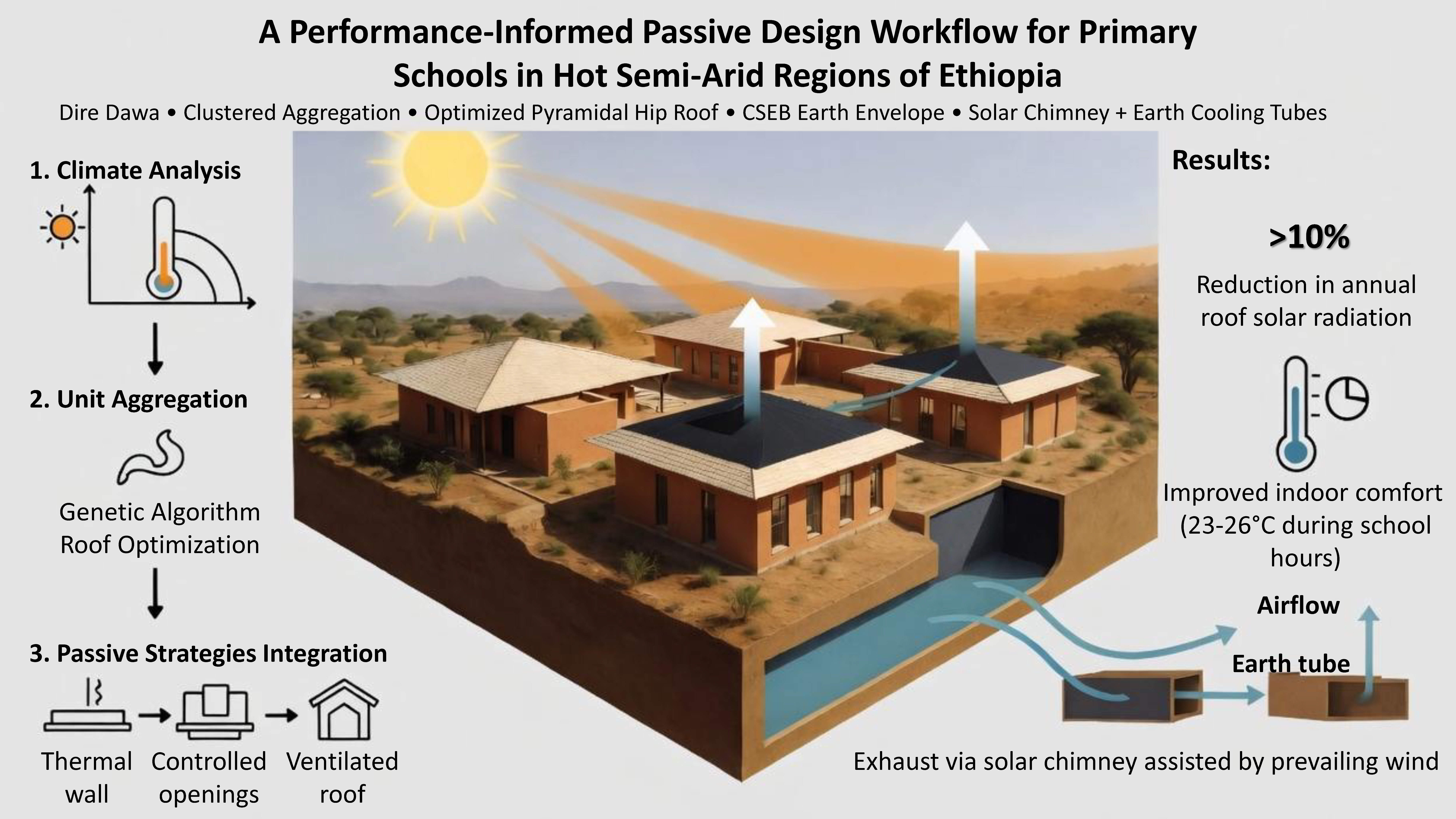
Educational infrastructure across hot semi-arid regions is expanding rapidly, often in contexts where mechanically conditioned classrooms are impractical. This study develops a climate-responsive, performance-informed passive design workflow for a primary-school prototype in Dire Dawa, Ethiopia. The novelty of the study lies in translating environmental performance analysis into a staged architectural decision-making process that links climate diagnosis, design criteria, form generation, envelope development, passive-system integration, and component refinement. The workflow integrates clustered unit aggregation, exploratory roof-form development, compressed stabilised earth block (CSEB) envelope construction, controlled fenestration, ground-coupled cooling tubes, and solar-chimney ventilation. Solar-radiation analysis is used to guide unit aggregation and roof-form refinement; EnergyPlus/Honeybee-based thermal simulation is used to compare indoor thermal responses under alternative passive strategies; and computational fluid dynamics (CFD) analysis is used to support the assessment of solar-chimney outlet orientation. At classroom scale, fenestration options are compared in terms of illuminance distribution and indoor-temperature response. The results show that the selected refined roof-form candidate reduces annual incident roof solar radiation from 3,449,700 kWh to 3,156,100 kWh, corresponding to an 8.51% reduction relative to the preceding combined configuration. The comparative thermal analysis further indicates that integrated passive-design measures improve comfort-related indoor conditions during school hours under the adopted modelling assumptions. Beyond the individual prototype, the study contributes a transferable workflow for linking climate-responsive design principles with performance-based analysis in low-tech educational buildings for resource-constrained hot semi-arid regions.
- Open Access
- Article
A Climate-Responsive, Performance-Informed Passive Design Workflow for Primary Schools in Dire Dawa, Ethiopia
- Zihao Su 1,†,
- Zihao Chen 1,†,
- Zhaofeng Chen 1,
- Xi Deng 2,*,
- Giuliana Iannaccone 1,*
Author Information
Received: 28 Mar 2026 | Revised: 24 Jun 2026 | Accepted: 25 Jun 2026 | Published: 13 Jul 2026
Abstract
Graphical Abstract
Keywords
hot semi-arid climate | primary-school design | passive environmental design | solar chimney | roof solar radiation | performance-informed design
References
- 1.
Kokatnur, T.; Ferreira, S.; Karadeniz Akkoc, B.; et al. A review of passive design strategies and their effect on thermal resilience in low-income households. Energy Build. 2025, 348, 116508. https://doi.org/10.1016/j.enbuild.2025.116508.
- 2.
Ben-Alon, L.; Rempel, A.R. Thermal comfort and passive survivability in earthen buildings. Build. Environ. 2023, 238, 110339. https://doi.org/10.1016/j.buildenv.2023.110339.
- 3.
Shiferaw, A.T. Carbon Conscious Construction: Evaluating Compressed Stabilized Earth Blocks for Low-Carbon Building. Buildings 2025, 15, 4362. https://doi.org/10.3390/buildings15234362.
- 4.
Amankwaa, E.F.; Roberts, B.M.; Mensah, P.; et al. Impact of roofing materials on school temperatures in tropical Africa. Build. Cities 2025, 6, 139–157. https://doi.org/10.5334/bc.581.
- 5.
Fereidoni, S.; Fereidooni, L.; Tamjid Shabestari, S.; et al. Application of solar chimneys and hybrid solar chimneys for ventilation in buildings: A review. Sol. Energy 2025, 288, 113246. https://doi.org/10.1016/j.solener.2025.113246.
- 6.
Ouedraogo, B.; Ouedraogo, A.; Kabore, A.; et al. Performance Evaluation of Solar Chimney Draft: Application to Ventilation. Smart Grid Renew. Energy 2024, 15, 107–122. https://doi.org/10.4236/sgre.2024.154007.
- 7.
Koshlak, H. A Review of Earth-Air Heat Exchangers: From Fundamental Principles to Hybrid Systems with Renewable Energy Integration. Energies 2025, 18, 1017. https://doi.org/10.3390/en18051017.
- 8.
Wakil, M.; Sghiouri, H.; Mghazli, M.O.; et al. Integrating EAHX and ventilation systems through a decision-making algorithm for enhanced energy efficiency and thermal comfort in smart buildings. Energy Convers. Manag. 2025, 325, 119411. https://doi.org/10.1016/j.enconman.2024.119411.
- 9.
Alaa, H.; Yehia, M.; Ayoub, M. Metaheuristic optimization of roof designs to enhance energy performance and thermal comfort using parametrization and machine learning. Sol. Energy 2025, 286, 113186. https://doi.org/10.1016/j.solener.2024.113186.
- 10.
Wu, Y.; An, J.; Gui, C.; et al. A global typical meteorological year (TMY) database on ERA5 dataset. Build. Simul. 2023, 16, 1013–1026. https://doi.org/10.1007/s12273-023-1015-3.
- 11.
Beck, H.E.; McVicar, T.R.; Vergopolan, N.; et al. High-resolution (1 km) Köppen-Geiger maps for 1901–2099 based on constrained CMIP6 projections. Sci. Data 2023, 10, 724. https://doi.org/10.1038/s41597-023-02549-6.
- 12.
Belarbi, Y.E.; Poullain, P.; Othmen, I.; et al. Experimental evaluation of the time lag and decrement factor of a raw earth wall for various climates: Comparison of different methods. J. Build. Eng. 2025, 113, 113996. https://doi.org/10.1016/j.jobe.2025.113996.
- 13.
Li, J.; Calautit, J.; Jimenez-Bescos, C.; et al. Experimental and numerical evaluation of a novel dual-channel windcatcher with a rotary scoop for energy-saving technology integration. Build. Environ. 2023, 230, 110018. https://doi.org/10.1016/j.buildenv.2023.110018.
- 14.
Melgaard, S.P.; Nikolaisson, I.T.; Zhang, C.; et al. Double-skin façade simulation with computational fluid dynamics: A review of simulation trends, validation methods and research gaps. Build. Simul. 2023, 16, 2307–2331. https://doi.org/10.1007/s12273-023-1052-y.
- 15.
Jaouaf, S.; Bensaad, B.; Habib, M. Passive strategies for energy-efficient educational facilities: Insights from a mediterranean primary school. Energy Rep. 2024, 11, 3653–3683. https://doi.org/10.1016/j.egyr.2024.03.040.
- 16.
Balali, A.; Yunusa-Kaltungo, A.; Edwards, R. A systematic review of passive energy consumption optimisation strategy selection for buildings through multiple criteria decision-making techniques. Renew. Sustain. Energy Rev. 2023, 171, 113013. https://doi.org/10.1016/j.rser.2022.113013.
- 17.
Gupta, V.; Deb, C. Envelope design for low-energy buildings in the tropics: A review. Renew. Sustain. Energy Rev. 2023, 186, 113650. https://doi.org/10.1016/j.rser.2023.113650.
- 18.
Gong, J.; Chew, L.W.; Lee, P.S. Shape optimization of high-rise solar chimneys to improve the uniformity of flowrate distribution. Build. Environ. 2023, 243, 110650. https://doi.org/10.1016/j.buildenv.2023.110650.
- 19.
Czekajlo, A.; Alva, J.; Szeto, J.; et al. Impact of 2050 tree shading strategies on building cooling demands. Build. Cities 2023, 4, 817–837. https://doi.org/10.5334/bc.353.


This work is licensed under a Creative Commons Attribution 4.0 International License.

 Suite 4002 Level 4, 447 Collins Street, Melbourne, Victoria 3000, Australia
 General Inquiries: info@sciltp.com