
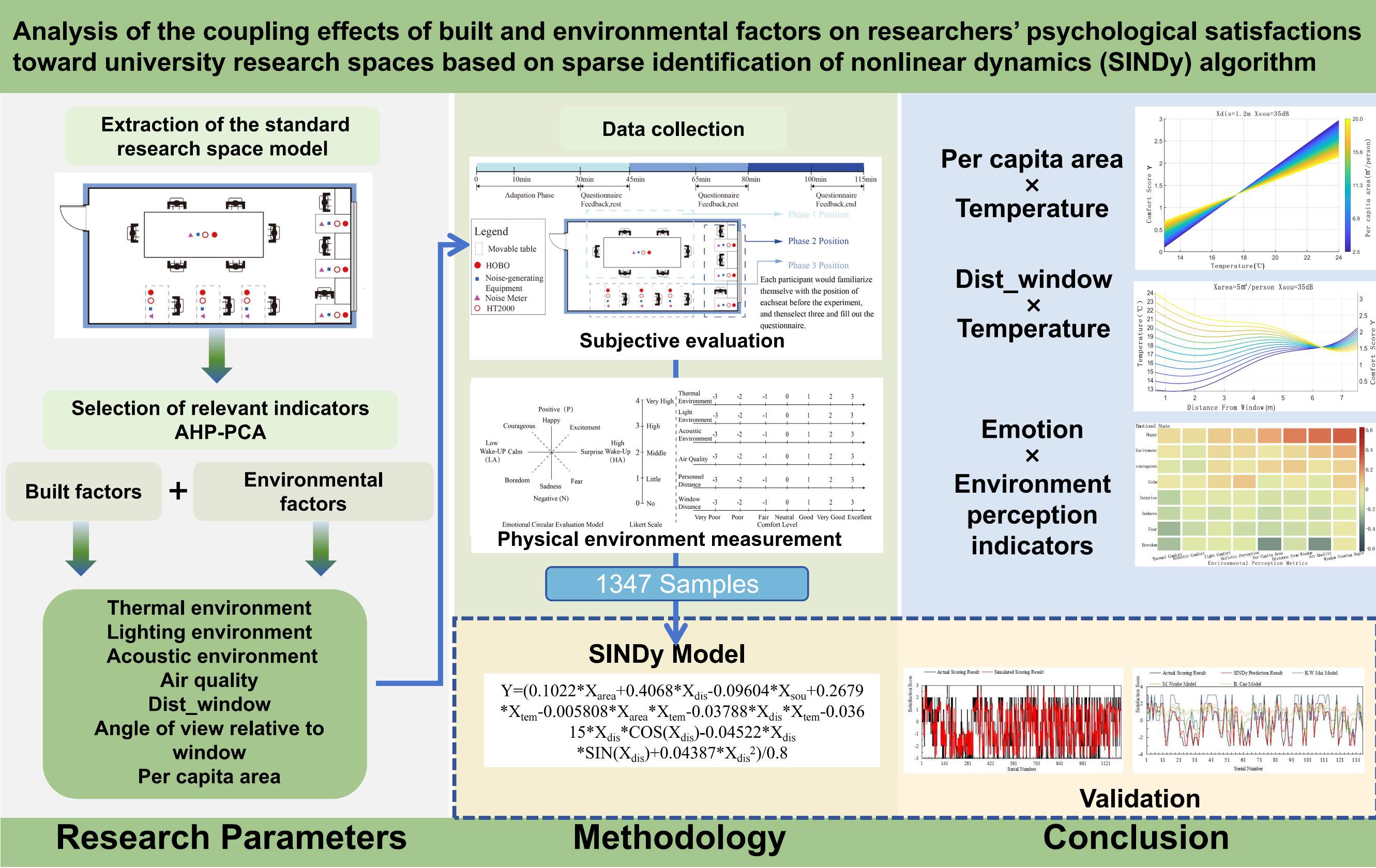
High levels of occupational stress are common among university researchers, creating increasingly stringent requirements for indoor environmental quality (IEQ). However, existing evaluation models tend to be built for conventional office or residential environments and typically assume linear relationships, making them insufficient for capturing the nonlinear coupling effects among multiple environmental variables. Previous evaluation models struggle to capture the nonlinear coupling relationships among multiple environmental factors, failing to establish a comprehensive psychological satisfaction evaluation model for university research spaces. This study focuses on the psychological health of university researchers and, taking the Shandong region as a case study, investigates how the built factors and environmental factors of research spaces (e.g., lighting, noise, layout form) influence researchers’ psychological states. A combined weighting method based on Principal Component Analysis and the Analytic Hierarchy Process (PCA-AHP) was employed to extract seven key environmental factors. A total of 1347 subjective and objective datasets were collected under 18 experimental conditions. The present study innovatively introduces the Sparse Identification of Nonlinear Dynamics (SINDy) algorithm from nonlinear dynamical systems theory to establish a psychological satisfaction evaluation model capable of capturing the coupling effects among multiple environmental factors. The results indicate that participants’ prior emotional states significantly affect psychological perception and evaluation. Significant coupling effects were observed between indoor temperature and per capita area, as well as between temperature and distance from the window (dist_window); with increasing temperature, the positive contributions of per capita area and dist_window to psychological satisfaction are attenuated. This study reveals the coupled relationships among multiple environmental factors in research spaces, which regulate users’ psychological states and behavioral patterns, thereby alleviating negative emotions stemming from occupational stress.
- Open Access
- Article
Analysis of the Coupling Effects of Built and Environmental Factors on Researchers’ Psychological Satisfaction with University Research Spaces Based on the Sparse Identification of Nonlinear Dynamics (SINDy) Algorithm
- Hanyu Zhou,
- Junqi Li,
- Wenchang Wang,
- Changan Liu *
Author Information
Received: 13 Apr 2026 | Revised: 28 Jun 2026 | Accepted: 01 Jul 2026 | Published: 30 Jul 2026
Abstract
Graphical Abstract
Keywords
psychological satisfaction evaluation | sparse identification of nonlinear dynamic systems | scientific research space | environmental psychology | indoor environmental quality
References
- 1.
Sakhare, V.V.; Ralegaonkar, R.V. Indoor Environmental Quality: Review of Parameters and Assessment Models. Archit. Sci. Rev. 2014, 57, 147–154.
- 2.
Heerwagen, J. Green Buildings, Organizational Success and Occupant Productivity. Build. Res. Inf. 2000, 28, 353–367.
- 3.
Abbaszadeh, S.; Zagreus, L.; Lehrer, D.; et al. Occupant Satisfaction with Indoor Environmental Quality in Green Buildings. Indoor Air 2006, 3, 365–370.
- 4.
Clements-Croome, D. Creative and Productive Workplaces: A Review. Intell. Build. Int. 2015, 7, 164–183.
- 5.
Sadick, A.M.; Issa, M.H. Occupants’ Indoor Environmental Quality Satisfaction Factors as Measures of School Teachers’ Well-Being. Build. Environ. 2017, 119, 99–109.
- 6.
Maigari, M.; Fu, C.; Balodimou, E.; et al. An Indoor Environmental Quality Study for Higher Education Buildings with an Integrated BIM-Based Platform. Sustainability 2025, 17, 6155.
- 7.
Weerasinghe, A.S.; Rasheed, E.O.; Rotimi, J.O.B. Environmental and Sociopsychological Drivers of Building Users’ Behaviours: A Case Study of Tertiary Institutional Offices in Auckland. J. Facil. Manag. 2024, 22, 564–587.
- 8.
Yang, D.; Mak, C.M. Relationships between Indoor Environmental Quality and Environmental Factors in University Classrooms. Build. Environ. 2020, 186, 107331.
- 9.
Choi, J.H.; Moon, J. Impacts of Human and Spatial Factors on User Satisfaction in Office Environments. Build. Environ. 2017, 114, 23–35.
- 10.
Lou, H.; Ou, D. The Effects of Speech Intelligibility on English Scientific Literature Reading in Chinese Open-Plan Offices. J. Acoust. Soc. Am. 2020, 147, EL1–EL6.
- 11.
Li, Z.; Zhang, Q.; Fan, F.; et al. A Comprehensive Comfort Assessment Method for Indoor Environmental Quality in University Open-Plan Offices in Severe Cold Regions. Build. Environ. 2021, 197, 107845.
- 12.
Kang, S.; Ou, D.; Mak, C.M. The Impact of Indoor Environmental Quality on Work Productivity in University Open-Plan Research Offices. Build. Environ. 2017, 124, 78–89.
- 13.
Rasheed, E.O.; Khoshbakht, M.; Baird, G. Time Spent in the Office and Workers’ Productivity, Comfort and Health: A Perception Study. Build. Environ. 2021, 195, 107747.
- 14.
Cheung, T.; Schiavon, S.; Graham, L.T.; et al. Occupant Satisfaction with the Indoor Environment in Seven Commercial Buildings in Singapore. Build. Environ. 2021, 188, 107443.
- 15.
Bortolini, R.; Rafaela, L.F.; Forcada, N.; et al. Assessing End-User Comfort: A Bayesian Network Approach for Classroom Performance Prediction at University Campus. J. Cleaner Prod. 2025, 500, 145190.
- 16.
Razak, T.R.; Jarimi, H.; Ismail, M.H.; et al. Data-Driven Thermal Comfort Modeling: Comparing AI-Based Predictions with PMV-PPD Models. Energy Build. 2025, 348, 116410.
- 17.
Mangalathu, S.; Hwang, S.H.; Jeon, J.S. Failure Mode and Effects Analysis of RC Members Based on Machine-Learning-Based SHapley Additive exPlanations (SHAP) Approach. Eng. Struct. 2020, 219, 110927.
- 18.
Zou, T.; Chang, Y.; Chen, P.; et al. Spatial-Temporal Variations of Ecological Vulnerability in Jilin Province (China), 2000 to 2018. Ecol. Indic. 2021, 133, 108429.
- 19.
Ergan, S.; Shi, Z.; Yu, X. Towards Quantifying Human Experience in the Built Environment: A Crowdsourcing Based Experiment to Identify Influential Architectural Design Features. J. Build. Eng. 2018, 20, 51–59.
- 20.
Zhou, J.L.; Xu, Q.Q.; Zhang, X.Y. Water Resources and Sustainability Assessment Based on Group AHP-PCA Method: A Case Study in the Jinsha River Basin. Water 2018, 10, 1880.
- 21.
Wu, Q.; Li, N.; Cai, X.; et al. Impact of Indoor Environmental Quality (IEQ) Factors on Occupants’ Environmental Perception and Satisfaction in Hospital Wards. Build. Environ. 2023, 245, 110918.
- 22.
Russell, J.A. A Circumplex Model of Affect. J. Pers. Soc. Psychol. 1980, 39, 1161–1178.
- 23.
Watson, D.; Tellegen, A. Toward a Consensual Structure of Mood. Psychol. Bull. 1985, 98, 219.
- 24.
Baur, J.W.; Tynon, J.F.; Gómez, E. Attitudes about Urban Nature Parks: A Case Study of Users and Nonusers in Portland, Oregon. Landscape Urban Plann. 2013, 117, 100–111.
- 25.
Martínez-Soto, J.; Gonzales-Santos, L.; Barrios, F.A.; et al. Affective and Restorative Valences for Three Environmental Categories. Percept. Mot. Skills 2014, 119, 901–923.
- 26.
Weidman, A.C.; Steckler, C.M.; Tracy, J.L. The Jingle and Jangle of Emotion Assessment: Imprecise Measurement, Casual Scale Usage, and Conceptual Fuzziness in Emotion Research. Emotion 2017, 17, 267.
- 27.
Sun, R.; Xu, S.; Han, Y.; et al. Exploring impacts of thermal and lighting conditions on office workers’ subjective evaluations, cognitive performance and EEG features in multi-person offices. J. Build. Eng. 2024, 95, 110170.
- 28.
Yang, W.; Moon, H.J. Combined Effects of Acoustic, Thermal, and Illumination Conditions on the Comfort of Discrete Senses and Overall Indoor Environment. Build. Environ. 2018, 148, 623–633.
- 29.
Chen, Y.; Caramanis, C.; Mannor, S. Robust Sparse Regression under Adversarial Corruption. In Proceedings of the 30th International Conference on Machine Learning, Atlanta, GA, USA, 17–19 June 2013; pp. 774–782.
- 30.
Abdullah, F.; Christofides, P.D. Data-Based Modeling and Control of Nonlinear Process Systems Using Sparse Identification: An Overview of Recent Results. Comput. Chem. Eng. 2023, 174, 108247.
- 31.
Mui, K.W.; Chan, W.T. A New Indoor Environmental Quality Equation for Air-Conditioned Buildings. Archit. Sci. Rev. 2005, 48, 41–46.
- 32.
Ncube, M.; Riffat, S. Developing an Indoor Environment Quality Tool for Assessment of Mechanically Ventilated Office Buildings in the UK—A Preliminary Study. Build. Environ. 2012, 53, 26–33.
- 33.
Cao, B.; Ouyang, Q.; Zhu, Y.; et al. Development of a Multivariate Regression Model for Overall Satisfaction in Public Buildings Based on Field Studies in Beijing and Shanghai. Build. Environ. 2012, 47, 394–399.
- 34.
Gao, Y.; Fu, Q.; Chen, J.; et al. Deep Transfer Learning-Based Hybrid Modelling Method for Individual Thermal Comfort Prediction. Indoor Built Environ. 2025, 34, 791–816.
- 35.
Li, H.; Appel-Meulenbroek, R.; Arentze, T.; et al. Revealing and Modelling Occupants’ Preferences for Comfort Adaptive Actions in Open-Plan Offices with the Inclusion of Contextual and Social-Psychological Aspects. Build. Environ. 2025, 285, 113681.


This work is licensed under a Creative Commons Attribution 4.0 International License.
