
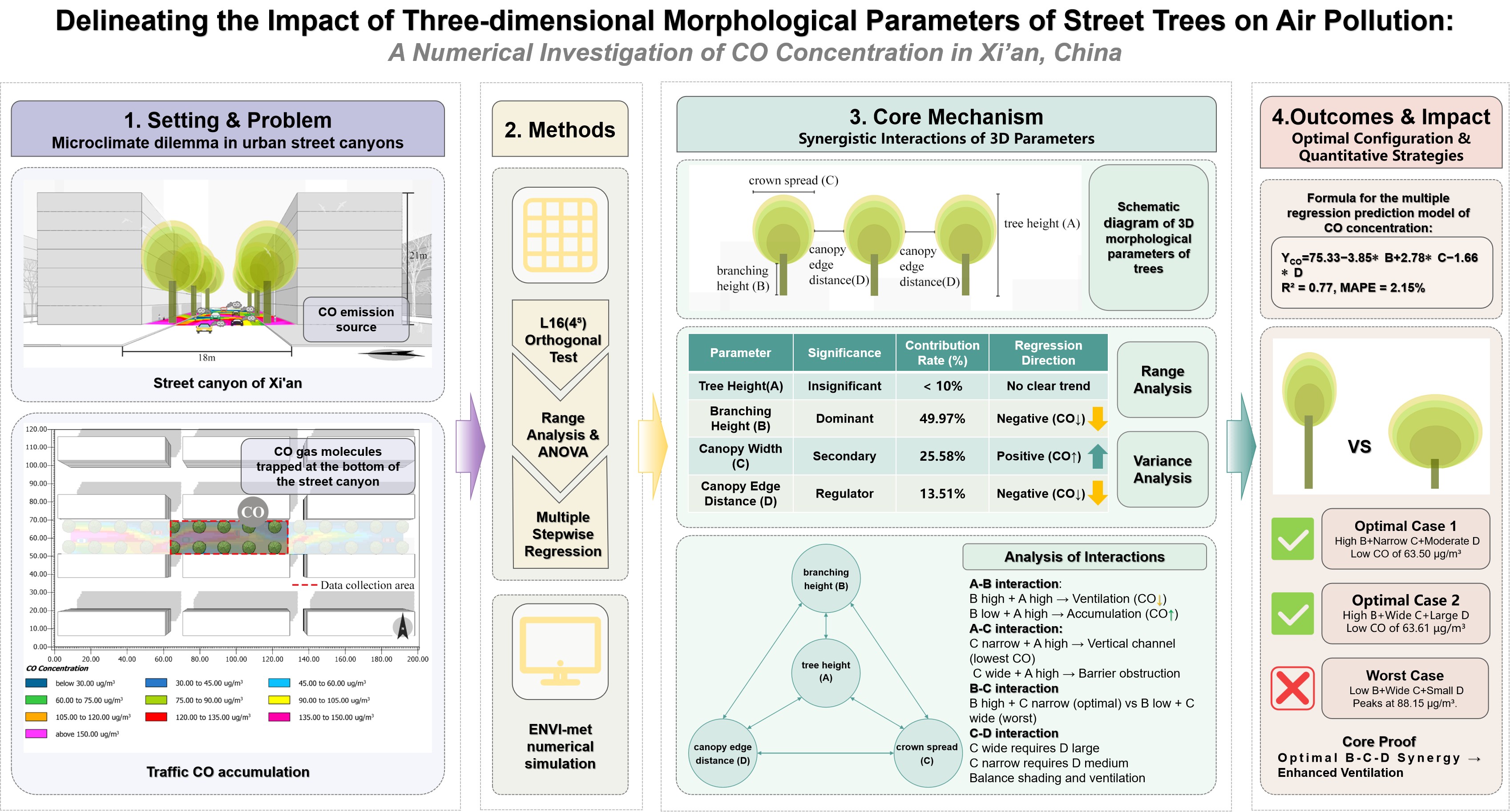
This study aims to investigate the perturbation mechanisms of street tree morphological characteristics on the near-surface carbon monoxide (CO) concentration distribution at the micro-scale. Based on the L16(45) orthogonal experimental design and numerical simulations, the impacts of four morphological parameters—tree height, branching height, crown spread, and canopy edge distance—on CO concentration were systematically quantified. Range and variance contribution analysis indicate that branching height is the absolute dominant factor governing CO dispersion with a contribution rate of 49.97%, which significantly promotes the dissipation of bottom-level pollutants by expanding the under-canopy clearance. Crown spread, with a contribution rate of 25.58%, exhibits a marginally significant positive correlation with CO concentration due to enhanced aerodynamic resistance, whereas the effect of tree height does not reach statistical significance. Furthermore, by eliminating redundant variables through stepwise regression analysis, a multivariate empirical prediction model for CO concentration (R2 = 0.77) was established, incorporating branching height, crown spread, and canopy edge distance as independent variables. This study reveals the decisive role of under-canopy spatial permeability in regulating the microclimate environment, and provides a solid quantitative basis for the topological optimization of urban green spaces targeting low pollutant retention and the precise selection of street trees.
- Open Access
- Article
Delineating the Impact of Three-Dimensional Morphological Parameters of Street Trees on Air Pollution: A Numerical Investigation of CO Concentration in Xi’an, China
- Zongzhou Zhu 1,*,
- Dan Wang 1,
- Dixuan Ma 2,
- Chaoyi Ma 1,
- Dongliang Wang 1,
- Yimeng Feng 3,
- Yue Xia 4,
- Weili Yang 1,*
Author Information
Received: 26 Mar 2026 | Revised: 08 Jul 2026 | Accepted: 09 Jul 2026 | Published: 21 Jul 2026
Abstract
Graphical Abstract
References
- 1.
OECD. OECD Environmental Outlook to 2050: The Consequences of Inaction—Key Facts and Figures; OECD Publishing: Paris, France, 2012.
- 2.
Ministry of Public Security of the People’s Republic of China. National Motor Vehicle Fleet Reaches 469 Million Vehicles; Number of Drivers Reaches 559 Million. 2026. Available online: https://www.mps.gov.cn/n2254314/n6409334/c10383533/content.html (accessed on 27 January 2026). (In Chinese)
- 3.
Yu, Y.; Liu, X.; Tian, D.; et al. Study on the influence of geometric planning elements of street canyons on solar energy potential. Ind. Archit. 2020, 50, 137–142. (In Chinese)
- 4.
Pan, H.; Wang, W.; Hu, C. The spatiotemporal distribution characteristics of PM2.5 and related air quality evaluation in urban street canyons. Hous. Sci. 2023, 43, 42–47. (In Chinese)
- 5.
Wang, W.; Cheng, X.; Hu, C.; et al. Spatiotemporal distribution characteristics of PM2.5 and air quality assessment in urban street canyons: A case study of Changhuai Street, Hefei. J. Ecol. Environ. Sci. 2021, 30, 2157–2164. (In Chinese)
- 6.
Luo, H.; Liu, X. Different street intersection forms on pollutant dispersion. Environ. Sci. Surv. 2024, 43, 20–24+35. https://doi.org/10.13623/j.cnki.hkdk.2024.05.017. (In Chinese)
- 7.
Zhao, F.; Huang, Z.; Wen, Y.; et al. Study on Ventilation and Pollutant Diffusion of Different Types of Building Blocks. Build. Energy Environ. 2022, 41, 47–52. (In Chinese)
- 8.
Qiu, Z.; Wang, Z.; Li, W. Influence of Urban Viaduct on the Diffusion and Distribution of Particulate Matter. China J. Highw. Transp. 2022, 35, 202–210. (In Chinese)
- 9.
Gong, W.; Cui, P.; Huang, Y.; et al. Influence of asymmetric building layout on pollutant diffusion in street canyon. J. Subtrop. Resour. Environ. 2025, 20, 122–128. https://doi/10.19687/j.cnki.1673-7105.2025.02.015. (In Chinese)
- 10.
Cui, A.; Miao, C.; He, H.; et al. Spatiotemporal distribution characteristics of atmospheric pollutants in urban street canyons based on mobile observations. Chin. J. Ecol. 2022, 41, 2035–2042. (In Chinese)
- 11.
Ahmadi, M.; Mirjalily, S.A.A.; Oloomi, S.A.A. Simulation of pollutant dispersion in urban street canyons using hybrid RANS-LES method with two-phase model. Comput. Fluids 2020, 210, 104676.
- 12.
Zhou, H.; Han, M.; Zhou, T.; et al. Influence of Urban Street Valley Distribution Pattern on Traffic Pollutant Diffusion. Environ. Sci. Manag. 2025, 50, 33–38. (In Chinese)
- 13.
Liu, W.; Huang, Z.; Zhan, Q.; et al. Numerical modeling of the effects of motor vehicle lanes layout on the transport and dispersion of exhaust pollutants in urban street canyons. Chin. J. Appl. Ecol. 2025, 36, 671–681. (In Chinese)
- 14.
Miao, C.; Yu, S.; Hu, Y.; et al. How the morphology of urban street canyons affects suspended particulate matter concentration at the pedestrian level: An in-situ investigation. Sustain. Cities Soc. 2020, 55, 102042.
- 15.
Hu, Y.; Ma, K. A comprehensive simulation study on the effects of urban street greening on air quality and microclimate. Acta Ecol. Sin. 2021, 41, 1314–1331. (In Chinese)
- 16.
Ren, F.; Bai, Y.; Qiu, Z.; et al. Research progress on roadside vegetation barriers for reducing particulate matter pollution. Acta Ecol. Sin. 2022, 42, 5177–5186. https://doi/10.5846/stxb202108042131. (In Chinese)
- 17.
Xu, P.; Li, X.; Lv, G.; et al. Effects of shrub vegetation on the dispersion of motor vehicle pollutants in street canyons. J. Northeast. Norm. Univ. 2022, 54, 129–135. (In Chinese)
- 18.
Zhao, F.; Zhao, Z. Analysis of the Impact of Urban Green Space Landscape Layout on the Diffusion of Air Pollutants. Environ. Sci. Manag. 2025, 50, 163–168. (In Chinese)
- 19.
Karttunen, S.; Kurppa, M.; Auvinen, M.; et al. Large-eddy simulation of the optimal street-tree layout for pedestrian-level aerosol particle concentrations: A case study from a city boulevard. Atmos. Environ. X 2020, 6, 100073.
- 20.
Li, P.; Wang, S.; Wang, Y.; et al. The “micro-canal effect” of urban roadside green belts and its impact on pollutant concentrations in bicycle lanes. Acta Ecol. Sin. 2011, 31, 2888–2896. (In Chinese)
- 21.
He, H.; Zhu, Y.; Liu, L.; et al. Effects of roadside trees three-dimensional morphology characteristics on traffic-related PM2.5 distribution in hot-humid urban blocks. Urban Clim. 2023, 49, 101448.
- 22.
Miao, C.; Chen, W.; Yu, S. Assessing Ozone Distribution Vertically and Horizontally in Urban Street Canyons Based on Field Investigation and ENVI-met Modelling. Buildings 2022, 12, 262.
- 23.
Xiong, N.; Song, H.; Zhou, F.; et al. Simulation of Microclimate and PM2.5 Dispersion in Typical Urban Parks in Beijing Based on the ENVI-Met Model. Sustainability 2025, 17, 7247.
- 24.
Guo, Y.; Xiao, Q.; Ling, C.; et al. The right tree for the right street canyons: An approach of tree species selection for mitigating air pollution. Build. Environ. 2023, 245, 110886.
- 25.
Maison, A.; Flageul, C.; Carissimo, B.; et al. Parameterizing the aerodynamic effect of trees in street canyons for the street network model MUNICH using the CFD model Code_Saturne. Atmos. Chem. Phys. 2022, 22, 9369–9388.
- 26.
Li, Z.; Zhang, H.; Juan, Y.-H.; et al. Effects of urban tree planting on thermal comfort and air quality in the street canyon in a subtropical climate. Sustain. Cities Soc. 2023, 91, 104334.
- 27.
Gromke, C.; Ruck, B. Influence of trees on the dispersion of pollutants in an urban street canyon—Experimental investigation of the flow and concentration field. Atmos. Environ. 2007, 41, 3287–3302.
- 28.
Tang, Y.-F.; Chen, H.; Yang, M.; et al. Weak geostrophic wind driven ventilation in street canyons with trees and green walls: Cooperating or opposing dispersions of airborne pollutants? Build. Environ. 2024, 259, 111654.
- 29.
Wang, X.; Zhou, Z.; Xiang, Y.; et al. Effects of street plants on atmospheric particulate dispersion in urban streets: A review. Environ. Rev. 2024, 32, 114–130.


This work is licensed under a Creative Commons Attribution 4.0 International License.

 Suite 4002 Level 4, 447 Collins Street, Melbourne, Victoria 3000, Australia
 General Inquiries: info@sciltp.com