
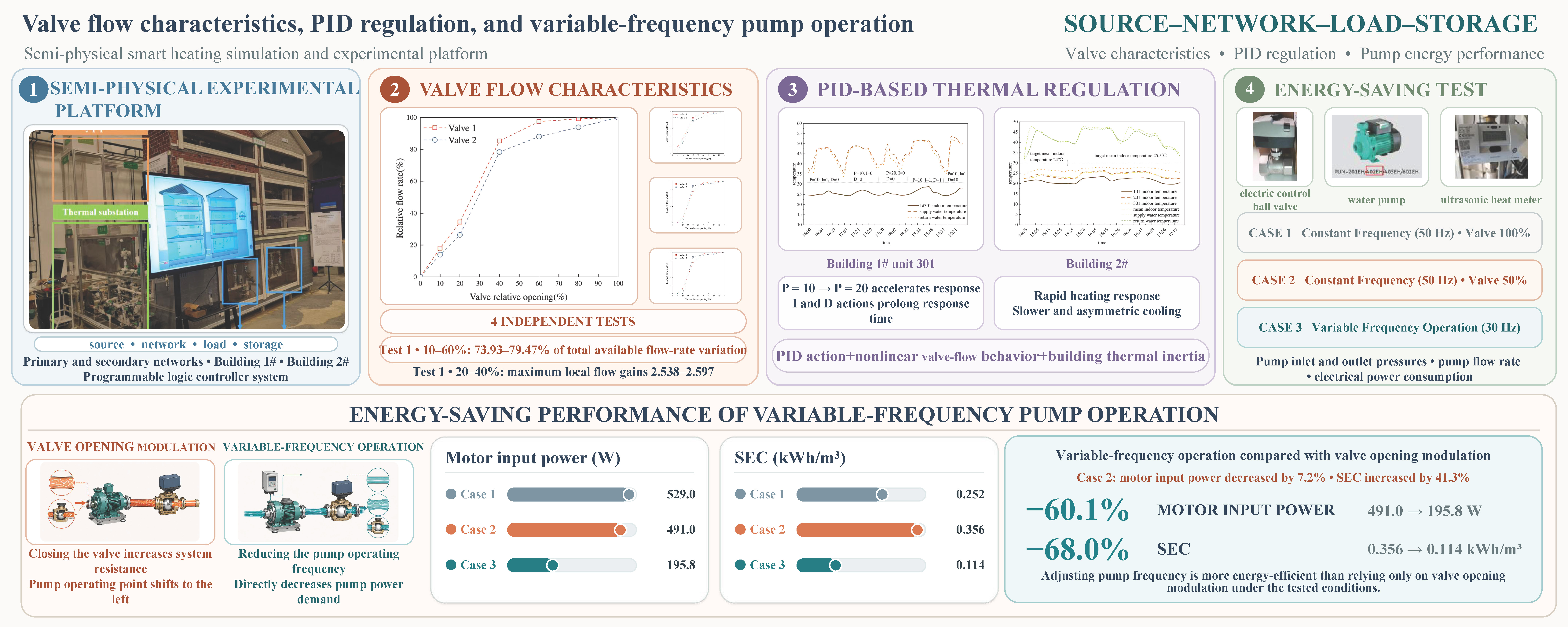
Central heating systems typically exhibit high energy consumption and carbon emissions. Within these networks, the flow characteristics of electric control ball valves are critical for precise thermal regulation. Theoretical research on this topic is already extensive. However, further investigation through field tests is needed to elucidate both the intrinsic flow behaviors of these valves and their coupling with proportional-integral-derivative (PID) control, as well as the energy efficiency comparison between variable-frequency water pumps and valve-based modulation. Therefore, a semi-physical smart heating simulation and experimental platform was proposed, and corresponding field tests were conducted. The valve was subsequently applied to both household-level room temperature regulation and building mean room temperature regulation, and the room temperature responses under various PID parameter settings were also evaluated. The research results indicate that when the opening degree of the electric control ball valve is within the range of 10% to 60%, the valve can maintain sufficient regulation sensitivity. For household-level room-temperature regulation, increasing the proportional gain from P = 10 to P = 20 under proportional-only control accelerated the thermal response and shortened the room-temperature rise process. At P = 10, introducing the integral action prolonged the rise time, while the addition of derivative action further delayed the thermal response, with a larger derivative parameter producing a more pronounced damping effect. For building-level mean room-temperature regulation, the heating response was relatively rapid, whereas the cooling process exhibited a slower and asymmetric temperature decay due to the thermal inertia of the tested building. Compared with valve opening modulation, variable-frequency operation reduces pump input power by 60.12%, whereas valve opening modulation yields only a 7.19% reduction. It indicates that regulating flow by adjusting pump frequency is more energy-efficient than relying only on valve opening modulation under the tested operating conditions. These findings provide a practical basis for the efficient operation and optimization of central heating systems.
- Open Access
- Article
An Experimental Study on the Flow Characteristics of Electric Control Ball Valves and the Energy Saving Effects of Variable-Frequency Water Pumps in Building Central Heating Systems
- Xiyao Li 1,
- Xunjie Gan 2,
- Changhong Zhan 1,*,
- Yongjie Wang 3,*,
- Yunhai Li 4,*,
- Wenbin Zhang 5,
- Yimeng Feng 6
Author Information
Received: 11 Apr 2026 | Revised: 08 Jul 2026 | Accepted: 13 Jul 2026 | Published: 24 Jul 2026
Abstract
Graphical Abstract
Keywords
building | central heating system | electric control ball valves | PID | pump | variable-frequency
References
- 1.
2022 Global Status Report for Buildings and Construction. Available online: https://www.unep.org/resources/publication/2022-global-status-report-buildings-and-construction (accessed on 1 June 2026).
- 2.
Filippín, C.; Larsen, S.F. Energy efficiency in buildings. In Energy Efficiency, Recovery and Storage; Nova Science Publishers: Hauppauge, NY, USA, 2001.
- 3.
Research Center for Building Energy Efficiency, Tsinghua University. Annual Development and Research Report on Building Energy Efficiency in China 2025 (Urban Residential Housing); China Construction Industry Press: Beijing, China, 2025.
- 4.
Bao, M.; Xie, Y.; Zhang, X.; et al. Performance Improvement of a Control Valve with Energy Harvesting. Energy 2023, 263, 125862. https://doi.org/10.1016/j.energy.2022.125862.
- 5.
Zhao, P.; Yin, J.; Wang, J. Performance Analysis of Control Valves for Supply–Demand Balance Regulation in Heating Stations. Buildings 2025, 15, 1624. https://doi.org/10.3390/buildings15101624.
- 6.
Si, H.; Ren, Y.; Guo, K.; et al. Flow and Droplet Evaporation Characteristics of High Parameter Temperature and Pressure Reducing Valves under Off-Design Conditions. Case Stud. Therm. Eng. 2026, 80, 107855. https://doi.org/10.1016/j.csite.2026.107855.
- 7.
Zhang, G.; Qi, S.; Zhu, Z.; et al. Numerical Study on Cavitation Characteristics and Flow Field Instability in a Butterfly Valve under Choked Conditions. Int. J. Multiph. Flow 2026, 198, 105647. https://doi.org/10.1016/j.ijmultiphaseflow.2026.105647.
- 8.
Trica, D.J. Multi-Loop PID Tuning Strategy Based on Non-Iterative Linear Matrix Inequalities. Comput. Chem. Eng. 2025, 199, 109137. https://doi.org/10.1016/j.compchemeng.2025.109137.
- 9.
Santos, J.E.W.; Trierweiler, J.O.; Farenzena, M. MIMO PID Tuning for Nonminimum Phase Systems: Setting Attainable Limits for a Stable Behaviour. IFAC-PapersOnLine 2019, 52, 964–969. https://doi.org/10.1016/j.ifacol.2019.06.187.
- 10.
Sarbu, I.; Valea, E.S. Energy Savings Potential for Pumping Water in District Heating Stations. Sustainability 2015, 7, 5705–5719. https://doi.org/10.3390/su7055705.
- 11.
Housh, M.; Salomons, E. Energy-Efficient Local Control Strategies for Pumping Stations with Variable-Speed Pumps: A Practical Model-Based Approach. J. Clean. Prod. 2025, 498, 145131. https://doi.org/10.1016/j.jclepro.2025.145131.
- 12.
Shi, L.; Lao, W.; Wu, F.; et al. DDPG-based load frequency control for power systems with renewable energy by DFIM pumped storage hydro unit. Renew. Energy 2023, 218, 119274. https://doi.org/10.1016/j.renene.2023.119274.
- 13.
Wang, H.; Wang, S.; Shan K. Experimental study on the dynamics, quality and impacts of using variable-speed pumps in buildings for frequency regulation of smart power grids. Energy 2020, 199, 117406. https://doi.org/10.1016/j.energy.2020.117406.


This work is licensed under a Creative Commons Attribution 4.0 International License.
