
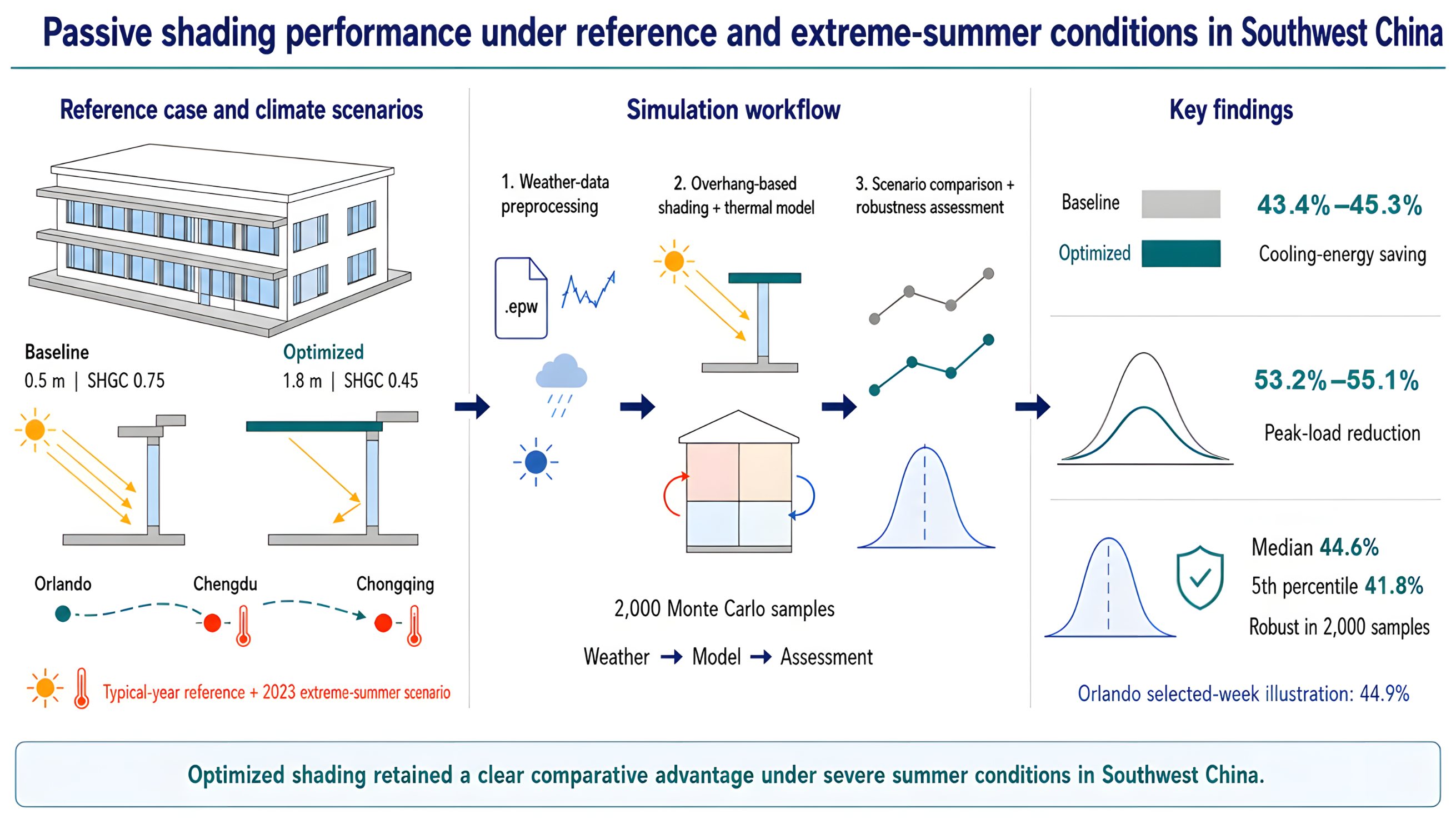
This study examines the transferability of a passive shading optimization approach under extreme-heat conditions in Southwest China. A university-building prototype serves as the geometric reference, and its envelope and operation settings are then adapted for Chengdu and Chongqing in accordance with the relevant building standards. The workflow combines weather-data preprocessing, a simplified overhang-based shading representation, dynamic thermal-response calculation, and differential-evolution-based parameter search. To separate routine and extreme-condition performance, the analysis was organized into three parts: an annual benchmark under typical meteorological year (TMY) conditions, a 2023 extreme-summer scenario comparison, and a Monte Carlo robustness analysis. Under the Southwest China cases, the optimized scheme reduced cooling energy use by approximately 43–45% and peak load by more than 50% in the reported scenarios. The Orlando reference scenario showed a smaller improvement, indicating that the performance gain depended strongly on climate context and baseline envelope characteristics. The Monte Carlo analysis further showed that the optimized scheme remained superior to the baseline across the sampled perturbation cases, with lower-tail energy-saving performance remaining above 40%. The retained annual, extreme-summer, and perturbation results all point in the same direction: the workflow is more useful as a comparative stress-testing tool than as a substitute for measured building validation. The study does not claim full real-world validation: the weather-adjustment procedure is treated as a scenario-construction assumption, and the simplified shading model does not fully represent façade-specific projection geometry.
- Open Access
- Article
Passive Shading Optimization for University Buildings in Southwest China: A Simulation-Based Transferability Assessment with Heatwave Stress Testing
- Rui Yuan 1, *,
- Xiaojie Long 2, 3, *,
- Chengxiang Yan 1,
- Guozheng Zhao 1,
- Weizheng Zhang 4,
- Intan Bayani Zakaria 5
Author Information
Received: 01 Jun 2026 | Revised: 14 Jul 2026 | Accepted: 14 Jul 2026 | Published: 30 Jul 2026
Abstract
Graphical Abstract
Keywords
passive shading | dynamic thermal model | extreme-summer stress test | Monte Carlo robustness | scenario-based weather adjustment
References
- 1.
Lehmann S. Energy-Efficient building design: Towards climate-responsive architecture. In Encyclopedia of Life Support Systems; Sustainable Built Environment; UNESCO: Paris, France, 2011; pp. 1–11.
- 2.
Bucking S. Pathways to Net-Zero Energy Buildings: An Optimization Methodology. Ph.D. Thesis, Concordia University, Montreal, QC, Canada, 2013.
- 3.
GB 50176-2016; Thermal Design Code for Civil Buildings. Ministry of Housing and Urban-Rural Development of the People’s Republic of China: Beijing, China, 2016.
- 4.
ANSI/ASHRAE Standard 90.1-2019; Energy Standard for Buildings Except Low-Rise Residential Buildings. ASHRAE: Peachtree Corners, GA, USA, 2020.
- 5.
ASHRAE. ASHRAE Handbook—Fundamentals; American Society of Heating, Refrigerating and Air-Conditioning Engineers: Atlanta. GA, USA, 2021.
- 6.
ASHRAE. ASHRAE Handbook—HVAC Applications; American Society of Heating, Refrigerating and Air-Conditioning Engineers: Atlanta, GA, USA, 2021.
- 7.
Deru, M.; Field, K.; Studer, D.; et al. U.S. Department of Energy Commercial Reference Building Models of the National Building Stock; National Renewable Energy Laboratory: Golden, CO, USA, 2011. Available online: https://research-hub.nlr.gov/en/publications/us-department-of-energy-commercial-reference-building-models-of-t/ (accessed on 22 January 2026).
- 8.
ANSI/ASHRAE Standard 55-2020; Thermal Environmental Conditions for Human Occupancy. American Society of Heating, Refrigerating and Air-Conditioning Engineers: Atlanta, GA, USA, 2020.
- 9.
GB 50736-2012; Design Code for Heating Ventilation and Air Conditioning of Civil Buildings. China Architecture & Building Press: Beijing, China, 2012.
- 10.
Perez, R.; Ineichen, P.; Seals, R.; et al. Modeling daylight availability and irradiance components from direct and global irradiance. Sol. Energy 1990, 44, 271–289.
- 11.
Banos, R.; Manzano-Agugliaro, F.; Montoya, F.G.; et al. Optimization methods applied to renewable and sustainable energy: A review. Renew. Sustain. Energy Rev. 2011, 15, 1753–1766.
- 12.
Zhong, X.; Voogt, J.; Zhan, W.; et al. UAV-based low-altitude remote sensing in built-environment thermal studies: A review across different spatial scales. Build. Environ. 2026, 303, 114937. https://doi.org/10.1016/j.buildenv.2026.114937.


This work is licensed under a Creative Commons Attribution 4.0 International License.
