
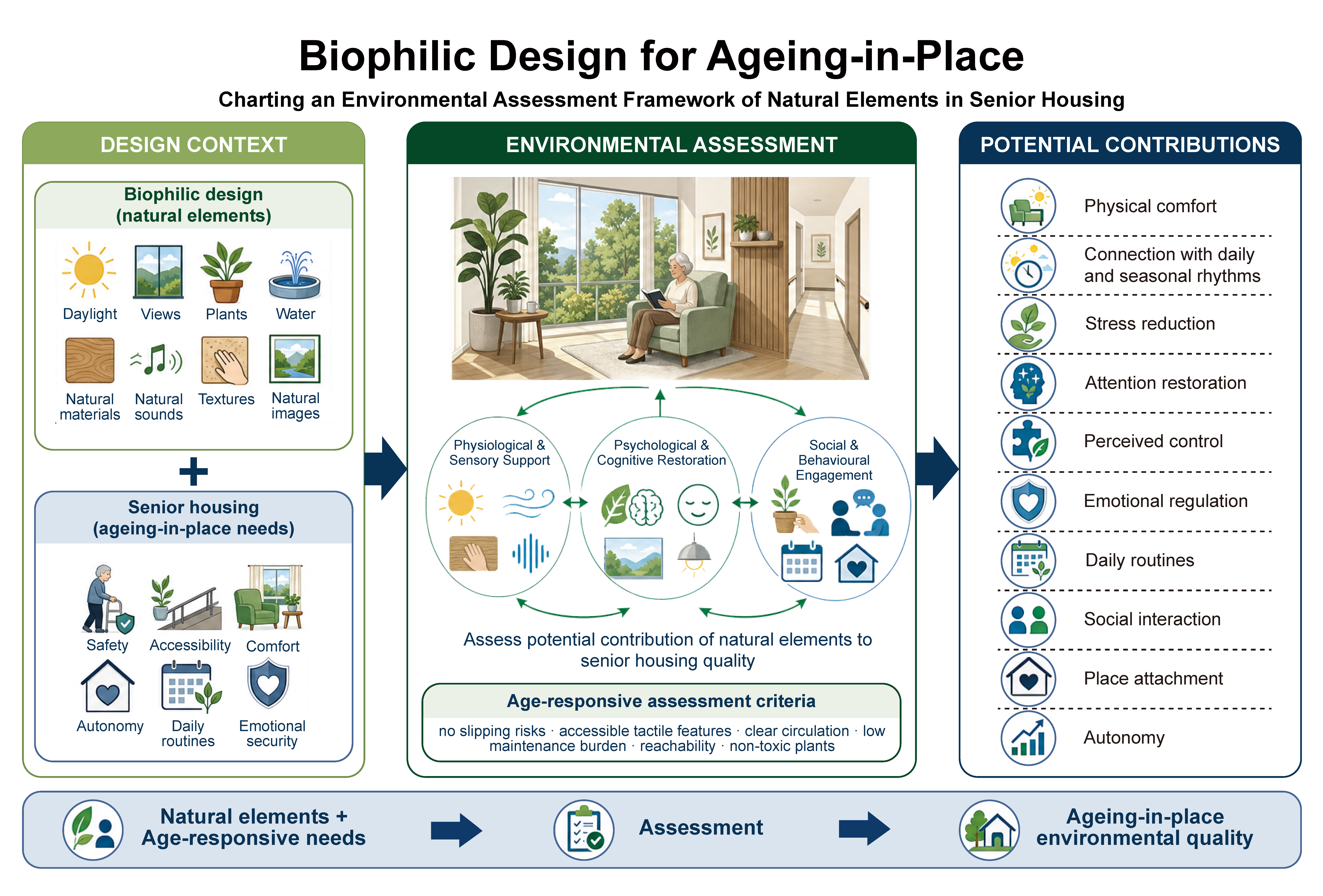
The physical living environment plays a pivotal role in the success of ageing-in-place. Although various environmental assessment tools have been developed to evaluate residential settings for older adults, many of them prioritise physical safety, accessibility, and risk prevention. However, the psychological, sensory, and emotional perception of the home are also important to overall well-being in later life. Older adults with mobility decline often experience limited contact with the outdoor natural environment, which can lead to sensory deprivation, cognitive fatigue, emotional distress, and reduced quality of life. Drawing upon biophilic design approaches and the specific needs of senior housing, this paper proposes a conceptual framework for evaluating the potential contribution of natural elements to older adults’ living environments. The framework organises assessment into three interrelated dimensions: physiological and sensory support, psychological and cognitive restoration, and social and behavioural engagement. Within these dimensions, natural elements are considered in relation to age-responsive criteria, including visibility, accessibility, safety, maintenance burden, sensory suitability, and relevance to daily routines. This framework provides architects, occupational therapists, and researchers with a structured perspective for considering biophilic design in senior housing. The paper identifies key evaluative dimensions and outlines future development towards scoring rules, resident-reported modules, pilot testing, and reliability and validity assessment. Therefore, it positions natural elements as part of the environmental infrastructure of ageing-in-place and highlights their potential role in supporting comfort, emotional resilience, autonomy, and quality of life in later years.
- Open Access
- Commentary
Biophilic Design for Ageing-in-Place: Charting an Environmental Assessment Framework of Natural Elements in Senior Housing
- Weijie Zhong 1,
- Chuan Ma 2,*
Author Information
Received: 07 Apr 2026 | Revised: 09 Aug 2026 | Accepted: 10 Aug 2026 | Published: 19 Aug 2026
Abstract
Graphical Abstract
Keywords
biophilic design | ageing-in-place | senior housing | environmental assessment | psychological well-being | restorative environments
References
- 1.
Centers for Disease Control and Prevention. Healthy Places Terminology: Aging in Place; Centers for Disease Control and Prevention: Atlanta, GA, USA, 2017.
- 2.
Ma, C.; Guerra-Santin, O.; Mohammadi, M. Exploring the influence of indoor environment and spatial layout on changed behaviours of people with dementia in a nursing home. Build. Environ. 2024, 256, 111452. https://doi.org/10.1016/j.buildenv.2024.111452.
- 3.
Clemson, L.; Fitzgerald, M.H.; Heard, R. Content Validity of an Assessment Tool to Identify Home Fall Hazards: The Westmead Home Safety Assessment. Br. J. Occup. Ther. 1999, 62, 171–179.
- 4.
Iwarsson, S.; Slaug, B.; Fänge, A.M. The Housing Enabler Screening Tool: Feasibility and Interrater Agreement in a Real Estate Company Practice Context. J. Appl. Gerontol. 2012, 31, 641–660. https://doi.org/10.1177/0733464810397354.
- 5.
Serrano-Jiménez, A.; Lima, M.L.; Molina-Huelva, M.; et al. Promoting urban regeneration and aging in place: APRAM—An interdisciplinary method to support decision-making in building renovation. Sustain. Cities Soc. 2019, 47, 101505. https://doi.org/10.1016/j.scs.2019.101505.
- 6.
Olszewska-Guizzo, A.; Fogel, A.; Escoffier, N.; et al. Effects of COVID-19-related stay-at-home order on neuropsychophysiological response to urban spaces: Beneficial role of exposure to nature? J. Environ. Psychol. 2021, 75, 101590. https://doi.org/10.1016/j.jenvp.2021.101590.
- 7.
Kellert, S.R. The Biological Basis for Human Values of Nature. In The Biophilia Hypothesis; Kellert, S.R., Wilson, E.O., Eds.; Island Press: Washington, DC, USA, 1993; pp. 42–69.
- 8.
Miola, L.; Boldrini, A.; Pazzaglia, F. The healing power of nature. Biophilic design applied to healthcare facilities. Curr. Opin. Psychol. 2025, 64, 102049. https://doi.org/10.1016/j.copsyc.2025.102049.
- 9.
Kellert, S.R. Dimensions, elements, and attributes of biophilic design. Biophilic Des. Theory Sci. Pract. Bringing Build. Life 2008, 2008, 3–19.
- 10.
Browning, W.; Ryan, C.; Clancy, J. 14 Patterns of Biophilic Design: Improving Health & Well-Being in the Built Environment, New York, 2014. Available online: https://www.terrapinbrightgreen.com/reports/14-patterns/ (accessed on 12 March 2026).
- 11.
Zhong, W.; Schroeder, T.; Bekkering, J. Designing with nature: Advancing three-dimensional green spaces in architecture through frameworks for biophilic design and sustainability. Front. Archit. Res. 2023, 12, 732–753. https://doi.org/10.1016/j.foar.2023.03.001.
- 12.
Ryan, C.O.; Browning, W.D.; Clancy, J.O.; et al. Biophilic design patterns: Emerging nature-based parameters for health and well-being in the built environment. Archnet-IJAR 2014, 8, 62–76. https://doi.org/10.26687/archnet-ijar.v8i2.436.
- 13.
Abdelaal, M.S.; Soebarto, V. Biophilia and Salutogenesis as restorative design approaches in healthcare architecture. Archit. Sci. Rev. 2019, 62, 195–205. https://doi.org/10.1080/00038628.2019.1604313.
- 14.
Ma, C.; Guerra-Santin, O.; Mohammadi, M. Smart home modification design strategies for ageing in place: A systematic review. J. Hous. Built Environ. 2022, 37, 625–651. https://doi.org/10.1007/s10901-021-09888-z.
- 15.
Zhong, W.; Schröder, T.; Bekkering, J. Biophilic design towards sustainability in architecture: An evaluation framework and design guidelines for three-dimensional green spaces. Build. Environ. 2026, 287, 113868. https://doi.org/10.1016/j.buildenv.2025.113868.
- 16.
Xue, F.; Lau, S.S.Y.; Gou, Z.; et al. Incorporating biophilia into green building rating tools for promoting health and wellbeing. Environ. Impact Assess. Rev. 2019, 76, 98–112. https://doi.org/10.1016/j.eiar.2019.02.004.
- 17.
Ma, C.; Najafi, P.; Guerra-santin, O.; et al. Social housing renovation for ageing-in-place in the Netherlands: Synergising co-design and empathic design with virtual reality. CoDesign 2026. https://doi.org/10.1080/15710882.2026.2638929.
- 18.
Kellert, S.R.; Heerwagen, J.H.; Mador, M.L. Biophilic Design: The Theory, Science, and Practice of Bringing Buildings to Life; John Wiley & Sons: Hoboken, NJ, USA, 2008.
- 19.
Kellert, S.R.; Calabrese, E.F. The Practice of Biophilic Design. 2015. Available online: www.biophilic-design.com (accessed on 12 March 2026).
- 20.
Zhong, W.; Schröder, T.; Bekkering, J. Biophilic design in architecture and its contributions to health, well-being, and sustainability: A critical review. Front. Archit. Res. 2022, 11, 114–141. https://doi.org/10.1016/j.foar.2021.07.006.
- 21.
Schweitzer, M.; Gilpin, L.; Frampton, S.; et al. Healing Spaces: Elements of Environmental Design That Make an Impact on Health. J. Altern. Complement. Med. 2004, 10, 71–83. https://doi.org/10.1089/acm.2004.10.S-71.
- 22.
Salingaros, N.A.; Masden, K.G. Neuroscience, the Natural Environment, and Building Design. In Biophilic Design: The Theory, Science and Practice of Bringing Buildings to Life; Kellert, S.R., Heerwagen, J.H., Mador, M.L., Eds.; John Wiley & Sons: Hoboken, NJ, USA, 2008; pp. 59–83.
- 23.
Aries, M.B.C.; Aarts, M.P.J.; van Hoof, J. Daylight and health: A review of the evidence and consequences for the built environment. Light. Res. Technol. 2015, 47, 6–27. https://doi.org/10.1177/1477153513509258.
- 24.
Kellert, S. Biophilia and biomimicry: Evolutionary adaptation of human versus nonhuman nature. Intell. Build. Int. 2014, 8, 51–56. https://doi.org/10.1080/17508975.2014.902802.
- 25.
Kaplan, S.; Kaplan, R. The Experience of Nature: A Psychological Perspective; Cambridge University Press: Cambridge, UK, 1989.
- 26.
Ulrich, R.S. Aesthetic and Affective Response to Natural Environment. Hum. Behav. Environ. 1983, 6, 85–125. https://doi.org/10.1007/978-1-4613-3539-9.
- 27.
Hartig, T.; van den Berg, A.E.; Hagerhall, M. Health benefits of nature experience: Psychological, social and cultural processes. In Forests, Trees and Human Health, Part 2; Nilsson, K., Sangster, M., Gallis, C.; et al., Eds.; Springer: Berlin/Heidelberg, Germany, 2011; pp. 127–168. Available online: https://research.wur.nl/en/publications/health-benefits-of-nature-experience-psychological-social-and-cul/ (accessed on 23 May 2026).
- 28.
Sugiyama, T.; Carver, A.; Sugiyama, M.; et al. Views of Greenery and Psychological Well-Being in Residential Aged Care Facilities: Longitudinal Associations. Health Environ. Res. Des. J. 2022, 15, 219–232. https://doi.org/10.1177/19375867211059757.
- 29.
Yin, J.; Zhu, S.; MacNaughton, P.; et al. Physiological and cognitive performance of exposure to biophilic indoor environment. Build. Environ. 2018, 132, 255–262. https://doi.org/10.1016/j.buildenv.2018.01.006.
- 30.
Detweiler, M.B.; Sharma, T.; Detweiler, J.G.; et al. What is the evidence to support the use of therapeutic gardens for the elderly? Psychiatry Investig. 2012, 9, 100–110. https://doi.org/10.4306/pi.2012.9.2.100.
- 31.
Yoon, E.; Lim, Y. A Study on the Composition between Nature and Architectural Space in Healthcare Facilities. Archit. Res. 2020, 22, 113–122. https://doi.org/10.5659/AIKAR.2020.22.4.113.
- 32.
Pedrinolla, A.; Tamburin, S.; Brasioli, A.; et al. An Indoor Therapeutic Garden for Behavioral Symptoms in Alzheimer’s Disease: A Randomized Controlled Trial. J. Alzheimer’s Dis. 2019, 71, 813–823. https://doi.org/10.3233/JAD-190394.
- 33.
Berto, R.; Barbiero, G. The Biophilic Quality Indexes. A Tool to Improve a Building from “Green” to Restorative. Visions Sustain. 2017, 8, 38–45. https://doi.org/10.13135/2384-8677/2333.
- 34.
Salingaros, N.A. The Biophilic Healing Index Predicts Effects of the Built Environment on Our Wellbeing. J. Biourbanism 2019, 8, 13–34.
- 35.
Wijesooriya, N.; Brambilla, A.; Markauskaite, L. Biophilic Quality Matrix: A tool to evaluate the biophilic quality of a building during early design stage. Clean. Prod. Lett. 2025, 8, 100094. https://doi.org/10.1016/j.clpl.2025.100094.
- 36.
WELL, WELL Building Standard Version. 2, 2025. Available online: https://v2.wellcertified.com/en/wellv2/overview/ (accessed on 23 May 2026).
- 37.
Zhong, W. Biophilic Design and Integrating Nature in Architecture: Guidelines for Three-Dimensional Green Spaces to Innovate Architectural Typologies and Create Impact for Sustainability, Ph.D. Thesis, Eindhoven University of Technology, Eindhoven, The Netherlands, 2024.
- 38.
Hartig, T.; Korpela, K.; Evans, G.W.; et al. A measure of restorative quality in environments. Scand. Hous. Plan. Res. 1997, 14, 175–194.


This work is licensed under a Creative Commons Attribution 4.0 International License.
