
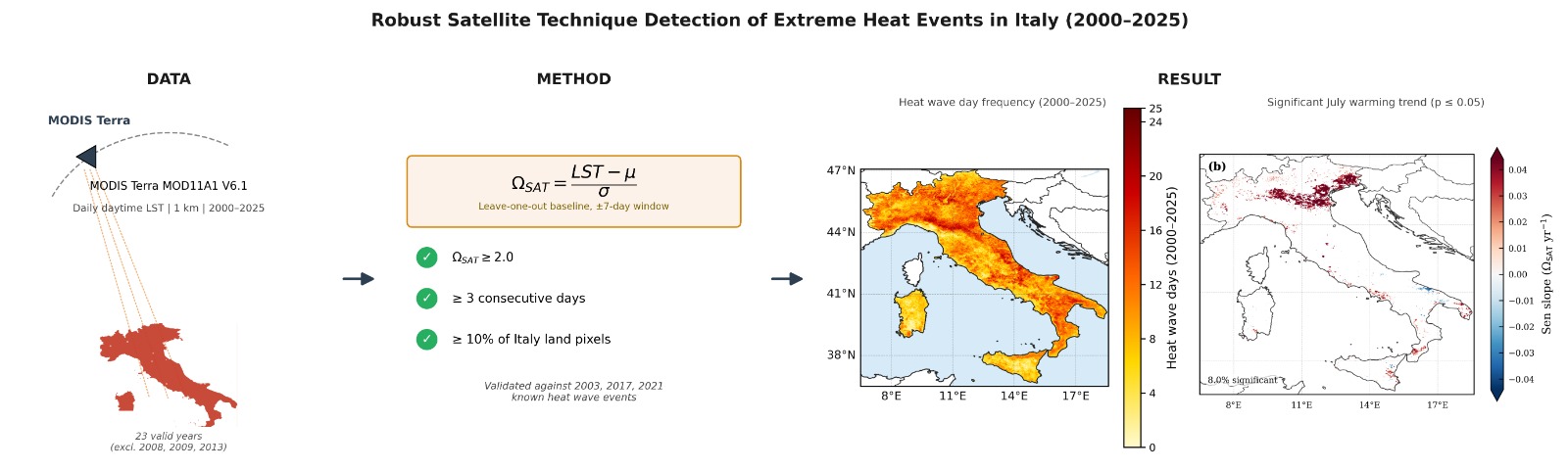
Extreme heat events pose significant socio-ecological risks across the Mediterranean region, with Italy being particularly vulnerable due to its complex topographies, microclimates, and non-stationary land surface temperature (LST) patterns driven by accelerating climate change. To overcome the limitations of fixed baseline thermal monitoring in non-stationary thermal environments, this study applies the Robust Satellite Technique (RST) to a 26-year record (2000–2025) of Moderate Resolution Imaging Spectroradiometer (MODIS) Terra daytime LST data to systematically detect and characterize extreme heat events across Italy. By deploying a leave-one-out baseline climatology and multi-criteria event definitions (\(\Omega_{\mathrm{SAT}} \ge 2.0\), minimum 3-day duration, and ≥10% spatial coverage), we isolate thermal anomalies while excluding seismically active years (2008, 2009, 2013) that corrupt baseline statistics. Validation against major historical heat waves (2003, 2017, 2021) confirms that the framework reliably captures regional heat footprints, showing peak cumulative heat wave frequency concentrated across the Po Valley, southern Alpine foothills, and the Adriatic coastal corridor. Analysis of peak spatial events shows that while extreme anomalies can extend into spring (e.g., March 2001, covering 43% of land area) vulnerability remains most acute during summer. Although national seasonal mean anomalies display no statistically significant trend due to high interannual variability, pixel-wise trend analysis uncovers a localized July warming hotspot (Sen slope > +0.03 \(\Omega_{\mathrm{SAT}}\) year\(^{-1}\), \(p \le 0.05\)) across 8.0% of land pixels, heavily centered in the northeastern Po Valley. These findings highlight the strength of high-quality satellite remote sensing in delineating non-stationary sub-regional heat vulnerability and guiding targeted climate adaptation strategies across heterogeneous landscapes.
- Open Access
- Article
Robust Satellite Technique Detection of Extreme Heat Events in Italy: A 26-Year (2000–2025) Study of Non-Stationary Thermal Baselines
Author Information
Received: 30 Mar 2026 | Revised: 13 Aug 2026 | Accepted: 14 Aug 2026 | Published: 20 Aug 2026
Abstract
Graphical Abstract
Keywords
extreme heat events | land surface temperature | robust satellite technique | thermal anomalies
References
- 1.
Russo, S.; Sillmann, J.; Fischer, E.M. Top ten European heatwaves since 1950 and their occurrence in the coming decades. Environ. Res. Lett. 2015, 10, 124003. https://doi.org/10.1088/1748-9326/10/12/124003.
- 2.
Kovats, R.S.; Hajat, S. Heat stress and public health: A critical review. Annu. Rev. Public Health 2008, 29, 41–55. https://doi.org/10.1146/annurev.publhealth.29.020907.090843.
- 3.
Fischer, E.M.; Schär, C. Consistent geographical patterns of changes in high-impact European heatwaves. Nat. Geosci. 2010, 3, 398–403. https://doi.org/10.1038/ngeo866.
- 4.
Lionello, P.; Abrantes, F.; Gacic, M.; et al. The climate of the Mediterranean region: research progress and climate change impacts. Reg. Environ. Change 2014, 14, 1679–1684. https://doi.org/10.1007/s10113-014-0666-0.
- 5.
Toreti, A.; Xoplaki, E.; Maraun, D.; et al. Characterisation of extreme winter precipitation in Mediterranean coastal sites and associated anomalous atmospheric circulation patterns. Nat. Hazards Earth Syst. Sci. 2010, 10, 1037–1050. https://doi.org/10.5194/nhess-10-1037-2010.
- 6.
Abunyewah, M.; Gajendran, T.; Erdiaw-Kwasie, M.O.; et al. The multidimensional impacts of heatwaves on human ecosystems: A systematic literature review and future research direction. Environ. Sci. Policy 2025, 165, 104024. https://doi.org/10.1016/j.envsci.2025.104024.
- 7.
Lateef, M.B.; Elegba, O.G.; Adegoke, M.O.; et al. Remote Sensing of Extreme Heat Events in Nigeria: A Multi-Index Study; Springer Nature: Cham, Switzerland, 2026; pp. 169–192. https://doi.org/10.1007/978-3-032-11678-9_8.
- 8.
Saber, A.; De Luca, C.; Pourzangbar, A.; et al. Heat wave risk assessment in Bologna using Spatio-temporal artificial intelligence: Leveraging LSTM enhanced by the hippopotamus optimization algorithm. Sustain. Cities Soc. 2025, 131, 106671. https://doi.org/10.1016/j.scs.2025.106671.
- 9.
Beniston, M.; Stephenson, D.B.; Christensen, O.B.; et al. Future extreme events in European climate: An exploration of regional climate model projections. Clim. Chang. 2007, 81, 71–95. https://doi.org/10.1007/s10584-006-9226-z.
- 10.
Lateef, M.B.; Ayanlade, O.S.; Adepiti, A.O.; et al. Machine learning-based projections of earth skin temperature anomalies in Nigeria using ERA5-land data. Clim. Interact. 2026, 2, 2624855. https://doi.org/10.1080/29966876.2026.2624855.
- 11.
Wan, Z.; Zhang, Y.; Zhang, Q.; et al. Quality assessment and validation of the MODIS global land surface temperature. Int. J. Remote Sens. 2004, 25, 261–274. https://doi.org/10.1080/0143116031000116417.
- 12.
Tramutoli, V.; Aliano, C.; Corrado, R.; et al. On the possible origin of thermal infrared radiation (TIR) anomalies in earthquake-prone areas observed using robust satellite techniques (RST). Chem. Geol. 2013, 339, 157–168. https://doi.org/10.1016/j.chemgeo.2012.10.042.
- 13.
Tramutoli, V.; Corrado, R.; Filizzola, C.; et al. From visual comparison to robust satellite techniques: 30 years of thermal infrared satellite data analyses for the study of earthquake preparation phases. Boll. Geofis. Teor. Appl. 2015, 56, 167–202. https://doi.org/10.4430/bgta0149.
- 14.
Tramutoli, V.; Di Bello, G.; Pergola, N.; et al. Robust satellite techniques for remote sensing of seismically active areas. Ann. Geophys. 2001, 44, 295–312. https://doi.org/10.4401/ag-3596.
- 15.
Genzano, N.; Aliano, C.; Corrado, R.; et al. RST analysis of MSG-SEVIRI TIR radiances at the time of the Abruzzo 6 April 2009 earthquake. Nat. Hazards Earth Syst. Sci. 2009, 9, 2073–2084. https://doi.org/10.5194/nhess-9-2073-2009.
- 16.
Tramutoli, V.; Marchese, F.; Falconieri, A.; et al. Tropospheric and ionospheric anomalies induced by volcanic and saharan dust events as part of geosphere interaction phenomena. Geosciences 2019, 9, 177. https://doi.org/10.3390/geosciences9040177.
- 17.
Peleli, S.; Kouli, M.; Vallianatos, F. Satellite-observed thermal anomalies and deformation patterns associated to the 2021, central crete seismic sequence. Remote Sens. 2022, 14, 3413. https://doi.org/10.3390/rs14143413.
- 18.
Lacava, T.; Ciancia, E.; Coviello, I.; et al. A modis-based Robust Satellite Technique (RST) for timely detection of oil spilled areas. Remote Sens. 2017, 9, 128. https://doi.org/10.3390/rs9020128.
- 19.
Zhang, Y.; Zhu, K.; Marchetti, D.; et al. Carbon monoxide anomalies for the 2013 Mw =6.7 lushan earthquake using MSSA-RST approach. IEEE Trans. Geosci. Remote Sens. 2024, 62, 4112420. https://doi.org/10.1109/tgrs.2024.3492254.
- 20.
Wan, Z.; Hook, S.; Hulley, G. MODIS/Terra Land Surface Temperature/Emissivity Daily L3 Global 1 km SIN Grid V006. NASA Earthdata. Available online: https://www.earthdata.nasa.gov/data/catalog/lpcloud-mod11a1-006 (accessed on 20 July 2026).
- 21.
Gorelick, N.; Hancher, M.; Dixon, M.; et al. Google Earth Engine: Planetary-scale geospatial analysis for everyone. Remote Sens. Environ. 2017, 202, 18–27. https://doi.org/10.1016/j.rse.2017.06.031.
- 22.
Perkins, S.E.; Alexander, L.V. On the measurement of heat waves. J. Clim. 2013, 26, 4500–4517. https://doi.org/10.1175/jcli-d-12-00383.1.
- 23.
Tramutoli, V. Robust AVHRR techniques (RAT) for environmental monitoring: theory and applications. In Proceedings of the Earth Surface Remote Sensing II, Barcelona, Spain, 21–24 September 1998; Volume 3496, pp. 101–113. https://doi.org/10.1117/12.332714.
- 24.
Tramutoli, V. Robust Satellite Techniques (RST) for natural and environmental hazards monitoring and mitigation: Theory and applications. In Proceedings of the 2007 International Workshop on the Analysis of Multi-temporal Remote Sensing Images, Leuven, Belgium, 18–20 July 2007; pp. 1–6. https://doi.org/10.1109/multitemp.2007.4293057.
- 25.
Filizzola, C.; Corrado, A.; Genzano, N.; et al. RST analysis of anomalous TIR sequences in relation with earthquakes occurred in Turkey in the period 2004–2015. Remote Sens. 2022, 14, 381. https://doi.org/10.3390/rs14020381.
- 26.
Sen, P.K. Estimates of the regression coefficient based on Kendall’s tau. J. Am. Stat. Assoc. 1968, 63, 1379–1389. https://doi.org/10.1080/01621459.1968.10480934.
- 27.
Conti, S.; Meli, P.; Minelli, G.; et al. Epidemiologic study of mortality during the Summer 2003 heat wave in Italy. Environ. Res. 2005, 98, 390–399. https://doi.org/10.1016/j.envres.2004.10.009.
- 28.
Fink, A.H.; Brücher, T.; Krüger, A.; et al. The 2003 European summer heatwaves and drought—synoptic diagnosis and impacts. Weather 2004, 59, 209–216. https://doi.org/10.1256/wea.73.04.
- 29.
*BREAKING NEWS* Italy Set a New European Heat Record as Siracusa, Sicily Peaks at +48.8 °C Today. Intense Heatwave Now Heads for Spain and Portugal This Weekend. Available online: https://www.severe-weather.eu/europe-weather/record-heatwave-mediterranean-italy-spain-portugal-mk/ (accessed on 20 July 2026).
- 30.
Sicily Records Europe’s ‘Highest Ever’ Temperature as Fires Rage. Available online: https://www.aljazeera.com/news/2021/8/12/italy-fires-spread-as-authorities-warn-of-record-temperatures (accessed on 20 July 2026).
- 31.
Almazroui, M.; Awad, A.M. Synoptic regimes associated with the eastern Mediterranean wet season cyclone tracks. Atmos. Res. 2016, 180, 92–118. https://doi.org/10.1016/j.atmosres.2016.05.015.
- 32.
Samman, A.E. Synoptic and Dynamic Analyses of an Intense Mediterranean Cyclone: A Case Study. Climate 2025, 13, 126. https://doi.org/10.3390/cli13060126.
- 33.
Cureau, R.J.; Balocco, C.; Pigliautile, I.; et al. On urban microclimate spatial-temporal dynamics: Evidence from the integration of fixed and wearable sensing and mapping techniques. Environ. Res. 2024, 262, 119795. https://doi.org/10.1016/j.envres.2024.119795.
- 34.
Reiners, P.; Sobrino, J.; Kuenzer, C. Satellite-derived land surface temperature dynamics in the context of global change—A review. Remote Sens. 2023, 15, 1857. https://doi.org/10.3390/rs15071857.
- 35.
Jia, K.; Sheng, Q.; Liu, Y.; et al. A framework for achieving urban sustainable development goals (SDGs): Evaluation and interaction. Sustain. Cities Soc. 2024, 114, 105780. https://doi.org/10.1016/j.scs.2024.105780.


This work is licensed under a Creative Commons Attribution 4.0 International License.
