
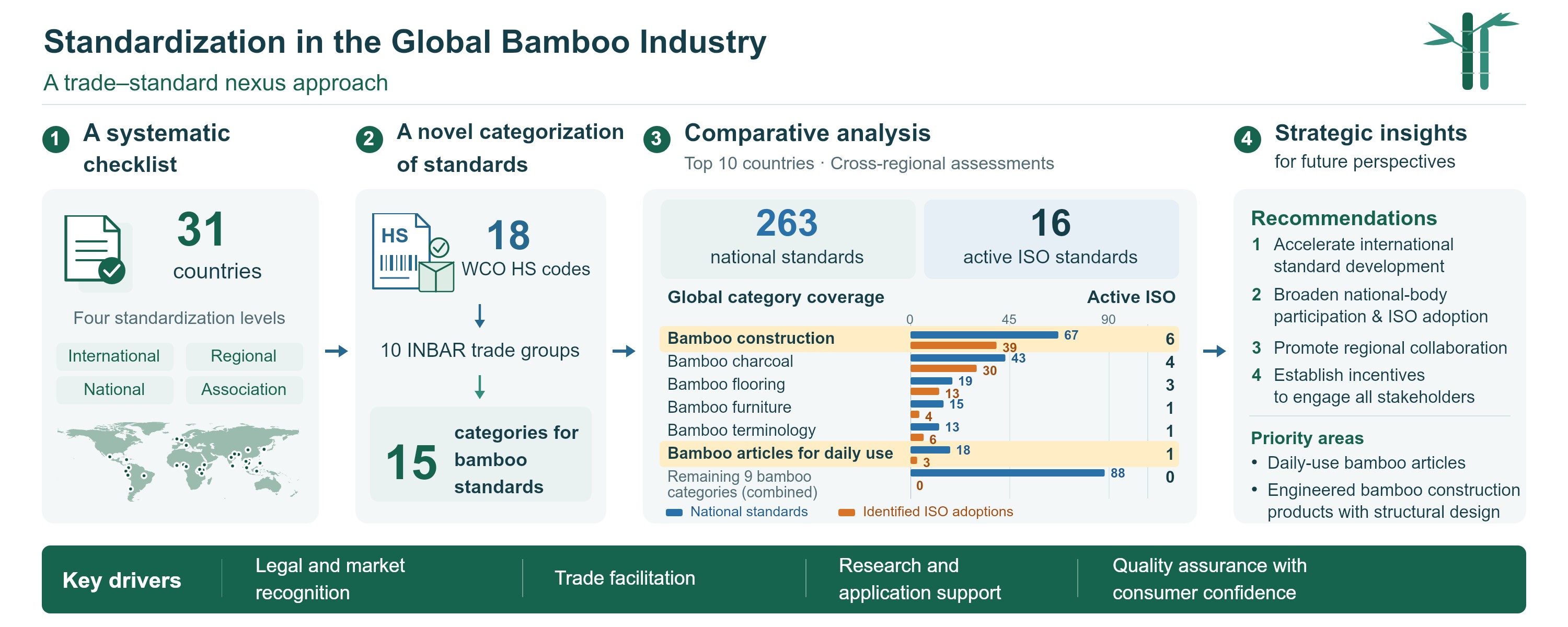
Bamboo, once a traditional material, has become a global commodity through innovation and market growth. Bamboo standards are now essential to reduce non-tariff trade barriers and maintain market competitiveness. This study systematically examines global bamboo standards across international, regional, national, and association levels, employing a novel trade-standard nexus approach to analyze development trends and driving factors. ISO/TC 296 and ISO/TC 165 are the primary technical committees for international bamboo standards. The priority areas for future promotion include daily-use bamboo articles, and engineered bamboo construction products with structural design. Thirty-one countries have established national bamboo standards (13 in Asia, 8 in Africa, 7 in Latin America and the Caribbean, and 3 in Europe). China leads in coverage (12 categories), while India pioneered national standards in the 1970s. Colombia’s standards have influenced bamboo construction regulations in Brazil, Ecuador and Peru, and the adoption of ISO standards has driven standardization in Kenya, the Philippines, Indonesia, Ethiopia, the UK, and the Netherlands. No bamboo-specific regional standards have been established to date. Association standards are rapidly expanding in China, with China Association for Engineering Construction Standardization (CECS) and China Bamboo Industry Association (CBIA) playing pivotal roles. Four key drivers of global standardization were identified: legal and market recognition, trade facilitation, research and application support, and quality assurance with consumer confidence. Based on these findings, four actionable recommendations are proposed to promote both international and national standardization, namely, accelerating international standard development under the two TCs, broadening national-body participation in international standardization, promoting regional collaboration, and establishing incentives to engage all stakeholders.
- Open Access
- Article
Standardization in the Global Bamboo Industry: A Trade-Standard Nexus Approach
- Kewei Liu 1,2,*,
- Yiming Sun 3,
- Anna Caterina Rossi 4,
- Changhua Fang 5,
- Pablo Jacome Estrella 1,
- Yongjiu Shi 2,
- Rene Kaam 1,
- Yuechu Shi 6,
- Durai Jayaraman 1
Author Information
Received: 18 Jun 2026 | Revised: 29 Aug 2026 | Accepted: 14 Sep 2026 | Published: 19 Oct 2026
Abstract
Graphical Abstract
Keywords
bamboo | standardization | international standards | national standards | trade | International Organization for Standardization (ISO)
References
- 1.
Vorontsova, M.S.; Clark, L.G.; Dransfield, J.; et al. World Checklist of Bamboos and Rattans; INBAR Technical Report; International Bamboo and Rattan Organization (INBAR): Beijing, China, 2016.
- 2.
Lou, Y.P.; Li, Y.X.; Buckingham, K.; et al. Bamboo and Climate Change Mitigation: A Comparative Analysis of Carbon Sequestration; INBAR Technical Report; International Bamboo and Rattan Organization (INBAR): Beijing, China, 2010.
- 3.
Panmei, L.; Selvan, T.; Jayaraman, D.; et al. Ecological restoration of fragile Eastern Himalayan landscapes through bamboo bioengineering. Adv. Bamboo Sci. 2025, 13, 100203.
- 4.
Huy, B.; Long, T.T. A Manual for Bamboo Forest Biomass and Carbon Assessment; INBAR Technical Report; International Bamboo and Rattan Organization (INBAR): Beijing, China, 2019.
- 5.
Janssen, J.J.A. Designing and Building with Bamboo; INBAR Technical Report; International Bamboo and Rattan Organization (INBAR): Beijing, China, 2000.
- 6.
Liu, K.W.; Xu, Q.F.; Wang, G.; et al. Contemporary Bamboo Architecture in China; Tsinghua University Press: Beijing, China; Springer: Singapore, 2022.
- 7.
Malingan, J.J. Green Foundation: Elevating Bamboo as Resilient, Affordable Construction Material. Available online: https://pia.gov.ph/features/green-foundation-elevating-bamboo-as-resilient-affordable-construction-material/#1 (accessed on 27 August 2026).
- 8.
Reza, S.; Shibeshi, T.T.; Burru, D.Y.; et al. Rapid Assessment of the Bamboo Value Chain in Ethiopia: Products, Markets, and Supply Chains; INBAR Working Paper; International Bamboo and Rattan Organization (INBAR): Beijing, China, 2024.
- 9.
FAO; INBAR. Bamboo for Land Restoration; INBAR Policy Synthesis Report; International Bamboo and Rattan Organization (INBAR): Beijing, China, 2018.
- 10.
Deng, J.L.; Zhang, J.H.; Li, H. Current situation and development prospect of bamboo flooring industry in China. For. Mach. Woodwork. Equip. 2010, 38, 4–6.
- 11.
Bao, Y.S.; Li, Z.Y. Status and trend of foreign bamboo industry. World Bamboo Ratt. 2005, 3, 40–42.
- 12.
Hanumappa, H.G. AGARBATHI: A Bamboo-Based Industry in India; International Bamboo and Rattan Organization (INBAR): Beijing, China; International Fund for Agricultural Development (IFAD): Roma, Italy, 1996.
- 13.
Fan, Y.H.; He, H.C.; Chen, J.Z.; et al. Research status and development trend of bamboo fiber for textiles. For. Mach. Woodwork. Equip. 2009, 37, 11–14.
- 14.
Wang, G.; Wang, Y.P.; Cheng, H.T. Bamboo Fiber Properties and Its Textile Processing Applications; China Textile Press: Beijing, China, 2017.
- 15.
Amjad, A.I. Bamboo fibre: A sustainable solution for textile manufacturing. Adv. Bamboo Sci. 2024, 7, 100088.
- 16.
Jais, F.N.M.; Mokeramin, M.; Roslan, M.N.; et al. Bamboo fiber for textile applications. In Multifaceted Bamboo: Engineered Products and Other Applications; Tahir, P.M., Lee, S.H., Osman Al-Edrus, S.S.; et al., Eds.; Springer: Singapore, 2023; pp. 275–290.
- 17.
Sutrisno, B.; Sukada, B.A. Rumah Bambu: Arsitektur Khas Jawa Barat; Pustaka Rumah Kebun: Jakarta, Indonesia, 2010.
- 18.
Minke, G. Building with Bamboo: Design and Technology of a Sustainable Architecture; Birkhäuser: Berlin, Germany, 2022.
- 19.
INBAR (Translator). Three-Year Action Plan for Accelerating the Development of the Bamboo as a Substitute for Plastic (BASP) Industry in China; International Bamboo and Rattan Organization (INBAR): Beijing, China, 2024.
- 20.
Alamerew, A.N.; Zhu, Z.; Kozak, R.; et al. Exploring the shift to bamboo alternatives: A Case Study on wood and plastic replacement in Ethiopia. J. Clean. Prod. 2025, 486, 144507.
- 21.
Li, M.P.; Li, H.Y.; Yuan, Z.T.; et al. Performance of lightweight bamboo fiber-reinforced sandwich composites applied in automotive interior. World Bamboo Ratt. 2024, 22, 12–21.
- 22.
Cheng, H.T.; Li, M.P. Making car interiors more environmentally friendly: “replacing plastic with bamboo” drives the high-quality development of green new materials for bamboo fiber car interiors. Chin. For. Ind. 2025, 12, 61–66.
- 23.
Chen, X.Y.; Chen, F.M.; Yang, Q.; et al. An environmental food packaging material part I: A case study of life-cycle assessment (LCA) for bamboo fiber environmental tableware. Ind. Crops Prod. 2023, 194, 116279.
- 24.
Luan, Y.; Yang, Y.Y.; Su, Q.; et al. Eco-friendly innovation: Industrial-scale all-natural bamboo drinking straw inspired by bamboo’s flexibility and toughness. J. Bioresour. Bioprod. 2025, 10, 239–252.
- 25.
INBAR. Annual Highlights 2025; International Bamboo and Rattan Organization (INBAR): Beijing, China, 2026.
- 26.
INBAR. Trade Overview 2023: Bamboo and Rattan Commodities in the International Market; International Bamboo and Rattan Organization (INBAR): Beijing, China, 2026.
- 27.
American National Standards Institute (ANSI). Available online: https://www.ansi.org/trade-development/standardization/overview (accessed on 30 September 2025).
- 28.
UNIDO. Role of Standards: A Guide for Small and Medium-Sized Enterprises; United Nations Industrial Development Organization (UNIDO): Vienna, Austria, 2006.
- 29.
UK Government. Standardisation. Available online: https://www.gov.uk/guidance/standardisation (accessed on 30 September 2025).
- 30.
Beckmann, D. European Standards—CEN between Global and National Standardization. Kautsch. Gummi Kunststoffe 1994, 47, 58–61.
- 31.
Baharuddin, N.; Abdul Karim, S.R.; Kassim, A.S.; et al. Global Bamboo Industries: An Overview. In Multifaceted Bamboo: Engineered Products and Other Applications; Tahir, P.M., Lee, S.H., Osman Al-Edrus, S.S., et al., Eds.; Springer, Singapore, 2023; pp. 15–41.
- 32.
China Bamboo Industry Association (CBIA). Available online: https://cbiachina.com/Index/ (accessed on 30 September 2025).
- 33.
INBAR. Trade Overview 2022: Bamboo and Rattan Commodities in the International Market; International Bamboo and Rattan Organization (INBAR): Beijing, China, 2023.
- 34.
Abebe, S.; Jayaraman, D.; Malinga, M.; et al. Carbon stock of Oxytenanthera abyssinica (A. Rich.) Munro forests in northern Uganda: A vital nature-based climate solution. Adv. Bamboo Sci. 2026, 14, 100216.
- 35.
Ministry of the President’s Office of Myanmar. Invest in Bamboo Processing for Export. Available online: https://presoffministry.gov.mm/en/subject/40823 (accessed on 27 August 2026).
- 36.
ISO/TC 165; Timber Structures. ISO: Geneva, Switzerland, 1976. Available online: https://www.iso.org/committee/53584.html (accessed on 30 September 2025).
- 37.
ISO/TC 296; Bamboo and Rattan. ISO: Geneva, Switzerland, 2015. Available online: https://www.iso.org/committee/5819148.html (accessed on 30 September 2025).
- 38.
Feng, P.F.; Li, Y.M. China’s bamboo resources in 2021. World Bamboo Ratt. 2023, 21, 100–103.
- 39.
ASTM International (ASTM). Available online: https://www.astm.org (accessed on 30 September 2025).
- 40.
China Association for Engineering Construction Standardization (CECS). Available online: http://www.cecs.org.cn/ (accessed on 30 September 2025).
- 41.
United Nations International Trade Statistics Database (UN Comtrade). Available online: https://comtradeplus.un.org/ (accessed on 30 September 2025).
- 42.
Jiang, W.A.; Liu, K.W.; Zhang, X.; et al. Trends and path for development of bamboo structural engineering towards 2035 in China. China Civ. Eng. J. 2021, 54, 125–132.
- 43.
Blind, K.; von Laer, M. Paving the path: Drivers of standardization participation at ISO. J. Technol. Transf. 2022, 47, 1115–1134.
- 44.
INBAR. Defining the Future of Structural Glued Laminated Bamboo. Available online: https://www.inbar.int/defining-the-future-of-structural-glued-laminated-bamboo/ (accessed on 30 September 2025).
- 45.
Kaminski, S.; Lawrence, A.; Trujillo, D. Design Guide for Engineered Bahareque Housing; International Bamboo and Rattan Organization (INBAR): Beijing, China, 2016.
- 46.
Gatóo, A.; Sharma, B.; Bock, M.; et al. Sustainable structures: Bamboo standards and building codes. Proc. Inst. Civ. Eng. Eng. Sustain. 2014, 167, 189–196.
- 47.
Sharma, B.; Gatóo, A.; Bock, M.; et al. Engineered bamboo for structural applications. Constr. Build. Mater. 2015, 81, 66–73.

This work is licensed under a Creative Commons Attribution 4.0 International License.
