
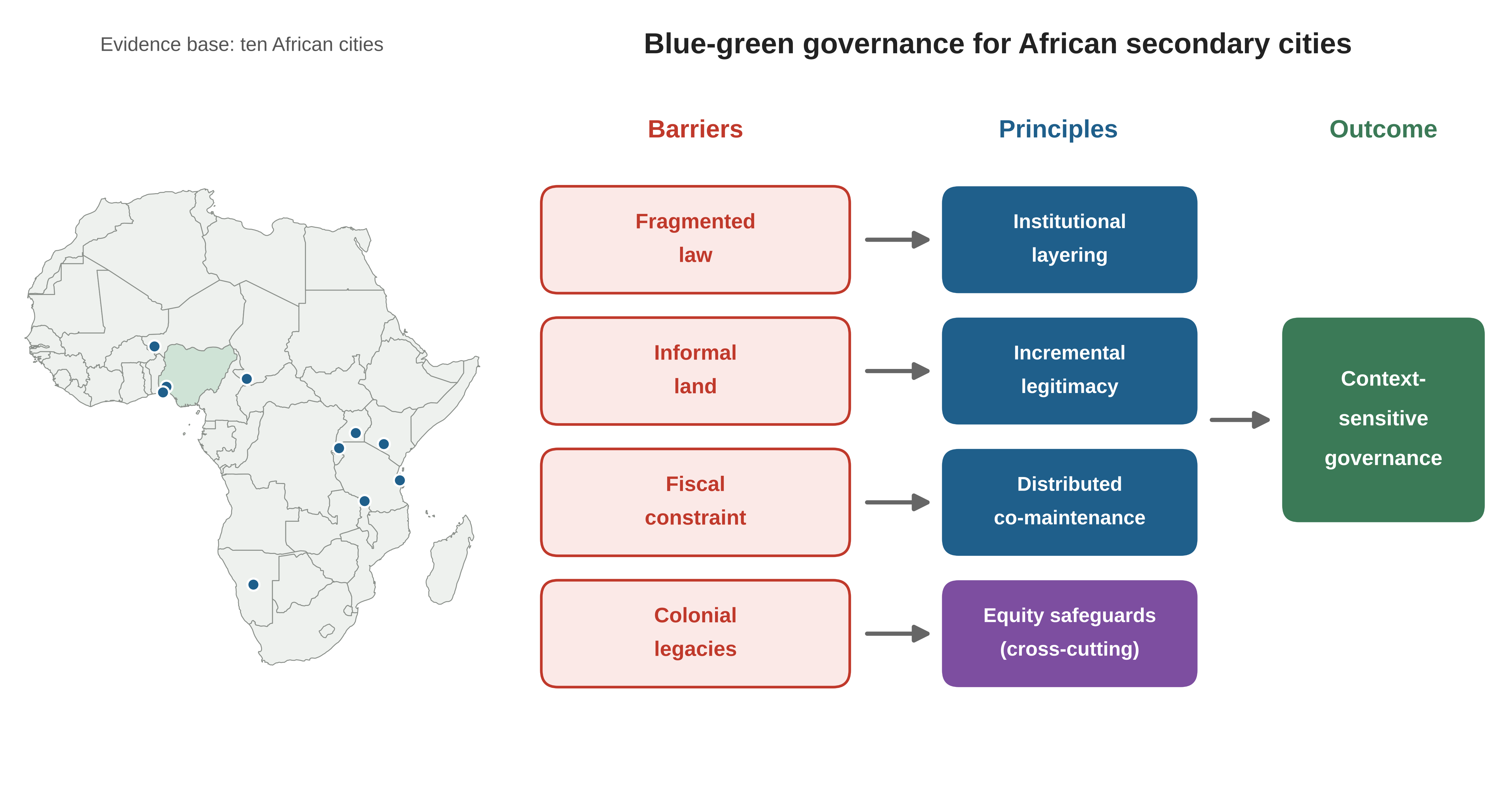
Water-Sensitive Urban Design (WSUD) has, since its formulation in Australia in the early 1990s, become a widely referenced paradigm for integrating stormwater, groundwater, and water-supply management into urban planning. Its fullest articulation, the water-sensitive city, describes a societal transition rather than a design technique alone. Its diffusion across the Global South has, however, exposed a translation problem: frameworks developed for well-resourced, formally planned cities do not travel cleanly into the institutional, fiscal, and tenurial conditions of many Sub-Saharan African secondary cities. The region also lacks a single shared vocabulary: South Africa has a formal WSUD framework, while Kenya, Uganda, and Rwanda organise comparable interventions as nature-based solutions. This narrative review draws on 24 sources identified through a documented search and selection procedure. It synthesises the conceptual evolution of WSUD and examines four recurring barriers to its translation: legal and regulatory fragmentation; fiscal constraint at municipal level; the mismatch between formal design frameworks and informally held land; and colonial and postcolonial drainage legacies. Nigerian cities provide an illustrative lens, with Ibadan as the exemplar secondary city and Lagos as a deliberately contrasting megacity. A comparative analysis separates evidence from secondary cities from evidence drawn from capitals and megacities, and qualifies the transferability of each. The review proposes a context-sensitive blue-green infrastructure governance framework built on institutional layering, incremental legitimacy, and distributed co-maintenance. It traces each principle to its supporting evidence, distinguishes that evidence from the author’s own proposals, and sets out how the principles could be operationalised and validated. It closes with a research agenda centred on comparative institutional ethnography of blue-area governance in West African secondary cities.
- Open Access
- Review
Water-Sensitive Urban Design in Sub-Saharan African Secondary Cities: Institutional Barriers, Informality, and Pathways toward Context-Sensitive Blue-Green Infrastructure Governance
Author Information
Received: 21 July 2026 | Revised: 06 November 2026 | Accepted: 25 November 2026 | Published: 27 November 2026
Abstract
Graphical Abstract
Keywords
water-sensitive urban design | blue-green infrastructure | institutional governance | informal settlements | flood risk | Sub-Saharan Africa | Nigeria
References
- 1.
World Bank. Lagos Platform for Development: Overview and Objectives. Available online: https://documents1.worldbank.org/curated/en/099062123034024444/pdf/P17503106a495a0c90af5f0c3f872c99b4f.pdf (accessed on 6 November 2026).
- 2.
Salami, R.O.; Von Meding, J.K.; Giggins, H. Vulnerability of Human Settlements to Flood Risk in the Core Area of Ibadan Metropolis, Nigeria. Jàmbá J. Disaster Risk Stud. 2017, 9, 371. https://doi.org/10.4102/jamba.v9i1.371.
- 3.
Wahab, B.; Ojolowo, S. Building Contraventions and Incidence of Flood in the Lagos Metropolis, Nigeria. J. Environ. Plan. Manag. 2018, 61, 385–405. https://doi.org/10.1080/09640568.2017.1311249.
- 4.
Wong, T.H.F.; Brown, R.R. The Water Sensitive City: Principles for Practice. Water Sci. Technol. 2009, 60, 673–682. https://doi.org/10.2166/wst.2009.436.
- 5.
Fletcher, T.D.; Shuster, W.; Hunt, W.F.; et al. SUDS, LID, BMPs, WSUD and More—The Evolution and Application of Terminology Surrounding Urban Drainage. Urban Water J. 2015, 12, 525–542. https://doi.org/10.1080/1573062x.2014.916314.
- 6.
O’Donnell, E.; Dolman, N.; Everett, G.; et al. Managing Flood Risk in Blue-Green Cities. In Research Handbook on Flood Risk Management; Edward Elgar Publishing: Cheltenham, UK, 2024; pp. 97–111. https://doi.org/10.4337/9781839102981.00015.
- 7.
Armitage, N.; Fisher-Jeffes, L.; Carden, K.; et al. Water-Sensitive Urban Design (WSUD) for South Africa: Framework and Guidelines; Water Research Commission: Pretoria, South Africa, 2014.
- 8.
Mulligan, J.; Bukachi, V.; Clause, J.C.; et al. Hybrid Infrastructures, Hybrid Governance: New Evidence from Nairobi (Kenya) on Green-Blue-Grey Infrastructure in Informal Settlements. Anthropocene 2020, 29, 100227. https://doi.org/10.1016/j.ancene.2019.100227.
- 9.
Muwafu, S.P.; Celliers, L.; Scheffran, J.; et al. Community Governance Performance of Nature-Based Solutions for Sustainable Urban Stormwater Management in Sub-Saharan Africa. Sustainability 2024, 16, 8328. https://doi.org/10.3390/su16198328.
- 10.
Rwanda Young Water Professionals. Nature-Based Flood Adaptation in Kigali’s Mpazi Sub-Catchment. Available online: https://www.preventionweb.net/news/nature-based-flood-adaptation-kigalis-mpazi-sub-catchment (accessed on 6 November 2026).
- 11.
Thorn, J.P.R.; Biancardi Aleu, R.; Wijesinghe, A.; et al. Mainstreaming Nature-Based Solutions for Climate Resilient Infrastructure in Peri-Urban Sub-Saharan Africa. Landsc. Urban Plan. 2021, 216, 104235. https://doi.org/10.1016/j.landurbplan.2021.104235.
- 12.
Haou, E.; Allarané, N.; Aholou, C.C.; et al. Integrating Sustainable Development Goals into Urban Planning to Advance Sustainability in Sub-Saharan Africa: Barriers and Practical Solutions from the Case Study of Moundou, Chad. Urban Sci. 2025, 9, 22. https://doi.org/10.3390/urbansci9020022.
- 13.
Kumar, A.; Button, C.; Gupta, S.; et al. Water Sensitive Planning for the Cities in the Global South. Water 2023, 15, 235. https://doi.org/10.3390/w15020235.
- 14.
Leck, H.; Pelling, M.; Adelekan, I.; et al. Towards Risk-Sensitive and Transformative Urban Development in Sub Saharan Africa. Sustainability 2018, 10, 2645. https://doi.org/10.3390/su10082645.
- 15.
Whelans Consultants; Halpern Glick Maunsell; Thompson, P. Planning and Management Guidelines for Water Sensitive Urban (Residential) Design; Department of Planning and Urban Development: Perth, Australia, 1994.
- 16.
Wong, T.H.F. Water Sensitive Urban Design—the Journey Thus Far. Australas. J. Water Resour. 2006, 10, 213–222. https://doi.org/10.1080/13241583.2006.11465296.
- 17.
Brown, R.R.; Keath, N.; Wong, T.H.F. Urban Water Management in Cities: Historical, Current and Future Regimes. Water Sci. Technol. 2009, 59, 847–855. https://doi.org/10.2166/wst.2009.029.
- 18.
Federal Republic of Nigeria. Urban and Regional Planning Law (Decree No. 88 of 1992) and Land Use Act (Cap. L5, Laws of the Federation of Nigeria 2004); Federal Government Printer: Lagos/Abuja, Nigeria.
- 19.
Diep, L.; Mulligan, J.; Oloo, M.A.; et al. Co-Building Trust in Urban Nature: Learning from Participatory Design and Construction of Nature-Based Solutions in Informal Settlements in East Africa. Front. Sustain. Cities 2022, 4, 927723. https://doi.org/10.3389/frsc.2022.927723.
- 20.
Wijesinghe, A.; Thorn, J.P.R. Governance of Urban Green Infrastructure in Informal Settlements of Windhoek, Namibia. Sustainability 2021, 13, 8937. https://doi.org/10.3390/su13168937.
- 21.
Adegun, O.B. Green Infrastructure Can Improve the Lives of Slum Dwellers in African Cities. Front. Sustain. Cities 2021, 3, 621051. https://doi.org/10.3389/frsc.2021.621051.
- 22.
Gandy, M. Planning, Anti-Planning and the Infrastructure Crisis Facing Metropolitan Lagos. Urban Stud. 2006, 43, 371–396. https://doi.org/10.1080/00420980500406751.
- 23.
Wahab, B.; Ojolowo, S.; Adelekan, I.; et al. Building Contraventions and Incidence of Flood in the Lagos Metropolis. In Proceedings of the International Conference on Flood Management, São Paulo, Brazil, 17–19 September 2014.
- 24.
Kim, S.K.; Cho, H.; Wu, L.; et al. The Gentrification Paradox of Green–Blue Adaptation in African Cities. Nat. Cities 2026, 3, 438–446. https://doi.org/10.1038/s44284-026-00432-0.


This work is licensed under a Creative Commons Attribution 4.0 International License.
