
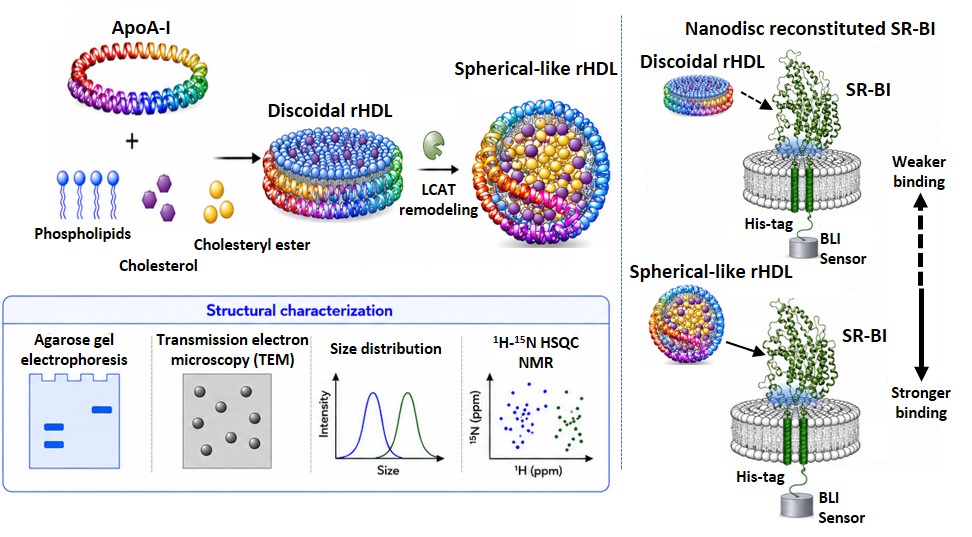
Reconstituted high-density lipoprotein (rHDL) particles adopt distinct structural states, yet how these states influence receptor recognition remains incompletely understood. Here, we compared the structural features of discoidal rHDL and LCAT-remodeled spherical-like rHDL model particles and evaluated their interactions with scavenger receptor class B type I (SR-BI). Recombinant apolipoprotein A-I (ApoA-I) was expressed and used to assemble discoidal rHDL, which was subsequently converted into spherical-like rHDL through lecithin-cholesterol acyltransferase (LCAT)-mediated remodeling. Agarose gel electrophoresis, transmission electron microscopy, and 1H–15N HSQC NMR spectroscopy confirmed that the two rHDL species differed in electrophoretic mobility, morphology, size distribution, and ApoA-I spectral properties. In particular, ApoA-I in discoidal rHDL exhibited greater NMR visibility than in LCAT-remodeled spherical-like rHDL, consistent with distinct conformational and dynamic states. Biolayer interferometry further showed that LCAT-remodeled spherical-like rHDL model particles bound SR-BI with substantially higher apparent affinity than discoidal rHDL. Together, these findings demonstrate that the structural state of rHDL strongly influences its interaction with SR-BI and support a model in which the LCAT-remodeled structural transition of rHDL is accompanied by ApoA-I reorganization that favors receptor binding. This study provides mechanistic insight into how structural changes in model rHDL particles modulate receptor engagement.
- Open Access
- Article
LCAT-Remodeled Structural Transition of Reconstituted HDL Enhances SR-BI Binding
Author Information
Received: 14 Apr 2026 | Revised: 02 Jun 2026 | Accepted: 09 Jun 2026 | Published: 15 Oct 2026
Abstract
Graphical Abstract
Keywords
ApoA-I | reconstituted HDL | SR-BI | biolayer interferometry
References
- 1.
Bhale, A.S.; Venkataraman, K. Leveraging knowledge of HDLs major protein ApoA1: Structure, function, mutations, and potential therapeutics. Biomed. Pharmacother. 2022, 154, 113634. https://doi.org/10.1016/j.biopha.2022.113634.
- 2.
Franczyk, B.; Mlynarska, E.; Rysz-Gorzynska, M.; Gluba-Sagr, A.; Rysz, J.; Sheth, S.; Surma, S.; Banach, M.; Toth, P.P. High-density lipoproteins, Part 1. Epidemiology, antiatherogenic effects, and therapies designed to increase their serum levels. Am. J. Prev. Cardiol. 2025, 23, 101068. https://doi.org/10.1016/j.ajpc.2025.101068.
- 3.
Ouimet, M.; Barrett, T.J.; Fisher, E.A. HDL and Reverse Cholesterol Transport. Circ. Res. 2019, 124, 1505–1518. https://doi.org/10.1161/CIRCRESAHA.119.312617.
- 4.
Marquez, A.B.; Nazir, S.; van der Vorst, E.P.C. High-Density Lipoprotein Modifications: A Pathological Consequence or Cause of Disease Progression? Biomedicines 2020, 8, 549. https://doi.org/10.3390/biomedicines8120549.
- 5.
Kingwell, B.A.; Chapman, M.J.; Kontush, A.; Miller, N.E. HDL-targeted therapies: Progress, failures and future. Nat. Rev. Drug Discov. 2014, 13, 445–464. https://doi.org/10.1038/nrd4279.
- 6.
Xu, C.; Zhu, H.; Wang, K.; Hu, H.; Wei, X.; Xu, D.; Zhang, J.; Liu, Y.; Chen, J.; Shen, Y.; et al. Oral Celastrol Micelles Forming High-Density Lipoprotein Corona Targeting Hepatocytes for MASLD Treatment. Adv. Sci. 2025, 12, e00854. https://doi.org/10.1002/advs.202500854.
- 7.
Ma, Z.; Zhong, J.; Tu, W.; Li, S.; Chen, J. The functions of apolipoproteins and lipoproteins in health and disease. Mol. Biomed. 2024, 5, 53. https://doi.org/10.1186/s43556-024-00218-7.
- 8.
Fox, C.A.; Moschetti, A.; Ryan, R.O. Reconstituted HDL as a therapeutic delivery device. Biochim. Biophys. Acta Mol. Cell Biol. Lipids 2021, 1866, 159025. https://doi.org/10.1016/j.bbalip.2021.159025.
- 9.
Anantharamaiah, G.M.; Brouillette, C.G.; Engler, J.A.; De Loof, H.; Venkatachalapathi, Y.V.; Boogaerts, J.; Segrest, J.P. Role of amphipathic helixes in HDL structure/function. Adv. Exp. Med. Biol. 1991, 285, 131–140. https://doi.org/10.1007/978-1-4684-5904-3_17.
- 10.
Segrest, J.P.; Jones, M.K.; De Loof, H.; Brouillette, C.G.; Anantharamaiah, G.M. The amphipathic helix in the exchangeable apolipoproteins: A review of secondary structure and function. J. Lipid Res. 1992, 33, 141–166.
- 11.
Ali, K.M.; Wonnerth, A.; Huber, K.; Wojta, J. Cardiovascular disease risk reduction by raising HDL cholesterol—Current therapies and future opportunities. Br. J. Pharmacol. 2012, 167, 1177–1194. https://doi.org/10.1111/j.1476-5381.2012.02081.x.
- 12.
Feingold, K.R. Introduction to Lipids and Lipoproteins. In Endotext; Feingold, K.R., Adler, R.A., Ahmed, S.F., Eds.; MDText.com, Inc.: South Dartmouth, MA, USA, 2000.
- 13.
Acton, S.; Rigotti, A.; Landschulz, K.T.; Xu, S.; Hobbs, H.H.; Krieger, M. Identification of scavenger receptor SR-BI as a high density lipoprotein receptor. Science 1996, 271, 518–520. https://doi.org/10.1126/science.271.5248.518.
- 14.
Brundert, M.; Ewert, A.; Heeren, J.; Behrendt, B.; Ramakrishnan, R.; Greten, H.; Merkel, M.; Rinninger, F. Scavenger Receptor Class B Type I Mediates the Selective Uptake of High-Density Lipoprotein–Associated Cholesteryl Ester by the Liver in Mice. Arterioscler. Thromb. Vasc. Biol. 2005, 25, 143–148. https://doi.org/10.1161/01.ATV.0000149381.16166.c6.
- 15.
Linton, M.F.; Tao, H.; Linton, E.F.; Yancey, P.G. SR-BI: A Multifunctional Receptor in Cholesterol Homeostasis and Atherosclerosis. Trends Endocrinol. Metab. 2017, 28, 461–472. https://doi.org/10.1016/j.tem.2017.02.001.
- 16.
Kozarsky, K.F.; Donahee, M.H.; Rigotti, A.; Iqbal, S.N.; Edelman, E.R.; Krieger, M. Overexpression of the HDL receptor SR-BI alters plasma HDL and bile cholesterol levels. Nature 1997, 387, 414–417. https://doi.org/10.1038/387414a0.
- 17.
Rigotti, A.; Trigatti, B.L.; Penman, M.; Rayburn, H.; Herz, J.; Krieger, M. A targeted mutation in the murine gene encoding the high density lipoprotein (HDL) receptor scavenger receptor class B type I reveals its key role in HDL metabolism. Proc. Natl. Acad. Sci. USA 1997, 94, 12610–12615. https://doi.org/10.1073/pnas.94.23.12610.
- 18.
Zanoni, P.; Khetarpal, S.A.; Larach, D.B.; Hancock-Cerutti, W.F.; Millar, J.S.; Cuchel, M.; DerOhannessian, S.; Kontush, A.; Surendran, P.; Saleheen, D.; et al. Rare variant in scavenger receptor BI raises HDL cholesterol and increases risk of coronary heart disease. Science 2016, 351, 1166–1171. https://doi.org/10.1126/science.aad3517.
- 19.
Xu, S.; Laccotripe, M.; Huang, X.; Rigotti, A.; Zannis, V.I.; Krieger, M. Apolipoproteins of HDL can directly mediate binding to the scavenger receptor SR-BI, an HDL receptor that mediates selective lipid uptake. J. Lipid Res. 1997, 38, 1289–1298. https://doi.org/10.1016/S0022-2275(20)37413-7.
- 20.
Pilon, A.; Briand, O.; Lestavel, S.; Copin, C.; Majd, Z.; Fruchart, J.-C.; Castro, G.; Clavey, V. Apolipoprotein AII Enrichment of HDL Enhances Their Affinity for Class B Type I Scavenger Receptor but Inhibits Specific Cholesteryl Ester Uptake. Arterioscler. Thromb. Vasc. Biol. 2000, 20, 1074–1081. https://doi.org/10.1161/01.Atv.20.4.1074.
- 21.
Freeman, L.A.; Demosky, S.J., Jr.; Konaklieva, M.; Kuskovsky, R.; Aponte, A.; Ossoli, A.F.; Gordon, S.M.; Koby, R.F.; Manthei, K.A.; Shen, M.; et al. Lecithin:Cholesterol Acyltransferase Activation by Sulfhydryl-Reactive Small Molecules: Role of Cysteine-31. J. Pharmacol. Exp. Ther. 2017, 362, 306–318. https://doi.org/10.1124/jpet.117.240457.
- 22.
Hagn, F.; Nasr, M.L.; Wagner, G. Assembly of phospholipid nanodiscs of controlled size for structural studies of membrane proteins by NMR. Nat. Protoc. 2018, 13, 79–98. https://doi.org/10.1038/nprot.2017.094.
- 23.
Sparks, D.L.; Phillips, M.C.; Lund-Katz, S. The conformation of apolipoprotein A-I in discoidal and spherical recombinant high density lipoprotein particles. 13C NMR studies of lysine ionization behavior. J. Biol. Chem. 1992, 267, 25830–25838. https://doi.org/10.1016/s0021-9258(18)35685-0.
- 24.
Delaglio, F.; Grzesiek, S.; Vuister G.W.; Zhu, G.; Pfeifer, J.; Bax, A.D. NMRPipe: A multidimensional spectral processing system based on UNIX pipes. J. Biomol. NMR 1995, 6, 277–293. https://doi.org/10.1007/BF00197809.
- 25.
Glukhova, A.; Hinkovska-Galcheva, V.; Kelly, R.; Abe, A.; Shayman, J.A.; Tesmer, J.J. Structure and function of lysosomal phospholipase A2 and lecithin:cholesterol acyltransferase. Nat. Commun. 2015, 6, 6250. https://doi.org/10.1038/ncomms7250.
- 26.
Sparks, D.L.; Lund-Katz, S.; Phillips, M.C. The charge and structural stability of apolipoprotein A-I in discoidal and spherical recombinant high density lipoprotein particles. J. Biol. Chem. 1992, 267, 25839–25847. https://doi.org/10.1016/s0021-9258(18)35686-2.
- 27.
Lagerstedt, J.O.; Budamagunta, M.S.; Oda, M.N.; Voss, J.C. Electron paramagnetic resonance spectroscopy of site-directed spin labels reveals the structural heterogeneity in the N-terminal domain of apoA-I in solution. J. Biol. Chem. 2007, 282, 9143–9149. https://doi.org/10.1074/jbc.M608717200.
- 28.
Baumstark, D.; Kremer, W.; Boettcher, A.; Schreier, C.; Sander, P.; Schmitz, G.; Kirchhoefer, R.; Huber, F.; Kalbitzer, H.R. 1H NMR spectroscopy quantifies visibility of lipoproteins, subclasses, and lipids at varied temperatures and pressures. J. Lipid Res. 2019, 60, 1516–1534. https://doi.org/10.1194/jlr.M092643.
- 29.
Bothe, S.; Hanzelmann, P.; Bohler, S.; Kehrein, J.; Zehe, M.; Wiedemann, C.; Hellmich, U.A.; Brenk, R.; Schindelin, H.; Sotriffer, C. Fragment screening using biolayer interferometry reveals ligands targeting the SHP-motif binding site of the AAA+ ATPase p97. Commun. Chem. 2022, 5, 169. https://doi.org/10.1038/s42004-022-00782-5.
- 30.
Nieland, T.J.; Xu, S.; Penman, M.; Krieger, M. Negatively cooperative binding of high-density lipoprotein to the HDL receptor SR-BI. Biochemistry 2011, 50, 1818–1830. https://doi.org/10.1021/bi101657j.
- 31.
Liadaki, K.N.; Liu, T.; Xu, S.; Ishida, B.Y.; Duchateaux, P.N.; Krieger, J.P.; Kane, J.; Krieger, M.; Zannis, V.I. Binding of high density lipoprotein (HDL) and discoidal reconstituted HDL to the HDL receptor scavenger receptor class B type I. Effect of lipid association and APOA-I mutations on receptor binding. J. Biol. Chem. 2000, 275, 21262–21271. https://doi.org/10.1074/jbc.M002310200.
- 32.
Shen, W.J.; Azhar, S.; Kraemer, F.B. SR-B1: A Unique Multifunctional Receptor for Cholesterol Influx and Efflux. Annu. Rev. Physiol. 2018, 80, 95–116. https://doi.org/10.1146/annurev-physiol-021317-121550.


This work is licensed under a Creative Commons Attribution 4.0 International License.

 Suite 4002 Level 4, 447 Collins Street, Melbourne, Victoria 3000, Australia
 General Inquiries: info@sciltp.com