
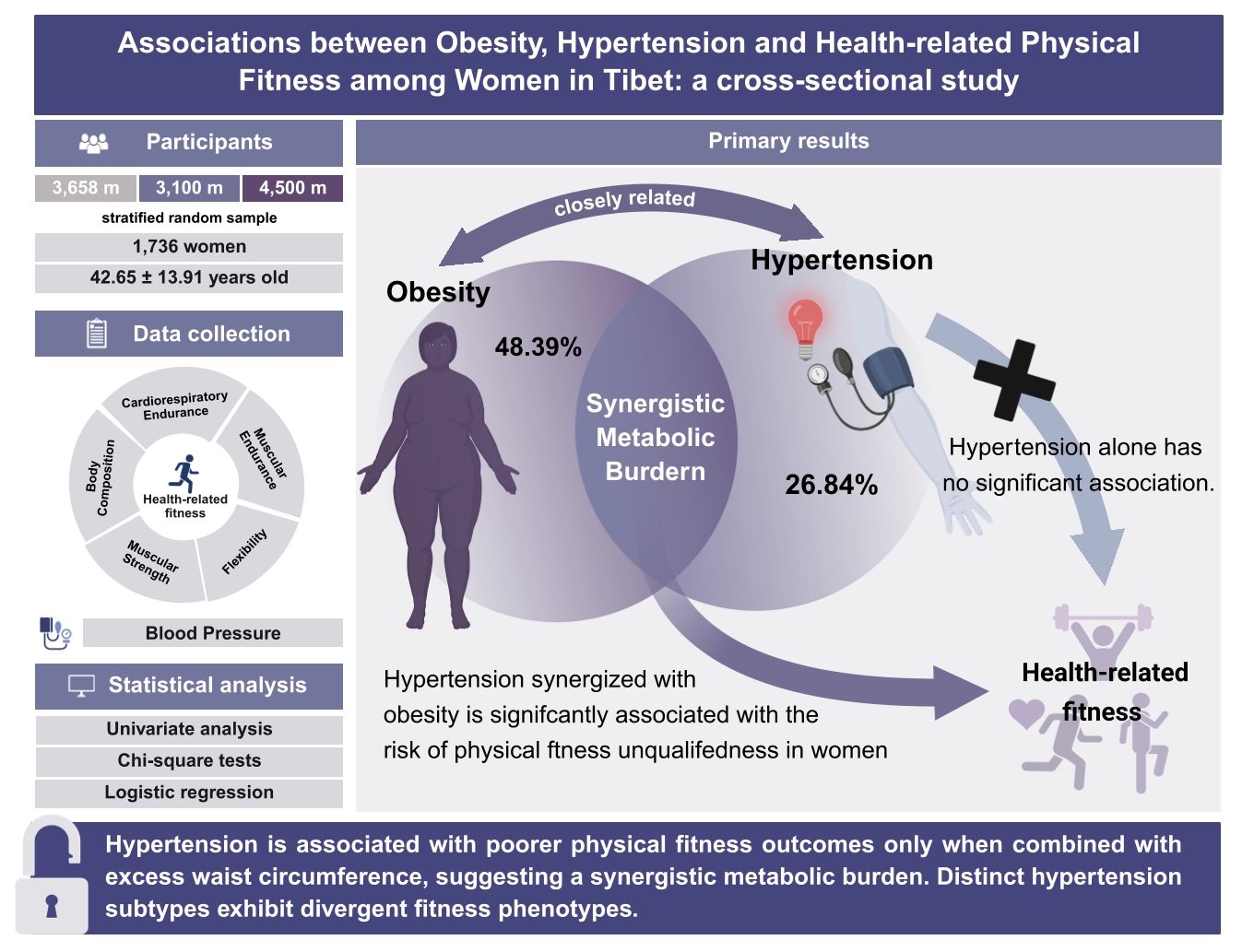
Objectives: To investigate the relationship between hypertension, obesity, and physical health in women at high altitude, and to identify modifiable associated factors. Methods: This cross-sectional study included 1736 women residing in Tibet aged 20–69 years from three altitudinal regions. Anthropometry, blood pressure, and health-related physical fitness (body composition, cardiorespiratory endurance, muscle strength, muscle endurance, flexibility) were measured. Group differences were examined using chi-square tests and one-way ANOVA, and binary logistic regression was used to identify factors associated with hypertension, obesity, and HPF qualification status. Results: Hypertension and obesity were highly prevalent. Regular exercise and higher education were independently associated with lower odds of both obesity and hypertension. Hypertension alone was not associated with an increased risk of physical unfitness; however, its co-presence with obesity was associated with a markedly elevated risk of unfitness. Conclusions: Hypertension alone was not significantly associated with unqualified HPF status, whereas the co-presence of hypertension and excess waist circumference was associated with poorer HPF outcomes. Different hypertension subtypes showed distinct patterns of association with selected HPF indicators. Regular exercise and higher education were associated with lower odds of obesity, hypertension, or unqualified HPF status. Integrated strategies targeting both adiposity and blood pressure are essential for metabolic health in high-altitude populations.
- Open Access
- Article
Associations of Obesity and Hypertension with Health-Related Physical Fitness among Women Living in Tibet: A Cross-Sectional Study
- Ting Chen 1,†,
- Jiaqiao Zhang 2,†,
- Xin Zhao 3,
- Jiajuan Wang 1,
- Xiaocan Li 1,
- Yaohan Peng 1,
- Dandan Jia 2,*
Author Information
Received: 13 Feb 2026 | Revised: 28 Apr 2026 | Accepted: 15 Jun 2026 | Published: 20 Aug 2026
Abstract
Graphical Abstract
Keywords
Tibetan women | hypertension | obesity | health-related physical fitness
References
- 1.
The State Council Information Office of the People’s Republic of China. Human Rights in Xizang in the New Era; State Council Information Office of the People’s Republic of China: Beijing, China, 2025. (In Chinese)
- 2.
National Health Commission of the People’s Republic of China. Statistical Bulletin of China’s Health Development in 2023. Chin. J. Viral. Dis. 2024, 14, 416–424. https://doi.org/10.16505/j.2095-0136.2024.0083. (In Chinese)
- 3.
Peng, W.; Li, K.; Yan, A.F.; Shi, Z.; Zhang, J.; Cheskin, L.J.; Hussain, A.; Wang, Y. Prevalence, Management, and Associated Factors of Obesity, Hypertension, and Diabetes in Tibetan Population Compared with China Overall. Int. J. Environ. Res. Public Health 2022, 19, 8787. https://doi.org/10.3390/ijerph19148787.
- 4.
Li, T.; Shuai, P.; Wang, J.; Wang, L. Prevalence, Awareness, Treatment and Control of Hypertension among Ngawa Tibetans in China: A Cross-Sectional Study. BMJ Open 2021, 11, e052207. https://doi.org/10.1136/bmjopen-2021-052207.
- 5.
Hu, J.; Thompson, B.; Wang, S.; Guo, M.; Yan, C.; Ding, F.; Guo, P.; Chen, L.; Cao, Z.; Wang, J. Rate and Risk Factors of Metabolic Components and Component Combinations according to Hypertension Status in Tibetans in a Cross-Sectional Study. Medicine 2022, 101, e31320. https://doi.org/10.1097/md.0000000000031320.
- 6.
Joint Committee for Guideline Revision. 2018 Chinese Guidelines for Prevention and Treatment of Hypertension—A report of the Revision Committee of Chinese Guidelines for Prevention and Treatment of Hypertension. J. Geriatr. Cardiol. 2019, 16, 182–241. https://doi.org/10.11909/j.issn.1671-5411.2019.03.014.
- 7.
Yuan, Z.; Zou, Y.; Liu, X.; Wang, L.; Chen, C. Longitudinal Study on Blood and Biochemical Indexes of Tibetan and Han in High Altitude Area. Front. Public Health 2023, 11, 1282051. https://doi.org/10.3389/fpubh.2023.1282051.
- 8.
Huang, X.; Hu, Y.; Du, L.; Lin, X.; Wu, W.; Fan, L.; Li, L.; Zhong, X.; Gong, Q.; Gao, L.; et al. Metabolic Syndrome in Native Populations Living at High Altitude: A Cross-Sectional Survey in Derong, China. BMJ Open 2020, 10, e032840. https://doi.org/10.1136/bmjopen-2019-032840.
- 9.
Li, W.; Li, X.; Huang, T.; Chen, Y.; Zhang, H.; Dai, H.; Wen, Y. Normative Reference Data for Body Composition in Healthy Indigenous Populations on the Qinghai-Tibet Plateau. Front. Public Health 2022, 10, 986720. https://doi.org/10.3389/fpubh.2022.986720.
- 10.
Jian, W.; Zhang, B.; Ma, Y.; Tang, X.; Nguyen, T.T.; Lv, M.; Meng, X.; Li, T.; Sun, X.; Wang, Y.; et al. Validation of Measurement of Body Composition by dual-energy X-ray Absorptiometry and Bioelectrical Impedance Analysis and Body Composition’s Profiling in Tibetan’s Adults. Public Health Nutr. 2025, 28, e96. https://doi.org/10.1017/s1368980025000291.
- 11.
Zhang, Y.; Sun, J.; Zhao, M.; Magnussen, C.; Xi, B. Prevalence of Thinness, Overweight and Obesity among Tibetan Adolescents Aged 12–17 years. Public Health Nutr. 2021, 24, 4017–4022. https://doi.org/10.1017/s1368980021000215.
- 12.
Yeung, F.; Kwok, T.; Helmer, C.; Woo, J.; Kwan, M.; Yuan, H. Nutritional Status of Older Tibetans in Rural Sichuan China. J. Nutr. Health Aging 2004, 8, 220–224.
- 13.
Xu, J.; Xiang, Q.; Lin, G.-P.; Fu, X.; Zhou, K.; Jiang, P.; Zheng, S.; Wang, T. Estrogen Improved Metabolic Syndrome Through Down-Regulation of VEGF and HIF-1α to Inhibit Hypoxia of Periaortic and Intra-Abdominal Fat in Ovariectomized Female Rats. Mol. Biol. Rep. 2012, 39, 8177–8185. https://doi.org/10.1007/s11033-012-1665-1.
- 14.
Liguori, G. ACSM’s Health-Related Physical Fitness Assessment Manual; Wolters Kluwer: Hong Kong, China, 2018.
- 15.
Patel, S.A.; Deepa, M.; Shivashankar, R.; Ali, M.K.; Kapoor, D.; Gupta, R.; Lall, D.; Tandon, N.; Mohan, V.; Kadir, M.M.; et al. Comparison of Multiple Obesity Indices for Cardiovascular Disease Risk Classification in South Asian adults: The CARRS Study. PLoS ONE 2017, 12, e0174251. https://doi.org/10.1371/journal.pone.0174251.
- 16.
Luo, W.; Zhang, Y.; Liu, X.; Yan, Y.; Zhang, W.; Ke, S.; Zhao, S.; Yuan, T.; Wang, L.; Yang, M.; et al. Association between Health-related Physical Fitness and Incident Hypertension among the Elderly in Wuhan: A Seven-year Cohort Study. BMC Public Health 2025, 25, 4342. https://doi.org/10.1186/s12889-025-25635-3.
- 17.
General Administration of Sport of China. National Physical Fitness Measurement Standards Manual; People’s Sports Publishing House: Beijing, China, 2003. (In Chinese)
- 18.
The National Health Commission of the People’s Republic of China. Health Industry Standards of the People’s Republic of China—Criteria of Weight for Adults; The National Health Commission of the People’s Republic of China: Beijing, China, 2013. (In Chinese)
- 19.
Mingji, C.; Onakpoya, I.J.; Perera, R.; Ward, A.M.; Heneghan, C.J. Relationship Between Altitude and the Prevalence of Hypertension in Tibet: A Systematic Review. Heart 2015, 101, 1054–1060. https://doi.org/10.1136/heartjnl-2014-307158.
- 20.
Marsh, M.L.; Oliveira, M.N.; Vieira-Potter, V.J. Adipocyte Metabolism and Health after the Menopause: The Role of Exercise. Nutrients 2023, 15, 444. https://doi.org/10.3390/nu15020444.
- 21.
Chen, Y.; Peng, Q.; Yang, Y.; Zheng, S.; Wang, Y.; Lu, W. The Prevalence and Increasing Trends of Overweight, General Obesity, and Abdominal Obesity among Chinese Adults: A Repeated Cross-Sectional Study. BMC Public Health 2019, 19, 1293. https://doi.org/10.1186/s12889-019-7633-0.
- 22.
Dupuit, M.; Maillard, F.; Pereira, B.; Marquezi, M.L.; Lancha, A.H., Jr.; Boisseau, N. Effect of High Intensity Interval Training on Body Composition in Women before and after Menopause: A Meta-Analysis. Exp. Physiol. 2020, 105, 1470–1490. https://doi.org/10.1113/ep088654.
- 23.
Liang, H.; Yan, J.; Song, K. Comprehensive Lipidomic Analysis Reveals Regulation of Glyceride Metabolism in Rat Visceral Adipose Tissue by High-altitude Chronic Hypoxia. PLoS ONE 2022, 17, e0267513. https://doi.org/10.1371/journal.pone.0267513.
- 24.
Palmer, B.; Clegg, D. The Sexual Dimorphism of Obesity. Mol. Cell. Endocrinol. 2015, 402, 113–119. https://doi.org/10.1016/j.mce.2014.11.029.
- 25.
Li, H.; Du, W.; Huang, C.; Zhang, M. Health-Related Physical Fitness Associated with Hypertension Risk in Adults Living in Sub-Plateau Environments. J. Clin. Hypertens. 2025, 27, e70184. https://doi.org/10.1111/jch.70184.
- 26.
Grassi, G.; Pisano, A.; Bolignano, D.; Seravalle, G.; D’Arrigo, G.; Quarti-Trevano, F.; Mallamaci, F.; Zoccali, C.; Mancia, G. Sympathetic Nerve Traffic Activation in Essential Hypertension and Its Correlates: Systematic Reviews and Meta-Analyses. Hypertension 2018, 72, 483–491. https://doi.org/10.1161/hypertensionaha.118.11038.
- 27.
Geissler, D.; Lison, A.; Schulze, C. Relevance of Body Weight Adaptation and Modern Obesity-defining Parameters in the Analysis of Isokinetic Trunk Strength in People with Obesity—A Retrospective Analysis. Clin. Obes. 2025, 15, e12736. https://doi.org/10.1111/cob.12736.
- 28.
Son, W.M.; Park, J.J. Resistance Band Exercise Training Prevents the Progression of Metabolic Syndrome in Obese Postmenopausal Women. J. Sports Sci. Med. 2021, 20, 291–299. https://doi.org/10.52082/jssm.2021.291.
- 29.
Lin, Y.Y.; Lee, S.D. Cardiovascular Benefits of Exercise Training in Postmenopausal Hypertension. Int. J. Mol. Sci. 2018, 19, 2523. https://doi.org/10.3390/ijms19092523.

This work is licensed under a Creative Commons Attribution 4.0 International License.

 Suite 4002 Level 4, 447 Collins Street, Melbourne, Victoria 3000, Australia
 General Inquiries: info@sciltp.com