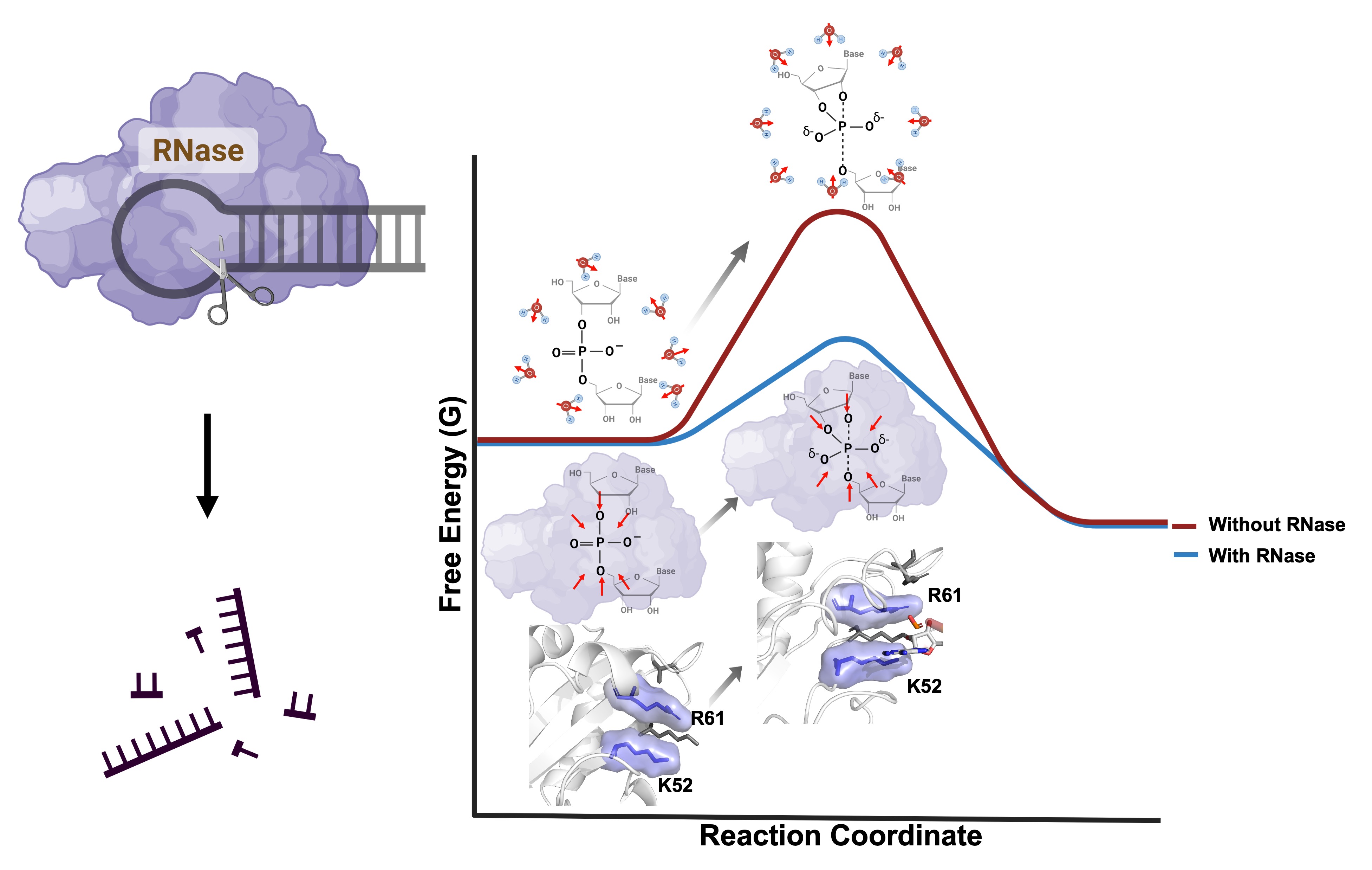
The catalytic efficiency of ribonucleases (RNases) is conventionally attributed to specific acid-base residues, metal cofactors, and conformational dynamics. Their apparent structural diversity may nevertheless reflect shared electrostatic principles that contribute to catalysis. In this review, we examine diverse RNase classes, including metal-independent, metal-dependent, and atypical toxin families, through the classic concept of electrostatic catalysis. Based on recent kinetic and thermodynamic data, such as heavy-atom kinetic isotope effects, substantial pKa shifts, and computational free energy profiles, we argue that RNase active sites can be understood as preorganized electrostatic environments that substantially contribute to catalysis. The protein scaffold rigidly positions a localized electric field to neutralize the accumulating negative charge of the pentacovalent phosphorane transition-state structure of the RNA substrate. Importantly, to avoid thermodynamic traps, natural RNases spatially segregate initial RNA recruitment from chemical catalysis. Extended cationic surfaces or accessory domains recruit the substrate by releasing its condensed counterions, driving an entropically favorable association. Decoupling long-range binding from transition-state stabilization allows these enzymes to optimize both affinity and turnover. These mechanisms may provide a conceptual framework for the rational design of artificial ribonucleases and compact, programmable biocatalysts for targeted RNA degradation.
- Open Access
- Review
An Electrostatic Re-Evaluation of Catalysis across Diverse Ribonuclease Classes
- Yongling Ying 1,2,
- Lan Zhang 1 and
- Fan Yang 1,*
Author Information
Received: 08 May 2026 | Revised: 16 June 2026 | Accepted: 20 July 2026 | Published: 03 November 2026
Abstract
Graphical Abstract
References
- 1.
Li, Z.; Deutscher, M.P. RNase E Plays an Essential Role in the Maturation of Escherichia Coli tRNA Precursors. RNA 2002, 8, 97–109. https://doi.org/10.1017/s1355838202014929.
- 2.
Li, Z.; Pandit, S.; Deutscher, M.P. RNase G (CafA Protein) and RNase E Are Both Required for the 5′ Maturation of 16S Ribosomal RNA. EMBO J. 1999, 18, 2878–2885. https://doi.org/10.1093/emboj/18.10.2878.
- 3.
Frank, D.N.; Pace, N.R. Ribonuclease P: Unity and Diversity in a tRNA Processing Ribozyme. Annu. Rev. Biochem. 1998, 67, 153–180. https://doi.org/10.1146/annurev.biochem.67.1.153.
- 4.
Bisbal, C.; Silverman, R.H. Diverse Functions of RNase L and Implications in Pathology. Biochimie 2007, 89, 789–798. https://doi.org/10.1016/j.biochi.2007.02.006.
- 5.
Chen, C.; Deutscher, M.P. Elevation of RNase R in Response to Multiple Stress Conditions. J. Biol. Chem. 2005, 280, 34393–34396. https://doi.org/10.1074/jbc.C500333200.
- 6.
Rosenberg, H.F. RNase A Ribonucleases and Host Defense: An Evolving Story. J. Leukoc. Biol. 2008, 83, 1079–1087. https://doi.org/10.1189/jlb.1107725.
- 7.
Thompson, J.E.; Kutateladze, T.G.; Schuster, M.C.; Venegas, F.D.; Messmore, J.M.; Raines, R.T. Limits to Catalysis by Ribonuclease A. Bioorg. Chem. 1995, 23, 471–481.
- 8.
Sun, D.; Han, C.; Sheng, J. The Role of Human Ribonuclease A Family in Health and Diseases: A Systematic Review. iScience 2022, 25, 105284. https://doi.org/10.1016/j.isci.2022.105284.
- 9.
Crow, Y.J.; Leitch, A.; Hayward, B.E.; Garner, A.; Parmar, R.; Griffith, E.; Ali, M.; Semple, C.; Aicardi, J.; Babul-hirji, R.; et al. Mutations in Genes Encoding Ribonuclease H2 Subunits Cause Aicardi-Goutieres Syndrome and Mimic Congenital Viral Brain Infection. Nat. Genet. 2006, 38, 910–916. https://doi.org/10.1038/ng1842.
- 10.
Arraiano, C.M.; Andrade, J.M.; Domingues, S.; Guinote, I.B.; Malecki, M.; Matos, R.G.; Moreira, R.N.; Pobre, V.; Reis, F.P.; Saramago, M.; et al. The Critical Role of RNA Processing and Degradation in the Control of Gene Expression. FEMS Microbiol. Rev. 2010, 34, 883–923. https://doi.org/10.1111/j.1574-6976.2010.00242.x.
- 11.
Garneau, N.L.; Wilusz, J.; Wilusz, C.J. The Highways and Byways of mRNA Decay. Nat. Rev. Mol. Cell Biol. 2007, 8, 113–126. https://doi.org/10.1038/nrm2104.
- 12.
Parker, R.; Song, H. The Enzymes and Control of Eukaryotic mRNA Turnover. Nat. Struct. Mol. Biol. 2004, 11, 121–127. https://doi.org/10.1038/nsmb724.
- 13.
Chakrabarti, A.; Jha, B.K.; Silverman, R.H. New Insights into the Role of RNase L in Innate Immunity. J. Interf. Cytokine Res. 2011, 31, 49–57. https://doi.org/10.1089/jir.2010.0120.
- 14.
Boix, E.; Acquati, F.; Leonidas, D.; Pulido, D. Editorial: Role of Ribonucleases in Immune Response Regulation During Infection and Cancer. Front. Immunol. 2020, 11, 236. https://doi.org/10.3389/fimmu.2020.00236.
- 15.
Nunes, I.V.; Breitenbach, L.; Pawusch, S.; Eigenbrod, T.; Ananth, S.; Schad, P.; Fackler, O.T.; Butter, F.; Dalpke, A.H.; Chen, L.S. Bacterial RNA Sensing by TLR8 Requires RNase 6 Processing and Is Inhibited by RNA 2′O-Methylation. EMBO Rep. 2024, 25, 4674–4692. https://doi.org/10.1038/s44319-024-00281-9.
- 16.
Abudayyeh, O.O.; Gootenberg, J.S.; Konermann, S.; Joung, J.; Slaymaker, I.M.; Cox, D.B.T.; Shmakov, S.; Makarova, K.S.; Semenova, E.; Minakhin, L.; et al. C2c2 Is a Single-Component Programmable RNA-Guided RNA-Targeting CRISPR Effector. Science 2016, 353, aaf5573. https://doi.org/10.1126/science.aaf5573.
- 17.
Kellner, M.J.; Koob, J.G.; Gootenberg, J.S.; Abudayyeh, O.O.; Zhang, F. SHERLOCK: Nucleic Acid Detection with CRISPR Nucleases. Nat. Protoc. 2019, 14, 2986–3012. https://doi.org/10.1038/s41596-019-0210-2.
- 18.
Costales, M.G.; Matsumoto, Y.; Velagapudi, S.P.; Disney, M.D. Small Molecule Targeted Recruitment of a Nuclease to RNA. J. Am. Chem. Soc. 2018, 140, 6741–6744. https://doi.org/10.1021/jacs.8b01233.
- 19.
Song, Y.; Cui, J.; Zhu, J.; Kim, B.; Kuo, M.L.; Potts, P.R. RNATACs: Multispecific Small Molecules Targeting RNA by Induced Proximity. Cell Chem. Biol. 2024, 31, 1101–1117. https://doi.org/10.1016/j.chembiol.2024.05.006.
- 20.
Cuchillo, C.M.; Nogués, M.V.; Raines, R.T. Bovine Pancreatic Ribonuclease: Fifty Years of the First Enzymatic Reaction Mechanism. Biochemistry 2011, 50, 7835–7841. https://doi.org/10.1021/bi201075b.
- 21.
Yoshida, H. The Ribonuclease T1 Family. Methods Enzymol. 2001, 341, 28–41. https://doi.org/10.1016/S0076-6879(01)41143-8.
- 22.
Loverix, S.; Winqvist, A.; Strömberg, R.; Steyaert, J. Mechanism of RNase T1: Concerted Triester-like Phosphoryl Transfer via a Catalytic Three-Centered Hydrogen Bond. Chem. Biol. 2000, 7, 651–658. https://doi.org/10.1016/S1074-5521(00)00005-3.
- 23.
Hyjek, M.; Figiel, M.; Nowotny, M. RNases H: Structure and Mechanism. DNA Repair 2019, 84, 102672. https://doi.org/10.1016/j.dnarep.2019.102672.
- 24.
MacRae, I.J.; Doudna, J.A. Ribonuclease Revisited: Structural Insights into Ribonuclease III Family Enzymes. Curr. Opin. Struct. Biol. 2007, 17, 138–145. https://doi.org/10.1016/j.sbi.2006.12.002.
- 25.
Nicholson, A.W. Ribonuclease III Mechanisms of Double-Stranded RNA Cleavage. Wiley Interdiscip. Rev. RNA 2014, 5, 31–48. https://doi.org/10.1002/wrna.1195.
- 26.
Howard, M.J.; Lim, W.H.; Fierke, C.A.; Koutmos, M. Mitochondrial Ribonuclease P Structure Provides Insight into the Evolution of Catalytic Strategies for Precursor-tRNA 5′ Processing. Proc. Natl. Acad. Sci. USA 2012, 109, 16149–16154. https://doi.org/10.1073/pnas.1209062109.
- 27.
Nowotny, M.; Gaidamakov, S.A.; Crouch, R.J.; Yang, W. Crystal Structures of RNase H Bound to an RNA/DNA Hybrid: Substrate Specificity and Metal-Dependent Catalysis. Cell 2005, 121, 1005–1016. https://doi.org/10.1016/j.cell.2005.04.024.
- 28.
Steitz, T.A.; Steitz, J.A. A General Two-Metal-Ion Mechanism for Catalytic RNA. Proc. Natl. Acad. Sci. USA 1993, 90, 6498–6502. https://doi.org/10.1073/pnas.90.14.6498.
- 29.
Warshel, A.; Sharma, P.K.; Kato, M.; Xiang, Y.; Liu, H.; Olsson, M.H.M. Electrostatic Basis for Enzyme Catalysis. Chem. Rev. 2006, 106, 3210–3235. https://doi.org/10.1021/cr0503106.
- 30.
Fried, S.D.; Boxer, S.G. Electric Fields and Enzyme Catalysis. Annu. Rev. Biochem. 2017, 86, 387–415. https://doi.org/10.1146/annurev-biochem-061516-044432.
- 31.
Ruiz-Pernía, J.J.; Świderek, K.; Bertran, J.; Moliner, V.; Tuñón, I. Electrostatics as a Guiding Principle in Understanding and Designing Enzymes. J. Chem. Theory Comput. 2024, 20, 1783–1795. https://doi.org/10.1021/acs.jctc.3c01395.
- 32.
Eberhart, M.E.; Wilson, T.R.; Johnston, N.W.; Alexandrova, A.N. Geometry of Charge Density as a Reporter on the Role of the Protein Scaffold in Enzymatic Catalysis: Electrostatic Preorganization and Beyond. J. Chem. Theory Comput. 2023, 19, 694–704. https://doi.org/10.1021/acs.jctc.2c01060.
- 33.
Kamerlin, S.C.L.; Warshel, A. At the Dawn of the 21st Century: Is Dynamics the Missing Link for Understanding Enzyme Catalysis. Proteins Struct. Funct. Bioinforma. 2010, 78, 1339–1375. https://doi.org/10.1002/prot.22654.
- 34.
Fried, S.D.; Bagchi, S.; Boxer, S.G. Measuring Electrostatic Fields in Both Hydrogen-Bonding and Non-Hydrogen-Bonding Environments Using Carbonyl Vibrational Probes. J. Am. Chem. Soc. 2013, 135, 11181–11192. https://doi.org/10.1021/ja403917z.
- 35.
Kellerman, D.L.; York, D.M.; Piccirilli, J.A.; Harris, M.E. Altered (Transition) States: Mechanisms of Solution and Enzyme Catalyzed RNA 2′-O-Transphosphorylation. Curr. Opin. Chem. Biol. 2014, 21, 96–102. https://doi.org/10.1016/j.cbpa.2014.06.010.
- 36.
Thompson, J.E.; Raines, R.T. Value of General Acid-Base Catalysis to Ribonuclease A. J. Am. Chem. Soc. 1994, 116, 5467–5468.
- 37.
Avey, H.P.; Boles, M.O.; Carlisle, C.H.; Evans, S.A.; Morris, S.J.; Palmer, R.A.; Woolhouse, B.A.; Shall, S. Structure of Ribonuclease. Nature 1967, 213, 557–562. https://doi.org/10.1038/213557a0.
- 38.
Gu, H.; Zhang, S.; Wong, K.Y.; Radak, B.K.; Dissanayake, T.; Kellerman, D.L.; Dai, Q.; Miyagi, M.; Anderson, V.E.; York, D.M.; et al. Experimental and Computational Analysis of the Transition State for Ribonuclease A-Catalyzed RNA 2′-O-Transphosphorylation. Proc. Natl. Acad. Sci. USA 2013, 110, 13002–13007. https://doi.org/10.1073/pnas.1215086110.
- 39.
Fisher, B.M.; Ha, J.; Raines, R.T. Coulombic Forces in Protein-RNA Interactions: Binding and Cleavage by Ribonuclease A and Variants at Lys7, Arg10, and Lys66. Biochemistry 1998, 37, 12121–12132.
- 40.
Fedor, M.J.; Williamson, J.R. The Catalytic Diversity of RNAs. Nat. Rev. Mol. Cell Biol. 2005, 6, 399–412. https://doi.org/10.1038/nrm1647.
- 41.
Messmore, J.M.; Raines, R.T. Pentavalent Organo-Vanadates as Transition State Analogues for Phosphoryl Transfer Reactions. J. Am. Chem. Soc. 2000, 122, 9911–9916. https://doi.org/10.1021/ja0021058.
- 42.
Raines, R.T. Ribonuclease A. Chem. Rev. 1998, 98, 1045–1065.
- 43.
Arni, R.K.; Watanabe, L.; Ward, R.J.; Kreitman, R.J.; Kumar, K.; Walz, F.G. Three-Dimensional Structure of Ribonuclease T1 Complexed with an Isosteric Phosphonate Substrate Analogue of GpU: Alternate Substrate Binding Modes and Catalysis. Biochemistry 1999, 38, 2452–2461. https://doi.org/10.1021/bi982612q.
- 44.
Ahsan, M.; Pindi, C.; Palermo, G. Emerging Mechanisms of Metal-Catalyzed RNA and DNA Modifications. Annu. Rev. Phys. Chem. 2025, 76, 497–518. https://doi.org/10.1146/annurev-physchem-082423-030241.
- 45.
Palermo, G.; Cavalli, A.; Klein, M.L.; Alfonso-Prieto, M.; Dal Peraro, M.; De Vivo, M. Catalytic Metal Ions and Enzymatic Processing of DNA and RNA. Acc. Chem. Res. 2015, 48, 220–228. https://doi.org/10.1021/ar500314j.
- 46.
Rosta, E.; Yang, W.; Hummer, G. Calcium Inhibition of Ribonuclease H1 Two-Metal Ion Catalysis. J. Am. Chem. Soc. 2014, 136, 3137–3144. https://doi.org/10.1021/ja411408x.
- 47.
Zhao, Y.; Lu, M.; Zhang, H.; Hu, J.; Zhou, C.; Xu, Q.; Ul Hussain Shah, A.M.; Xu, H.; Wang, L.; Hua, Y. Structural Insights into Catalysis and Dimerization Enhanced Exonuclease Activity of RNase J. Nucleic Acids Res. 2015, 43, 5550–5559. https://doi.org/10.1093/nar/gkv444.
- 48.
Sun, W.; Pertzev, A.; Nicholson, A.W. Catalytic Mechanism of Escherichia Coli Ribonuclease III: Kinetic and Inhibitor Evidence for the Involvement of Two Magnesium Ions in RNA Phosphodiester Hydrolysis. Nucleic Acids Res. 2005, 33, 807–815. https://doi.org/10.1093/nar/gki197.
- 49.
Sun, W.; Li, G.; Nicholson, A.W. Mutational Analysis of the Nuclease Domain of Escherichia Coli Ribonuclease III. Identification of Conserved Acidic Residues That Are Important for Catalytic Function in Vitro. Biochemistry 2004, 43, 13054–13062. https://doi.org/10.1021/bi049258i.
- 50.
De Vivo, M.; Dal Peraro, M.; Klein, M.L. Phosphodiester Cleavage in Ribonuclease H Occurs via an Associative Two-Metal-Aided Catalytic Mechanism. J. Am. Chem. Soc. 2008, 130, 10955–10962. https://doi.org/10.1021/ja8005786.
- 51.
Rosta, E.; Nowotny, M.; Yang, W.; Hummer, G. Catalytic Mechanism of RNA Backbone Cleavage by Ribonuclease H from Quantum Mechanics / Molecular Mechanics Simulations. J. Am. Chem. Soc. 2011, 133, 8934–8941. https://doi.org/10.1021/ja200173a.
- 52.
Steitz, T.A. A Mechanism for All Polymerases. Nature 1998, 391, 231–232.
- 53.
Borišek, J.; Aupič, J.; Magistrato, A. Third Metal Ion Dictates the Catalytic Activity of the Two-Metal-Ion Pre-Ribosomal RNA-Processing Machinery. Angew. Chemie Int. Ed. 2024, 63, e202405819. https://doi.org/10.1002/anie.202405819.
- 54.
Samara, N.L.; Yang, W. Cation Trafficking Propels RNA Hydrolysis. Nat. Struct. Mol. Biol. 2018, 25, 715–721. https://doi.org/10.1038/s41594-018-0099-4.
- 55.
Griffin, M.A.; Davis, J.H.; Strobel, S.A. Bacterial Toxin RelE: A Highly Efficient Ribonuclease with Exquisite Substrate Specificity Using Atypical Catalytic Residues. Biochemistry 2013, 52, 8633–8642. https://doi.org/10.1021/bi401325c.
- 56.
Neubauer, C.; Gao, Y.G.; Andersen, K.R.; Dunham, C.M.; Kelley, A.C.; Hentschel, J.; Gerdes, K.; Ramakrishnan, V.; Brodersen, D.E. The Structural Basis for mRNA Recognition and Cleavage by the Ribosome-Dependent Endonuclease RelE. Cell 2009, 139, 1084–1095. https://doi.org/10.1016/j.cell.2009.11.015.
- 57.
Dunican, B.F.; Hiller, D.A.; Strobel, S.A. Transition State Charge Stabilization and Acid-Base Catalysis of mRNA Cleavage by the Endoribonuclease RelE. Biochemistry 2015, 54, 7048–7057. https://doi.org/10.1021/acs.biochem.5b00866.
- 58.
Hiller, D.A.; Dunican, B.F.; Nallur, S.; Li, N.S.; Piccirilli, J.A.; Strobel, S.A. The Positively Charged Active Site of the Bacterial Toxin RelE Causes a Large Shift in the General Base PKa. Biochemistry 2020, 59, 1665–1671. https://doi.org/10.1021/acs.biochem.9b01047.
- 59.
Haruki, M.; Tsunaka, Y.; Morikawa, M.; Iwai, S.; Kanaya, S. Catalysis by Escherichia Coli Ribonuclease HI Is Facilitated by a Phosphate Group of the Substrate. Biochemistry 2000, 39, 13939–13944.
- 60.
Abdur, R.; Gerlits, O.O.; Gan, J.; Jiang, J.; Salon, J.; Kovalevsky, A.Y.; Chumanevich, A.A.; Weber, I.T.; Huang, Z. Novel Complex MAD Phasing and RNase H Structural Insights Using Selenium Oligonucleotides. Acta Crystallogr. Sect. D Biol. Crystallogr. 2014, 70, 354–361. https://doi.org/10.1107/S1399004713027922.
- 61.
Domachowske, J.B.; Dyer, K.D.; Adams, A.G.; Leto, T.L.; Rosenberg, H.F. Eosinophil Cationic Protein/RNase 3 Is Another RNase A-Family Ribonuclease with Direct Antiviral Activity. Nucleic Acids Res. 1998, 26, 3358–3363. https://doi.org/10.1093/nar/26.14.3358.
- 62.
Mallorquí-Fernández, G.; Pous, J.; Peracaula, R.; Aymamí, J.; Maeda, T.; Tada, H.; Yamada, H.; Seno, M.; De Llorens, R.; Gomis-Rüth, F.X.; et al. Three-Dimensional Crystal Structure of Human Eosinophil Cationic Protein (RNase 3) at 1.75 Å Resolution. J. Mol. Biol. 2000, 300, 1297–1307. https://doi.org/10.1006/jmbi.2000.3939.
- 63.
Zhang, J.; Dyer, K.D.; Rosenberg, H.F. Human RNase 7: A New Cationic Ribonuclease of the RNase A Superfamily. Nucleic Acids Res. 2003, 31, 602–607. https://doi.org/10.1093/nar/gkg157.
- 64.
Wang, H.; Schwaderer, A.L.; Kline, J.; Spencer, J.D.; Kline, D.; Hainsa, D.S. Contribution of Structural Domains to the Activity of Ribonuclease 7 against Uropathogenic Bacteria. Antimicrob. Agents Chemother. 2013, 57, 766–774. https://doi.org/10.1128/AAC.01378-12.
- 65.
Huang, Y.C.; Lin, Y.M.; Chang, T.W.; Wu, S.J.; Lee, Y.S.; Chang, M.D.T.; Chen, C.; Wu, S.H.; Liao, Y. Di. The Flexible and Clustered Lysine Residues of Human Ribonuclease 7 Are Critical for Membrane Permeability and Antimicrobial Activity. J. Biol. Chem. 2007, 282, 4626–4633. https://doi.org/10.1074/jbc.M607321200.
- 66.
Liang, Y.H.; Lavoie, M.; Comeau, M.A.; Elela, S.A.; Ji, X. Structure of a Eukaryotic RNase III Postcleavage Complex Reveals a Double-Ruler Mechanism for Substrate Selection. Mol. Cell 2014, 54, 431–444. https://doi.org/10.1016/j.molcel.2014.03.006.
- 67.
MacRae, I.J.; Zhou, K.; Li, F.; Repic, A.; Brooks, A.N.; Cande, W.Z.; Adams, P.D.; Doudna, J.A. Structural Basis for Double-Stranded RNA Processing by Dicer. Science 2006, 311, 195–198. https://doi.org/10.1126/science.1121638.
- 68.
Kwon, S.C.; Nguyen, T.A.; Choi, Y.-G.; Jo, M.H.; Hohng, S.; Kim, V.N.; Woo, J.-S. Structure of Human DROSHA. Cell 2016, 164, 81–90. https://doi.org/10.1016/j.cell.2015.12.019.
- 69.
Partin, A.C.; Zhang, K.; Jeong, B.C.; Herrell, E.; Li, S.; Chiu, W.; Nam, Y. Cryo-EM Structures of Human Drosha and DGCR8 in Complex with Primary microRNA. Mol. Cell 2020, 78, 411-422.e4. https://doi.org/10.1016/j.molcel.2020.02.016.
- 70.
Callaghan, A.J.; Marcaida, M.J.; Stead, J.A.; McDowall, K.J.; Scott, W.G.; Luisi, B.F. Structure of Escherichia Coli RNase E Catalytic Domain and Implications for RNA Turnover. Nature 2005, 437, 1187–1191. https://doi.org/10.1038/nature04084.
- 71.
Jinek, M.; Coyle, S.M.; Doudna, J.A. Coupled 5′ Nucleotide Recognition and Processivity in Xrn1-Mediated mRNA Decay. Mol. Cell 2011, 41, 600–608. https://doi.org/10.1016/j.molcel.2011.02.004.
- 72.
Stevens, A.; Poole, T.L. 5′-Exonuclease-2 of Saccharomyces Cerevisiae. J. Biol. Chem. 1995, 270, 16063–16069. https://doi.org/10.1074/jbc.270.27.16063.
- 73.
Stevens, A. 5′-Exoribonuclease 1: Xrn 1. Methods Enzymol. 2001, 342, 251–259. https://doi.org/10.1016/S0076-6879(01)42549-3.
- 74.
Chamberlain, A.R.; Huynh, L.; Huang, W.; Taylor, D.J.; Harris, M.E. The Specificity Landscape of Bacterial Ribonuclease P. J. Biol. Chem. 2024, 300, 105498. https://doi.org/10.1016/j.jbc.2023.105498.
- 75.
Lan, P.; Tan, M.; Zhang, Y.; Niu, S.; Chen, J.; Shi, S.; Qiu, S.; Wang, X.; Peng, X.; Cai, G.; et al. Structural Insight into Precursor tRNA Processing by Yeast Ribonuclease P. Science, 2018, 362, eaat6678. https://doi.org/10.1126/science.aat6678.
- 76.
Wang, P.; Lin, J.; Zheng, X.; Xu, X. RNase P: Beyond Precursor tRNA Processing. Genom. Proteom. Bioinforma. 2024, 22, qzae016. https://doi.org/10.1093/gpbjnl/qzae016.
- 77.
Tambe, A.; East-Seletsky, A.; Knott, G.J.; Doudna, J.A.; O’Connell, M.R. RNA Binding and HEPN-Nuclease Activation Are Decoupled in CRISPR-Cas13a. Cell Rep. 2018, 24, 1025–1036. https://doi.org/10.1016/j.celrep.2018.06.105.
- 78.
Yan, W.X.; Hunnewell, P.; Alfonse, L.E.; Carte, J.M.; Keston-Smith, E.; Sothiselvam, S.; Garrity, A.J.; Chong, S.; Makarova, K.S.; Koonin, E.V.; et al. Functionally Diverse Type V CRISPR-Cas Systems. Science 2019, 363, 88–91. https://doi.org/10.1126/science.aav7271.
- 79.
Charlesworth, C.T.; Deshpande, P.S.; Dever, D.P.; Camarena, J.; Lemgart, V.T.; Cromer, M.K.; Vakulskas, C.A.; Collingwood, M.A.; Zhang, L.; Bode, N.M.; et al. Identification of Preexisting Adaptive Immunity to Cas9 Proteins in Humans. Nat. Med. 2019, 25, 249–254. https://doi.org/10.1038/s41591-018-0326-x.
- 80.
Wagner, D.L.; Amini, L.; Wendering, D.J.; Burkhardt, L.M.; Akyüz, L.; Reinke, P.; Volk, H.D.; Schmueck-Henneresse, M. High Prevalence of Streptococcus Pyogenes Cas9-Reactive T Cells within the Adult Human Population. Nat. Med. 2019, 25, 242–248. https://doi.org/10.1038/s41591-018-0204-6.
- 81.
Mehta, A.; Merkel, O.M. Immunogenicity of Cas9 Protein. J. Pharm. Sci. 2020, 109, 62–67. https://doi.org/10.1016/j.xphs.2019.10.003.
- 82.
Ruseska, I.; Zimmer, A. Internalization Mechanisms of Cell-Penetrating Peptides. Beilstein J. Nanotechnol. 2020, 11, 101–123. https://doi.org/10.3762/bjnano.11.10.
- 83.
Perr, J.; Langen, A.; Almahayni, K.; Mo, L.; Zaro, B.W.; Flynn, R.A. RNA-Binding Proteins and GlycoRNAs Form Domains on the Cell Surface for Cell-Penetrating Peptide Entry. Cell 2025, 188, 1878-1895.e25. https://doi.org/10.1016/j.cell.2025.01.040.


This work is licensed under a Creative Commons Attribution 4.0 International License.