
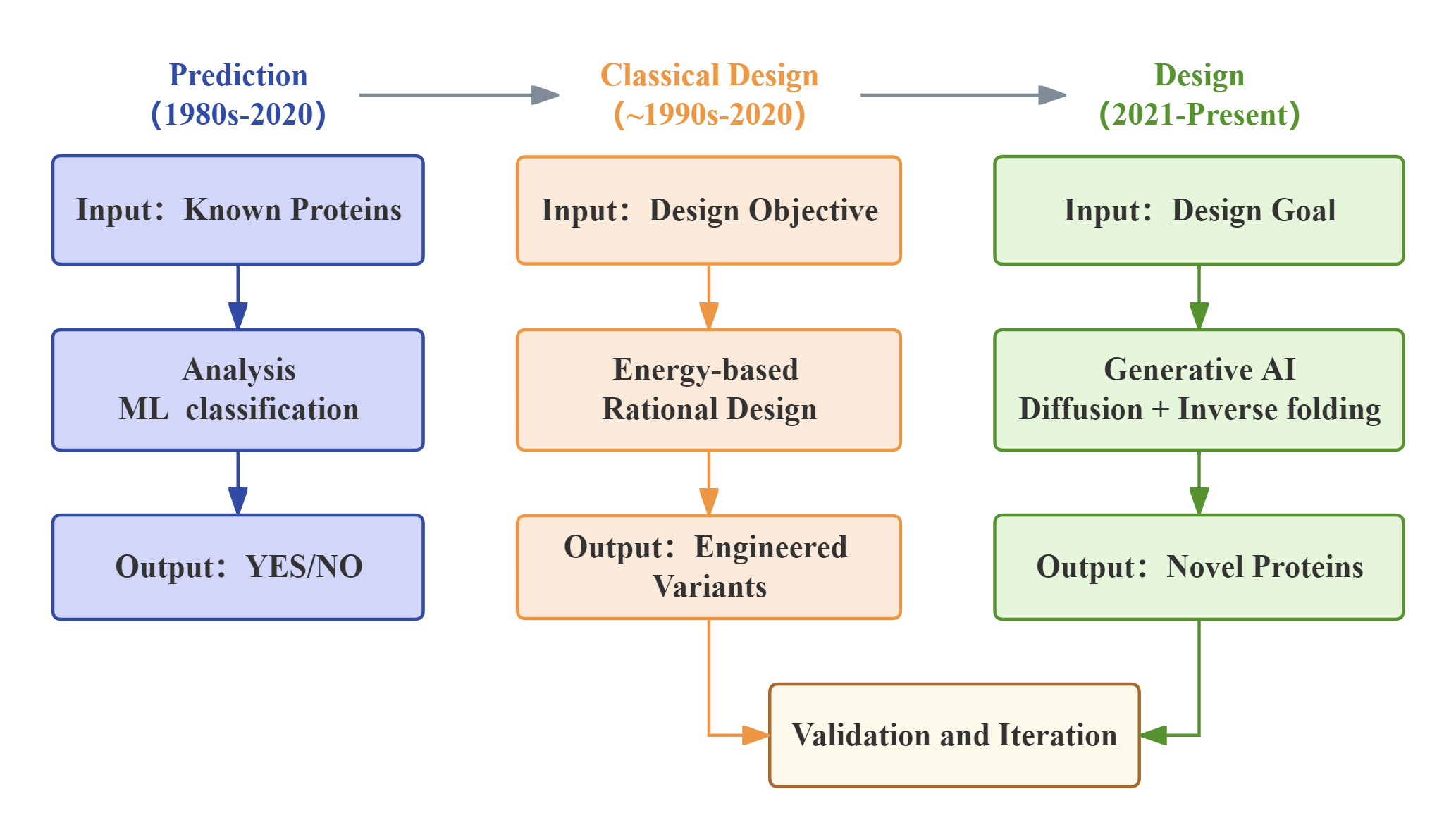
Protein-protein interactions (PPIs) form the molecular foundation of cellular life. Over the past two decades, computational methods for PPI analysis have primarily focused on prediction—inferring interaction properties from protein information. However, a notable conceptual shift is underway away from predictive analysis and toward rational protein interaction design. This transformation is driven by breakthroughs in protein language models, diffusion models, and equivariant neural networks. In this review, we discuss how this transition represents a notable conceptual shift, enabling exploration of sequence-structure space that evolution has never sampled. We synthesize the technical foundations, core design tasks, and challenges ahead. We address critical issues including evaluation bias, the hallucination problem, and dual-use considerations. We conclude with grand challenges for the field: mapping design ability boundaries, designing dynamic interactions, and developing interpretable methods for clinical translation. We further describe how modern AI reshapes computational approaches for biological discovery.
- Open Access
- Review
From Prediction to Design: A Paradigm Shift in AI-Driven Protein–Protein Interaction Research
- Yihuang Wu,
- Wei Hu and
- Linlin Zhao *
Author Information
Received: 16 June 2026 | Revised: 14 August 2026 | Accepted: 17 August 2026 | Published: 23 October 2026
Abstract
Graphical Abstract
Keywords
protein-protein interactions | protein design | deep learning | generative models | diffusion models | protein language models
References
- 1.
Szklarczyk, D.; Gable, A.L.; Lyon, D.; Junge, A.; Wyder, S.; Huerta-Cepas, J.; Simonovic, M.; Doncheva, N.T.; Morris, J.H.; Bork, P.; et al. STRING v11: Protein–Protein Association Networks with Increased Coverage, Supporting Functional Discovery in Genome-Wide Experimental Datasets. Nucleic Acids Res. 2019, 47, D607–D613. https://doi.org/10.1093/nar/gky1131.
- 2.
Rehman, A.U.; Khurshid, B.; Ali, Y.; Rasheed, S.; Wadood, A.; Ng, H.J.; Chen, H.Y.; Wei, Z.; Luo, R.; Zhang, J. Computational Approaches for the Design of Modulators Targeting Protein–Protein Interactions. Expert Opin. Drug Discov. 2023, 18, 315–333. https://doi.org/10.1080/17460441.2023.2171396.
- 3.
Sahni, N.; Yi, S.; Taipale, M.; Fuxman Bass, J.I.; Coulombe-Huntington, J.; Yang, F.; Peng, J.; Weile, J.; Karras, G.I.; Wang, Y.; et al. Widespread Macromolecular Interaction Perturbations in Human Genetic Disorders. Cell 2015, 161, 647–660. https://doi.org/10.1016/j.cell.2015.04.013.
- 4.
Chen, M.; Ju, C.J.T.; Zhou, G.; Chen, X.; Zhang, T.; Chang, K.W.; Zaniolo, C.; Wang, W. Multifaceted Protein–Protein Interaction Prediction Based on Siamese Residual RCNN. Bioinformatics 2019, 35, i305–i314. https://doi.org/10.1093/bioinformatics/btz328.
- 5.
Sledzieski, S.; Singh, R.; Cowen, L.; Berger, B. D-Script Translates Genome to Phenome with Sequence-Based, Structure-Aware, Genome-Scale Predictions of Protein–Protein Interactions. Cell Syst. 2021, 12, 969–982.e6. https://doi.org/10.1016/j.cels.2021.08.010.
- 6.
Abramson, J.; Adler, J.; Dunger, J.; Evans, R.; Green, T.; Pritzel, A.; Ronneberger, O.; Willmore, L.; Ballard, A.J.; Bambrick, J.; et al. Accurate Structure Prediction of Biomolecular Interactions with AlphaFold 3. Nature 2024, 630, 493–500. Erratum in Nature 2024, 636, E4. https://doi.org/10.1038/s41586-024-07487-w.
- 7.
Evans, R.; O'Neill, M.; Pritzel, A.; Antropova, N.; Senior, A.; Green, T.; Žídek, A.; Bates, R.; Blackwell, S.; Yim, J.; et al. Protein Complex Prediction with AlphaFold-Multimer. bioRxiv 2021. https://doi.org/10.1101/2021.10.04.463034.
- 8.
Watson, J.L.; Juergens, D.; Bennett, N.R.; Trippe, B.L.; Yim, J.; Eisenach, H.E.; Ahern, W.; Borst, A.J.; Ragotte, R.J.; Milles, L.F.; et al. De Novo Design of Protein Structure and Function with RFdiffusion. Nature 2023, 620, 1089–1100. https://doi.org/10.1038/s41586-023-06415-8.
- 9.
Rives, A.; Meier, J.; Sercu, T.; Goyal, S.; Lin, Z.; Liu, J.; Guo, D.; Ott, M.; Zitnick, C.L.; Ma, J.; et al. Biological Structure and Function Emerge from Scaling Unsupervised Learning to 250 Million Protein Sequences. Proc. Natl. Acad. Sci. USA 2021, 118, e2016239118. https://doi.org/10.1073/pnas.2016239118.
- 10.
Lin, Z.; Akin, H.; Rao, R.; Hie, B.; Zhu, Z.; Lu, W.; Smetanin, N.; Verkuil, R.; Kabeli, O.; Shmueli, Y.; et al. Evolutionary-Scale Prediction of Atomic-Level Protein Structure with a Language Model. Science 2023, 379, 1123–1130. https://doi.org/10.1126/science.ade2574.
- 11.
Ingraham, J.B.; Baranov, M.; Costello, Z.; Barber, K.W.; Wang, W.; Ismail, A.; Frappier, V.; Lord, D.M.; Ng-Thow-Hing, C.; Van Vlack, E.R.; et al. Illuminating Protein Space with a Programmable Generative Model. Nature 2023, 623, 1070–1078. https://doi.org/10.1038/s41586-023-06728-8.
- 12.
Jing, B.; Eismann, S.; Suriana, P.; Townshend, R.J.L.; Dror, R. Learning from Protein Structure with Geometric Vector Perceptrons. arXiv 2021, arXiv:2009.01411. https://doi.org/10.48550/arxiv.2009.01411.
- 13.
Fuchs, F.B.; Worrall, D.E.; Fischer, V.; Welling, M. SE(3)-Transformers: 3D Roto-Translation Equivariant Attention Networks. arXiv 2020, arXiv:2006.10503. https://doi.org/10.48550/arxiv.2006.10503.
- 14.
Tsishyn, M.; Pucci, F.; Rooman, M. Quantification of Biases in Predictions of Protein–Protein Binding Affinity Changes upon Mutations. Brief. Bioinform. 2024, 25, bbad491. https://doi.org/10.1093/bib/bbad491.
- 15.
Bock, J.R.; Gough, D.A. Predicting Protein–Protein Interactions from Primary Structure. Bioinformatics 2001, 17, 455–460. https://doi.org/10.1093/bioinformatics/17.5.455.
- 16.
Shen, J.; Zhang, J.; Luo, X.; Zhu, W.; Yu, K.; Chen, K.; Li, Y.; Jiang, H. Predicting Protein–Protein Interactions Based Only on Sequences Information. Proc. Natl. Acad. Sci. USA 2007, 104, 4337–4341. https://doi.org/10.1073/pnas.0607879104.
- 17.
Ben-Hur, A.; Noble, W.S. Kernel Methods for Predicting Protein–Protein Interactions. Bioinformatics 2005, 21, i38–i46. https://doi.org/10.1093/bioinformatics/bti1016.
- 18.
Guo, Y.; Yu, L.; Wen, Z.; Li, M. Using Support Vector Machine Combined with Auto Covariance to Predict Protein–Protein Interactions from Protein Sequences. Nucleic Acids Res. 2008, 36, 3025–3030. https://doi.org/10.1093/nar/gkn159.
- 19.
Li, Z.W.; You, Z.H.; Chen, X.; Li, L.P.; Huang, D.S.; Yan, G.Y.; Nie, R.; Huang, Y.A. Accurate Prediction of Protein–Protein Interactions by Integrating Potential Evolutionary Information Embedded in PSSM Profile and Discriminative Vector Machine Classifier. Oncotarget 2017, 8, 23638–23649. https://doi.org/10.18632/oncotarget.15564.
- 20.
Hashemifar, S.; Neyshabur, B.; Khan, A.A.; Xu, J. Predicting Protein–Protein Interactions through Sequence-Based Deep Learning. Bioinformatics 2018, 34, i802–i810. https://doi.org/10.1093/bioinformatics/bty573.
- 21.
Gao, Z.; Jiang, C.; Zhang, J.; Jiang, X.; Li, L.; Zhao, P.; Yang, H.; Huang, Y.; Li, J. Hierarchical Graph Learning for Protein–Protein Interaction. Nat. Commun. 2023, 14, 1093. https://doi.org/10.1038/s41467-023-36736-1.
- 22.
Réau, M.; Renaud, N.; Xue, L.C.; Bonvin, A.M.J.J. DeepRank-GNN: A Graph Neural Network Framework to Learn Patterns in Protein–Protein Interfaces. Bioinformatics 2023, 39, btac759. https://doi.org/10.1093/bioinformatics/btac759.
- 23.
Ko, Y.; Parkinson, J.; Liu, C.; Wang, W. TUnA: An Uncertainty-Aware Transformer Model for Sequence-Based Protein–Protein Interaction Prediction. Brief. Bioinform. 2024, 25, bbae359. https://doi.org/10.1093/bib/bbae359.
- 24.
Song, B.; Luo, X.; Luo, X.; Liu, Y.; Niu, Z.; Zeng, X. Learning Spatial Structures of Proteins Improves Protein–Protein Interaction Prediction. Brief. Bioinform. 2022, 23, bbab558. https://doi.org/10.1093/bib/bbab558.
- 25.
Singh, R.; Devkota, K.; Sledzieski, S.; Berger, B.; Cowen, L. Topsy-Turvy: Integrating a Global View into Sequence-Based PPI Prediction. Bioinformatics 2022, 38, i264–i272. https://doi.org/10.1093/bioinformatics/btac258.
- 26.
Berman, H.M.; Westbrook, J.; Feng, Z.; Gilliland, G.; Bhat, T.N.; Weissig, H.; Shindyalov, I.N.; Bourne, P.E. The Protein Data Bank. Nucleic Acids Res. 2000, 28, 235–242. https://doi.org/10.1093/nar/28.1.235.
- 27.
Dominguez, C.; Boelens, R.; Bonvin, A.M.J.J. HADDOCK: A Protein–Protein Docking Approach Based on Biochemical or Biophysical Information. J. Am. Chem. Soc. 2003, 125, 1731–1737. https://doi.org/10.1021/ja026939x.
- 28.
Chen, R.; Li, L.; Weng, Z. ZDOCK: An Initial-Stage Protein-Docking Algorithm. Proteins 2003, 52, 80–87. https://doi.org/10.1002/prot.10389.
- 29.
Kozakov, D.; Hall, D.R.; Xia, B.; Porter, K.A.; Padhorny, D.; Yueh, C.; Beglov, D.; Vajda, S. The ClusPro Web Server for Protein–Protein Docking. Nat. Protoc. 2017, 12, 255–278. https://doi.org/10.1038/nprot.2016.169.
- 30.
Yan, Y.; Zhang, D.; Zhou, P.; Li, B.; Huang, S.Y. HDOCK: A Web Server for Protein–Protein and Protein–DNA/RNA Docking Based on a Hybrid Strategy. Nucleic Acids Res. 2017, 45, W365–W373. https://doi.org/10.1093/nar/gkx407.
- 31.
Park, T.; Baek, M.; Lee, H.; Seok, C. GalaxyTongDock: Symmetric and Asymmetric Ab Initio Protein–Protein Docking Web Server with Improved Energy Parameters. J. Comput. Chem. 2019, 40, 2413–2417. https://doi.org/10.1002/jcc.25874.
- 32.
Gainza, P.; Sverrisson, F.; Monti, F.; Rodolà, E.; Boscaini, D.; Bronstein, M.M.; Correia, B.E. Deciphering Interaction Fingerprints from Protein Molecular Surfaces Using Geometric Deep Learning. Nat. Methods 2020, 17, 184–192. https://doi.org/10.1038/s41592-019-0666-6.
- 33.
Yuan, Q.; Chen, J.; Zhao, H.; Zhou, Y.; Yang, Y. Structure-Aware Protein–Protein Interaction Site Prediction Using Deep Graph Convolutional Network. Bioinformatics 2022, 38, 125–132. https://doi.org/10.1093/bioinformatics/btab643.
- 34.
Sverrisson, F.; Feydy, J.; Correia, B.E.; Bronstein, M. Fast End-to-End Learning on Protein Surfaces. In Proceedings of the 2021 IEEE/CVF Conference on Computer Vision and Pattern Recognition (CVPR), Virtual Event, 20–25 June 2021.
- 35.
Tubiana, J.; Schneidman-Duhovny, D.; Wolfson, H.J. ScanNet: An Interpretable Geometric Deep Learning Model for Structure-Based Protein Binding Site Prediction. Nat. Methods 2022, 19, 730–739. https://doi.org/10.1038/s41592-022-01490-7.
- 36.
Bryant, P.; Pozzati, G.; Elofsson, A. Improved Prediction of Protein–Protein Interactions Using Alphafold2. Nat. Commun. 2022, 13, 1265. Erratum in Nat. Commun. 2022, 13, 1694. https://doi.org/10.1038/s41467-022-28865-w.
- 37.
Guerois, R.; Nielsen, J.E.; Serrano, L. Predicting Changes in the Stability of Proteins and Protein Complexes: A Study of More than 1000 Mutations. J. Mol. Biol. 2002, 320, 369–387. https://doi.org/10.1016/s0022-2836(02)00442-4.
- 38.
Jankauskaitė, J.; Jiménez-García, B.; Dapkūnas, J.; Fernández-Recio, J.; Moal, I.H. SKEMPI 2.0: An Updated Benchmark of Changes in Protein–Protein Binding Energy, Kinetics and Thermodynamics upon Mutation. Bioinformatics 2019, 35, 462–469. https://doi.org/10.1093/bioinformatics/bty635.
- 39.
Ketata, M.A.; Laue, C.; Mammadov, R.; Stärk, H.; Wu, M.; Corso, G.; Marquet, C.L.; Barzilay, R.; Jaakkola, T.S. DiffDock-PP: Rigid Protein–Protein Docking with Diffusion Models. arXiv 2023, arXiv:2304.03889. https://doi.org/10.48550/arxiv.2304.03889.
- 40.
Kewalramani, N.; Emili, A.; Crovella, M. State‐of‐the‐Art Computational Methods to Predict Protein–Protein Interactions with High Accuracy and Coverage. Proteomics 2023, 23, e2200292. https://doi.org/10.1002/pmic.202200292.
- 41.
Smialowski, P.; Pagel, P.; Wong, P.; Brauner, B.; Dunger, I.; Fobo, G.; Frishman, G.; Montrone, C.; Rattei, T.; Frishman, D.; et al. The Negatome Database: A Reference Set of Non-Interacting Protein Pairs. Nucleic Acids Res. 2010, 38, D540–D544. https://doi.org/10.1093/nar/gkp1026.
- 42.
Blohm, P.; Frishman, G.; Smialowski, P.; Goebels, F.; Wachinger, B.; Ruepp, A.; Frishman, D. Negatome 2.0: A Database of Non-Interacting Proteins Derived by Literature Mining, Manual Annotation and Protein Structure Analysis. Nucleic Acids Res. 2014, 42, D396–D400. https://doi.org/10.1093/nar/gkt1079.
- 43.
Huttlin, E.L.; Bruckner, R.J.; Navarrete-Perea, J.; Cannon, J.R.; Baltier, K.; Gebreab, F.; Gygi, M.P.; Thornock, A.; Zarraga, G.; Tam, S.; et al. Dual Proteome-Scale Networks Reveal Cell-Specific Remodeling of the Human Interactome. Cell 2021, 184, 3022–3040.e28. https://doi.org/10.1016/j.cell.2021.04.011.
- 44.
Orchard, S.; Ammari, M.; Aranda, B.; Breuza, L.; Briganti, L.; Broackes-Carter, F.; Campbell, N.H.; Chavali, G.; Chen, C.; del-Toro, N.; et al. The MIntAct Project—IntAct as a Common Curation Platform for 11 Molecular Interaction Databases. Nucleic Acids Res. 2014, 42, D358–D363. https://doi.org/10.1093/nar/gkt1115.
- 45.
Hu, X.; Feng, C.; Ling, T.; Chen, M. Deep Learning Frameworks for Protein–Protein Interaction Prediction. Comput. Struct. Biotechnol. J. 2022, 20, 3223–3233. https://doi.org/10.1016/j.csbj.2022.06.025.
- 46.
Davis, M.J.; Shin, C.J.; Jing, N.; Ragan, M.A. Rewiring the Dynamic Interactome. Mol. Biosyst. 2012, 8, 2054–2066. https://doi.org/10.1039/c2mb25050k.
- 47.
Jumper, J.; Evans, R.; Pritzel, A.; Green, T.; Figurnov, M.; Ronneberger, O.; Tunyasuvunakool, K.; Bates, R.; Žídek, A.; Potapenko, A.; et al. Highly Accurate Protein Structure Prediction with AlphaFold. Nature 2021, 596, 583–589. https://doi.org/10.1038/s41586-021-03819-2.
- 48.
Baek, M.; DiMaio, F.; Anishchenko, I.; Dauparas, J.; Ovchinnikov, S.; Lee, G.R.; Wang, J.; Cong, Q.; Kinch, L.N.; Schaeffer, R.D.; et al. Accurate Prediction of Protein Structures and Interactions Using a Three-Track Neural Network. Science 2021, 373, 871–876. https://doi.org/10.1126/science.abj8754.
- 49.
Krishna, R.; Wang, J.; Ahern, W.; Sturmfels, P.; Venkatesh, P.; Kalvet, I.; Lee, G.R.; Morey-Burrows, F.S.; Anishchenko, I.; Humphreys, I.R.; et al. Generalized Biomolecular Modeling and Design with RoseTTAFold All-Atom. Science 2024, 384, eadl2528. https://doi.org/10.1126/science.adl2528.
- 50.
Bose, A.J.; Akhound-Sadegh, T.; Huguet, G.; Fatras, K.; Rector-Brooks, J.; Liu, C.H.; Nica, A.C.; Korablyov, M.; Bronstein, M.M.; Tong, A. SE(3) Stochastic Flow Matching for Protein Backbone Generation. In Proceedings of the 12th International Conference on Learning Representations, ICLR 2024, Vienna, Austria, 7–11 May 2024.
- 51.
Ullanat, V.; Jing, B.; Sledzieski, S.; Berger, B. Learning the Language of Protein–Protein Interactions. Nat. Commun. 2026, 17, 1199. https://doi.org/10.1038/s41467-025-67971-3.
- 52.
Liu, D.; Young, F.; Lamb, K.D.; Claudio Quiros, A.; Pancheva, A.; Miller, C.J.; Macdonald, C.; Robertson, D.L.; Yuan, K. PLM-Interact: Extending Protein Language Models to Predict Protein–Protein Interactions. Nat. Commun. 2025, 16, 9012. https://doi.org/10.1038/s41467-025-64512-w.
- 53.
Zambaldi, V.; La, D.; Chu, A.E.; Patani, H.; Danson, A.E.; Kwan, T.O.C.; Frerix, T.; Schneider, R.G.; Saxton, D.; Thillaisundaram, A.; et al. De Novo Design of High-Affinity Protein Binders with AlphaProteo. arXiv 2024, arXiv:2409.08022. https://doi.org/10.48550/arxiv.2409.08022.
- 54.
Dauparas, J.; Anishchenko, I.; Bennett, N.; Bai, H.; Ragotte, R.J.; Milles, L.F.; Wicky, B.I.M.; Courbet, A.; de Haas, R.J.; Bethel, N.; et al. Robust Deep Learning–Based Protein Sequence Design Using ProteinMPNN. Science 2022, 378, 49–56. https://doi.org/10.1126/science.add2187.
- 55.
Hsu, C.; Verkuil, R.; Liu, J.; Lin, Z.; Hie, B.; Sercu, T.; Lerer, A.; Rives, A. Learning Inverse Folding from Millions of Predicted Structures. In Proceedings of the 39th International Conference on Machine Learning, ICML 2022, Baltimore, MD, USA, 17–23 July 2022.
- 56.
Kortemme, T. De Novo Protein Design—from New Structures to Programmable Functions. Cell 2024, 187, 526–544. https://doi.org/10.1016/j.cell.2023.12.028.
- 57.
Garcia, M.; Dixit, S.M.; Rocklin, G.J. Evaluating Zero‐Shot Prediction of Monomeric Protein Design Success by AlphaFold, ESMFold, and ProteinMPNN. Protein Sci. 2026, 35, e70453. https://doi.org/10.1002/pro.70453.
- 58.
Sircar, A.; Kim, E.T.; Gray, J.J. RosettaAntibody: Antibody Variable Region Homology Modeling Server. Nucleic Acids Res. 2009, 37, W474–W479. https://doi.org/10.1093/nar/gkp387.
- 59.
Ruffolo, J.A.; Sulam, J.; Gray, J.J. Antibody Structure Prediction Using Interpretable Deep Learning. Patterns 2022, 3, 100406. https://doi.org/10.1016/j.patter.2021.100406.
- 60.
Ruffolo, J.A.; Chu, L.; Mahajan, S.; Gray, J.J. Fast, Accurate Antibody Structure Prediction from Deep Learning on Massive Set of Natural Antibodies. Nat. Commun. 2023, 14, 2389. https://doi.org/10.1038/s41467-023-38063-x.
- 61.
Kenlay, H.; Dreyer, F.A.; Cutting, D.; Nissley, D.; Deane, C.M. ABodyBuilder3: Improved and Scalable Antibody Structure Predictions. Bioinformatics 2024, 40, btae576. https://doi.org/10.1093/bioinformatics/btae576.
- 62.
Abanades, B.; Wong, W.K.; Boyles, F.; Georges, G.; Bujotzek, A.; Deane, C.M. ImmuneBuilder: Deep-Learning Models for Predicting the Structures of Immune Proteins. Commun. Biol. 2023, 6, 575. https://doi.org/10.1038/s42003-023-04927-7.
- 63.
Gao, M.; Skolnick, J. Improved Deep Learning Prediction of Antigen-Antibody Interactions. Proc. Natl. Acad. Sci. USA 2024, 121, e2410529121. https://doi.org/10.1073/pnas.2410529121.
- 64.
Raybould, M.I.J.; Marks, C.; Krawczyk, K.; Taddese, B.; Nowak, J.; Lewis, A.P.; Bujotzek, A.; Shi, J.; Deane, C.M. Five Computational Developability Guidelines for Therapeutic Antibody Profiling. Proc. Natl. Acad. Sci. USA 2019, 116, 4025–4030. https://doi.org/10.1073/pnas.1810576116.
- 65.
Deng, J.; Gu, M.; Zhang, P.; Dong, M.; Liu, T.; Zhang, Y.; Liu, M. Nanobody–Antigen Interaction Prediction with Ensemble Deep Learning and Prompt-Based Protein Language Models. Nat. Mach. Intell. 2024, 6, 1594–1604. https://doi.org/10.1038/s42256-024-00940-5.
- 66.
Barlow, K.A.; Ó Conchúir, S.; Thompson, S.; Suresh, P.; Lucas, J.E.; Heinonen, M.; Kortemme, T. Flex ddG: Rosetta Ensemble-Based Estimation of Changes in Protein–Protein Binding Affinity upon Mutation. J. Phys. Chem. B 2018, 122, 5389–5399. https://doi.org/10.1021/acs.jpcb.7b11367.
- 67.
Rodrigues, C.H.; Myung, Y.; Pires, D.E.; Ascher, D.B. mCSM-PPI2: Predicting the Effects of Mutations on Protein–Protein Interactions. Nucleic Acids Res. 2019, 47, W338–W344. https://doi.org/10.1093/nar/gkz383.
- 68.
Liu, X.; Luo, Y.; Li, P.; Song, S.; Peng, J. Deep Geometric Representations for Modeling Effects of Mutations on Protein–Protein Binding Affinity. PLoS Comput. Biol. 2021, 17, e1009284.
- 69.
Dehouck, Y.; Kwasigroch, J.M.; Rooman, M.; Gilis, D. BeAtMuSiC: Prediction of Changes in Protein–Protein Binding Affinity on Mutations. Nucleic Acids Res. 2013, 41, W333–W339. https://doi.org/10.1093/nar/gkt450.
- 70.
Huang, X.; Zheng, W.; Pearce, R.; Zhang, Y. SSIPe: Accurately Estimating Protein–Protein Binding Affinity Change upon Mutations Using Evolutionary Profiles in Combination with an Optimized Physical Energy Function. Bioinformatics 2020, 36, 2429–2437. https://doi.org/10.1093/bioinformatics/btz926.
- 71.
Yu, G.; Zhao, Q.; Bi, X.; Wang, J. DDAffinity: Predicting the Changes in Binding Affinity of Multiple Point Mutations Using Protein 3D Structure. Bioinformatics 2024, 40, i418–i427. https://doi.org/10.1093/bioinformatics/btae232.
- 72.
Xu, X.; Zhang, H.; Liu, Q.; Cheng, Q.; Guo, Y.; Yang, W.; Chen, X. SSIF-Affinity: Multimodal Deep Learning of Sequence-Structure Features for Precise Protein–Protein Binding Affinity Prediction. J. Chem. Inf. Model. 2026, 66, 74–87. https://doi.org/10.1021/acs.jcim.5c01734.
- 73.
Cho, Y.; Dauparas, J.; Tsuboyama, K.; Rocklin, G.; Ovchinnikov, S. Implicit Modeling of the Conformational Landscape and Sequence Allows Scoring and Generation of Stable Proteins. bioRxiv 2024. https://doi.org/10.1101/2024.12.20.629706.
- 74.
Ho, J.; Jain, A.; Abbeel, P. Denoising Diffusion Probabilistic Models. In Proceedings of the 34th Conference on Neural Information Processing Systems, NeurIPS 2020, Virtual Event, 6–12 December 2020.
- 75.
Yim, J.; Trippe, B.L.; De Bortoli, V.; Mathieu, E.; Doucet, A.; Barzilay, R.; Jaakkola, T. SE(3) Diffusion Model with Application to Protein Backbone Generation. In Proceedings of the 40th International Conference on Machine Learning, Honolulu, HI, USA, 23–29 July 2023.
- 76.
Krapp, L.F.; Abriata, L.A.; Rodriguez, F.C.; Dal Peraro, M. PeSTo: Parameter-Free Geometric Deep Learning for Accurate Prediction of Protein Binding Interfaces. Nat. Commun. 2023, 14, 2175. https://doi.org/10.1038/s41467-023-37701-8.
- 77.
Elnaggar, A.; Heinzinger, M.; Dallago, C.; Rehawi, G.; Wang, Y.; Jones, L.; Gibbs, T.; Feher, T.; Angerer, C.; Steinegger, M.; et al. ProtTrans: Toward Understanding the Language of Life through Self-Supervised Learning. IEEE Trans. Pattern Anal. Mach. Intell. 2022, 44, 7112–7127. https://doi.org/10.1109/tpami.2021.3095381.
- 78.
Chen, B.; Cheng, X.; Li, P.; Geng, Y.A.; Gong, J.; Li, S.; Bei, Z.; Tan, X.; Wang, B.; Zeng, X.; et al. xTrimoPGLM: Unified 100B-Scale Pre-Trained Transformer for Deciphering the Language of Protein. arXiv 2024, arXiv:2401.06199. https://doi.org/10.48550/arxiv.2401.06199.
- 79.
Kalifa, D.; Singer, U.; Radinsky, K. GoProteinGNN: Leveraging Protein Knowledge Graphs for Protein Representation Learning. arXiv 2024, arXiv:2408.00057. https://doi.org/10.48550/arxiv.2408.00057.
- 80.
Su, J.; Han, C.; Zhou, Y.; Shan, J.; Zhou, X.; Yuan, F. SaProt: Protein Language Modeling with Structure-Aware Vocabulary. In Proceedings of the 12th International Conference on Learning Representations, ICLR 2024, Vienna, Austria, 7–11 May 2024.
- 81.
Schmirler, R.; Heinzinger, M.; Rost, B. Fine-Tuning Protein Language Models Boosts Predictions Across Diverse Tasks. Nat. Commun. 2024, 15, 7407. https://doi.org/10.1038/s41467-024-51844-2.
- 82.
Salwinski, L.; Miller, C.S.; Smith, A.J.; Pettit, F.K.; Bowie, J.U.; Eisenberg, D. The Database of Interacting Proteins: 2004 Update. Nucleic Acids Res. 2004, 32, D449–D451. https://doi.org/10.1093/nar/gkh086.
- 83.
Chatr-aryamontri, A.; Ceol, A.; Palazzi, L.M.; Nardelli, G.; Schneider, M.V.; Castagnoli, L.; Cesareni, G. MINT: The Molecular Interaction Database. Nucleic Acids Res. 2007, 35, D572–D574. https://doi.org/10.1093/nar/gkl950.
- 84.
Trepte, P.; Secker, C.; Olivet, J.; Blavier, J.; Kostova, S.; Maseko, S.B.; Minia, I.; Silva Ramos, E.; Cassonnet, P.; Golusik, S.; et al. AI-guided Pipeline for Protein–Protein Interaction Drug Discovery Identifies a SARS-CoV-2 Inhibitor. Mol. Syst. Biol. 2024, 20, 428–457. https://doi.org/10.1038/s44320-024-00019-8.
- 85.
Barducci, A.; Bussi, G.; Parrinello, M. Well-Tempered Metadynamics: A Smoothly Converging and Tunable Free-Energy Method. Phys. Rev. Lett. 2008, 100, 020603. https://doi.org/10.1103/physrevlett.100.020603.
- 86.
Sugita, Y.; Okamoto, Y. Replica-Exchange Molecular Dynamics Method for Protein Folding. Chem. Phys. Lett. 1999, 314, 141–151. https://doi.org/10.1016/s0009-2614(99)01123-9.
- 87.
Jussupow, A.; Kaila, V.R.I. Effective Molecular Dynamics from Neural Network-Based Structure Prediction Models. J. Chem. Theory Comput. 2023, 19, 1965–1975. https://doi.org/10.1021/acs.jctc.2c01027.
- 88.
Huang, S.Y.; Zou, X. Efficient Molecular Docking of NMR Structures: Application to HIV‐1 Protease. Protein Sci. 2007, 16, 43–51. https://doi.org/10.1110/ps.062501507.
- 89.
Tunyasuvunakool, K.; Adler, J.; Wu, Z.; Green, T.; Zielinski, M.; Žídek, A.; Bridgland, A.; Cowie, A.; Meyer, C.; Laydon, A.; et al. Highly Accurate Protein Structure Prediction for the Human Proteome. Nature 2021, 596, 590–596. https://doi.org/10.1038/s41586-021-03828-1.
- 90.
National Research Council. Biotechnology Research in an Age of Terrorism; National Academies Press: Washington, DC, USA, 2004. https://doi.org/10.17226/10827.
- 91.
Sockolosky, J.T.; Trotta, E.; Parisi, G.; Picton, L.; Su, L.L.; Le, A.C.; Chhabra, A.; Silveria, S.L.; George, B.M.; King, I.C.; et al. Selective Targeting of Engineered T Cells Using Orthogonal IL-2 Cytokine-Receptor Complexes. Science 2018, 359, 1037–1042. https://doi.org/10.1126/science.aar3246.
- 92.
Overwijk, W.; Tagliaferri, M.; Zalevsky, J. Engineering IL-2 to Give New Life to T Cell Immunotherapy. Annu. Rev. Med. 2021, 72, 281–311. https://doi.org/10.1146/annurev-med-073118-011031.
- 93.
Saini, J.P.S.; Thakur, A.; Yadav, D. AI-driven Innovations in Pharmaceuticals: Optimizing Drug Discovery and Industry Operations. RSC Pharm. 2025, 2, 437–454. https://doi.org/10.1039/d4pm00323c.
- 94.
Wang, Y.; Wei, T.; Zhao, M.; Huang, A.; Sun, F.; Chen, L.; Lin, R.; Xie, Y.; Zhang, M.; Xu, S.; et al. Alkenyl Oxindole Is a Novel PROTAC Moiety that Recruits the CRL4DCAF11 E3 Ubiquitin Ligase Complex for Targeted Protein Degradation. PLoS Biol. 2024, 22, e3002550. https://doi.org/10.1371/journal.pbio.3002550.
- 95.
Shan, K.S.; Musleh Ud Din, S.; Dalal, S.; Gonzalez, T.; Dalal, M.; Ferraro, P.; Hussein, A.; Vulfovich, M. Bispecific Antibodies in Solid Tumors: Advances and Challenges. Int. J. Mol. Sci. 2025, 26, 5838. https://doi.org/10.3390/ijms26125838.
- 96.
Wouters, O.J.; McKee, M.; Luyten, J. Estimated Research and Development Investment Needed to Bring a New Medicine to Market, 2009–2018. JAMA 2020, 323, 844–853. Erratum in JAMA 2022, 328, 1111. https://doi.org/10.1001/jama.2020.1166.
- 97.
Helma, J.; Cardoso, M.C.; Muyldermans, S.; Leonhardt, H. Nanobodies and Recombinant Binders in Cell Biology. J. Cell Biol. 2015, 209, 633–644. https://doi.org/10.1083/jcb.201409074.
- 98.
Morsut, L.; Roybal, K.T.; Xiong, X.; Gordley, R.M.; Coyle, S.M.; Thomson, M.; Lim, W.A. Engineering Customized Cell Sensing and Response Behaviors Using Synthetic Notch Receptors. Cell 2016, 164, 780–791. https://doi.org/10.1016/j.cell.2016.01.012.
- 99.
Goldenzweig, A.; Fleishman, S.J. Principles of Protein Stability and Their Application in Computational Design. Annu. Rev. Biochem. 2018, 87, 105–129. https://doi.org/10.1146/annurev-biochem-062917-012102.
- 100.
Kim, C.; Chandrasekaran, A.; Jha, A.; Ramprasad, R. Active-Learning and Materials Design: The Example of High Glass Transition Temperature Polymers. MRS Commun. 2019, 9, 860–866. https://doi.org/10.1557/mrc.2019.78.
- 101.
Hicks, D.R.; Kennedy, M.A.; Thompson, K.A.; DeWitt, M.; Coventry, B.; Kang, A.; Bera, A.K.; Brunette, T.J.; Sankaran, B.; Stoddard, B.; et al. De Novo Design of Protein Homodimers Containing Tunable Symmetric Protein Pockets. Proc. Natl. Acad. Sci. USA 2022, 119, e2113400119. https://doi.org/10.1073/pnas.2113400119.


This work is licensed under a Creative Commons Attribution 4.0 International License.
