
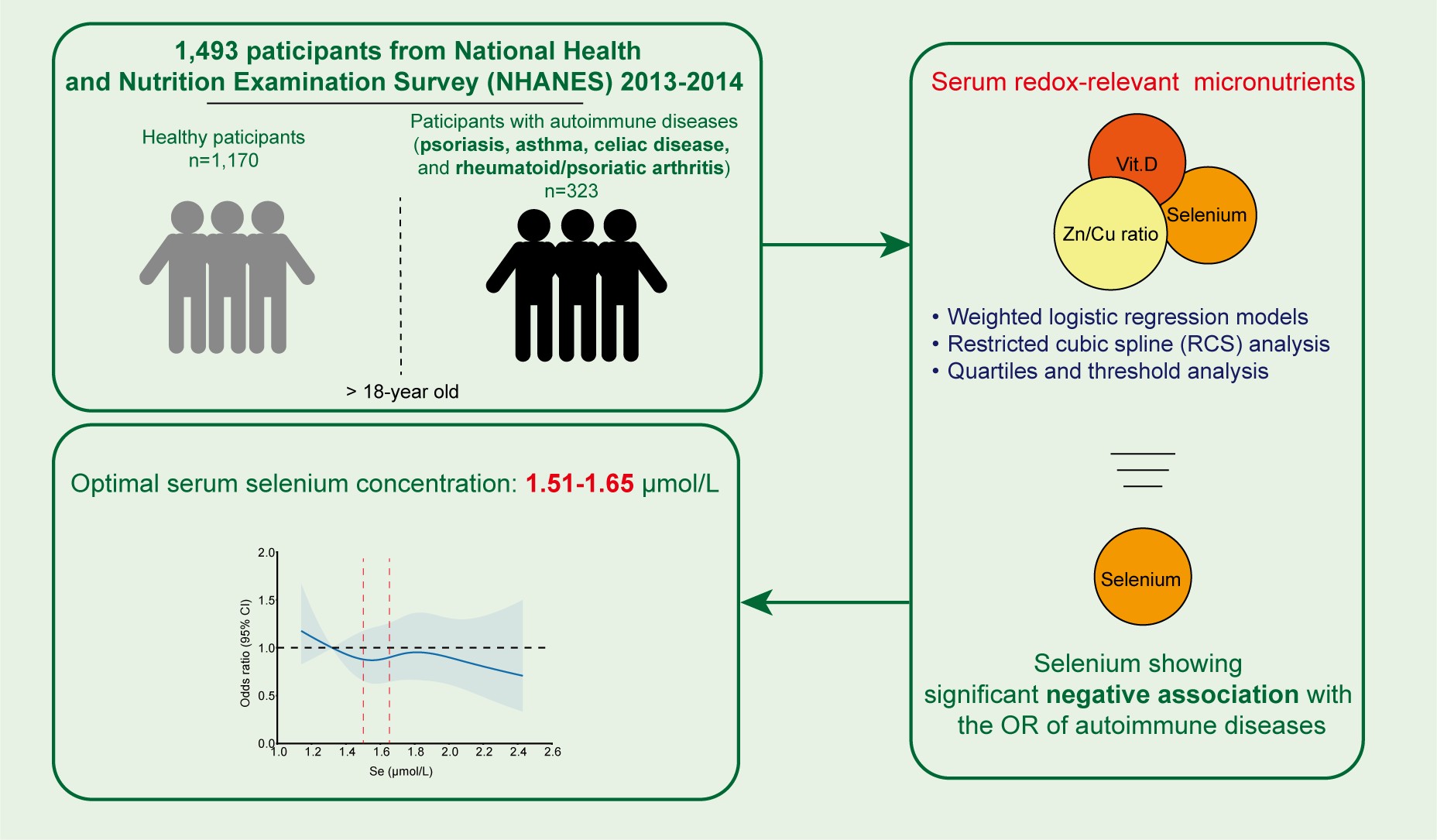
Background: Immune-mediated inflammatory diseases (IMIDs) occur when the immune system attacks the body’s own tissues, affecting approximately 8% of the global population. Objective: This study investigated the serum levels of a few redox-relevant essential micronutrients, aiming to explore their relationships with the prevalence of IMIDs and to identify the serum concentration ranges associated with the lowest observed prevalence of IMIDs. Methods: A cross-sectional study was conducted using NHANES 2013–2014 data, comprising 1493 participants. IMIDs were defined as the presence of asthma, celiac disease, psoriasis, or psoriatic/rheumatoid arthritis. Weighted binary logistic regression evaluated the association between serum selenium, vitamin D, and the zinc-to-copper ratio with the prevalence of IMIDs. We identified the serum-selenium quartile associated with the lowest observed prevalence of IMIDs in this dataset using quartile-based and threshold analyses, adjusting for smoking status, alcohol consumption, diabetes, and cancer history. Results: Higher serum selenium levels were significantly associated with a lower prevalence of IMIDs (OR: 0.627, 95% CI: 0.402–0.977). In contrast, no significant associations were observed for vitamin D or zinc-to-copper ratio. Quartile analysis revealed that individuals in the second quartile of serum selenium (1.51–1.65 μmol/L) had the lowest observed prevalence of IMIDs (18.85%), with significantly lower odds of IMIDs compared to the lowest (OR: 0.659, 95% CI: 0.447–0.971). However, sufficiency levels of vitamin D and the zinc-to-copper ratio were not significantly associated with a lower prevalence. Conclusion: The inverse association between higher serum selenium (1.51–1.65 μmol/L) and IMIDs was statistically significant in crude and partially-adjusted models but was attenuated and non-significant in the primary fully-adjusted weighted model. These findings suggest a potential observational link between selenium status and the prevalence of IMIDs that warrants further investigation.
- Open Access
- Article
The Association of Essential Micronutrients in Serum with Immune-Mediated Inflammatory Diseases: A Cross-Sectional Study from NHANES
- Shixin Tang 1,
- Muhammad Arif Asghar 2,
- Bing Wan 2,
- Xiao Zhang 2,
- Jingwei Wu 3,*,
- Jingfu Qiu 1,*,
- Qinjian Zhao 2,*
Author Information
Received: 21 Apr 2026 | Revised: 15 Sep 2026 | Accepted: 16 Sep 2026 | Published: 29 Sep 2026
Abstract
Graphical Abstract
Keywords
immune-mediated inflammatory diseases | essential micronutrients | NHANES | selenium | vitamin D | zinc-to-copper ratio
References
- 1.
Cuthrell, K.M.; Tzenios, N.; Umber, J. Burden of Autoimmune Disorders: A review. Asian J. Immunol. 2022, 6, 1–13.
- 2.
Gutierrez-Arcelus, M.; Rich, S.S.; Raychaudhuri, S. Autoimmune diseases—connecting risk alleles with molecular traits of the immune system. Nat. Rev. Genet. 2016, 17, 160–174. https://doi.org/10.1038/nrg.2015.33.
- 3.
Miller, F.W. The increasing prevalence of autoimmunity and autoimmune diseases: An urgent call to action for improved understanding, diagnosis, treatment, and prevention. Curr. Opin. Immunol. 2023, 80, 102266. https://doi.org/10.1016/j.coi.2022.102266.
- 4.
Conrad, N.; Misra, S.; Verbakel, J.Y.; Verbeke, G.; Molenberghs, G.; Taylor, P.N.; Mason, J.; Sattar, N.; McMurray, J.J.V.; McInnes, I.B.; et al. Incidence, prevalence, and co-occurrence of autoimmune disorders over time and by age, sex, and socioeconomic status: A population-based cohort study of 22 million individuals in the UK. Lancet 2023, 401, 1878–1890. https://doi.org/10.1016/s0140-6736(23)00457-9.
- 5.
Wang, L.; Wang, F.S.; Gershwin, M.E. Human autoimmune diseases: A comprehensive update. J. Intern. Med. 2015, 278, 369–395. https://doi.org/10.1111/joim.12395.
- 6.
Schett, G.; Nagy, G.; Krönke, G.; et al. B-cell depletion in autoimmune diseases. Ann. Rheum. Dis. 2024, 83, 1409–1420. https://doi.org/10.1136/ard-2024-225727.
- 7.
Ren, H.M.; Lukacher, A.E.; Rahman, Z.S.M.; Olsen, N.J. New developments implicating IL-21 in autoimmune disease. J. Autoimmun. 2021, 122, 102689. https://doi.org/10.1016/j.jaut.2021.102689.
- 8.
Dinarello, C.A. Anti-inflammatory Agents: Present and Future. Cell 2010, 140, 935–950. https://doi.org/10.1016/j.cell.2010.02.043.
- 9.
Martínez-Mateu, S.H.; Guillén, Y.; Angelats, E.; López-Lasanta, M.A.; Madonna, S.; Jiménez-Gracia, L.; Rodriguez-Nunez, I.; Álvarez-Errico, D.; Aterido, A.; Tortosa, R.; et al. Uncovering combination therapies for immune-mediated inflammatory diseases through systems biology analysis on longitudinal patient data. Cell Rep. Med. 2026, 103026. https://doi.org/10.1016/j.xcrm.2026.103026.
- 10.
Koekkoek, K.W.A.; Berger, M.M. An update on essential micronutrients in critical illness. Curr. Opin. Crit. Care 2023, 29, 315–329. https://doi.org/10.1097/mcc.0000000000001062.
- 11.
Gombart, A.F.; Pierre, A.; Maggini, S. A Review of Micronutrients and the Immune System–Working in Harmony to Reduce the Risk of Infection. Nutrients 2020, 12, 236. https://doi.org/10.3390/nu12010236.
- 12.
Zhang, Y.; Roh, Y.J.; Han, S.J.; Park, I.; Lee, H.M.; Ok, Y.S.; Lee, B.C.; Lee, S.R. Role of Selenoproteins in Redox Regulation of Signaling and the Antioxidant System: A Review. Antioxidants 2020, 9, 383. https://doi.org/10.3390/antiox9050383.
- 13.
Schomburg, L. Selenium Deficiency Due to Diet, Pregnancy, Severe Illness, or COVID-19—A Preventable Trigger for Autoimmune Disease. Int. J. Mol. Sci. 2021, 22, 8532. https://doi.org/10.3390/ijms22168532.
- 14.
Vaivode, I.; Zake, T.; Strele, I.; Upmale-Engela, S.; Gogins, D.; Gersone, G.; Skesters, A.; Dambrova, M.; Konrade, I. Stress-Related Immune Response and Selenium Status in Autoimmune Thyroid Disease Patients. Int. J. Mol. Sci. 2023, 24, 2440. https://doi.org/10.3390/ijms24032440.
- 15.
Wang, P.; Chen, B.; Huang, Y.; Li, J.; Cao, D.; Chen, Z.; Li, J.; Ran, B.; Yang, J.; Wang, R.; et al. Selenium intake and multiple health-related outcomes: An umbrella review of meta-analyses. Front. Nutr. 2023, 10, 1263853. https://doi.org/10.3389/fnut.2023.1263853.
- 16.
Diotallevi, F.; Campanati, A.; Martina, E.; Radi, G.; Paolinelli, M.; Marani, A.; Molinelli, E.; Candelora, M.; Taus, M.; Galeazzi, T.; et al. The Role of Nutrition in Immune-Mediated, Inflammatory Skin Disease: A Narrative Review. Nutrients 2022, 14, 591. https://doi.org/10.3390/nu14030591.
- 17.
Andersen, C.J.; Greco, J.M. Nutritional implications for the pathophysiology and treatment of autoimmune disorders. In Translational Autoimmunity; Elsevier: Amsterdam, The Netherlands, 2022; pp. 243–267. https://doi.org/10.1016/b978-0-12-824390-9.00003-7.
- 18.
Aranow, C. Vitamin D and the immune system. J. Investig. Med. 2011, 59, 881–886. https://doi.org/10.2310/jim.0b013e31821b8755.
- 19.
Harrison, S.R.; Li, D.; Jeffery, L.E.; Raza, K.; Hewison, M. Vitamin D, Autoimmune Disease and Rheumatoid Arthritis. Calcif. Tissue Int. 2020, 106, 58–75. https://doi.org/10.1007/s00223-019-00577-2.
- 20.
Ao, T.; Kikuta, J.; Ishii, M. The Effects of Vitamin D on Immune System and Inflammatory Diseases. Biomolecules 2021, 11, 1624. https://doi.org/10.3390/biom11111624.
- 21.
Sanlier, N.; Guney-Coskun, M. Vitamin D, the immune system, and its relationship with diseases. Egypt. Pediatr. Assoc. Gaz. 2022, 70, 39. https://doi.org/10.1186/s43054-022-00135-w.
- 22.
Ahsan, N.; Imran, M.; Mohammed, Y.; Al Anouti, F.; Khan, M.I.; Banerjee, T.; Adnan, M.; Ashfaq, F.; Kieliszek, M.; Ashraf, S.A.; et al. Mechanistic Insight into the role of Vitamin D and Zinc in Modulating Immunity Against COVID-19: A View from an Immunological Standpoint. Biol. Trace Elem. Res. 2023, 201, 5546–5560. https://doi.org/10.1007/s12011-023-03620-4.
- 23.
Lupu, V.V.; Jechel, E.; Mihai, C.M.; Mitrofan, E.C.; Lupu, A.; Starcea, I.M.; Fotea, S.; Mocanu, A.; Ghica, D.C.; Mitrofan, C.; et al. Connection between Celiac Disease and Systemic Lupus Erythematosus in Children—A Development Model of Autoimmune Diseases Starting from What We Inherit to What We Eat. Nutrients 2023, 15, 2535. https://doi.org/10.3390/nu15112535.
- 24.
Pouresmaeil, V.; Al Abudi, A.H.; Mahimid, A.H.; Sarafraz Yazdi, M.; Es-haghi, A. Evaluation of Serum Selenium and Copper Levels with Inflammatory Cytokines and Indices of Oxidative Stress in Type 2 Diabetes. Biol. Trace Elem. Res. 2023, 201, 617–626. https://doi.org/10.1007/s12011-022-03191-w.
- 25.
Moskalev, A.A. Molecular Biomarkers of Aging for Preventive Medicine. Bull. Rehabil. Med. 2017, 16, 18–29.
- 26.
National Health and Nutrition Examination Survey 2013–2014 Data Documentation, Codebook, and Frequencies. Available online: https://wwwn.cdc.gov/Nchs/Data/Nhanes/Public/2013/DataFiles/DEMO_H.htm (accessed on 23 September 2026).
- 27.
National Institutes of Health. Selenium: Health Professional Fact Sheet. Available online: https://ods.od.nih.gov/factsheets/Selenium-HealthProfessional/ (accessed on 23 September 2026).
- 28.
National Health and Nutrition Examination Survey 2013–2014. Available online: https://www.cdc.gov/nchs/nhanes/index.html (accessed on 23 September 2026).
- 29.
Rayman, M.P. Selenium and human health. Lancet 2012, 379, 1256–1268. https://doi.org/10.1016/s0140-6736(11)61452-9.
- 30.
Rolić, T.; Yazdani, M.; Mandić, S.; Distante, S. Iron Metabolism, Calcium, Magnesium and Trace Elements: A Review. Biol. Trace Elem. Res. 2025, 203, 2216–2225. https://doi.org/10.1007/s12011-024-04289-z.
- 31.
Zuo, S.; Liu, M.; Liu, Y.; Xu, S.; Zhong, X.; Qiu, J.; Qin, D.; Tan, R.; Liu, Y. Association Between the Blood Copper-Zinc (Cu/Zn) Ratio and Anemia in Patients Undergoing Maintenance Hemodialysis. Biol. Trace Elem. Res. 2022, 200, 2629–2638. https://doi.org/10.1007/s12011-021-02888-8.
- 32.
Holick, M.F.; Binkley, N.C.; Bischoff-Ferrari, H.A.; Gordon, C.M.; Hanley, D.A.; Heaney, R.P.; Murad, M.H.; Weaver, C.M. Evaluation, treatment, and prevention of vitamin D deficiency: An Endocrine Society clinical practice guideline. J. Clin. Endocrinol. Metab. 2011, 96, 1911–1930. https://doi.org/10.1210/jc.2011-0385.
- 33.
McInnes, I.B.; Gravallese, E.M. Immune-mediated inflammatory disease therapeutics: Past, present and future. Nat. Rev. Immunol. 2021, 21, 680–686. https://doi.org/10.1038/s41577-021-00603-1.
- 34.
Syed, U.; Subramanian, A.; Wraith, D.C.; Lord, J.M.; McGee, K.; Ghokale, K.; Nirantharakumar, K.; Haroon, S. Incidence of immune-mediated inflammatory diseases following COVID-19: A matched cohort study in UK primary care. BMC Med. 2023, 21, 363. https://doi.org/10.1186/s12916-023-03049-5.
- 35.
Bieber, K.; Hundt, J.E.; Yu, X.; Ehlers, M.; Petersen, F.; Karsten, C.M.; Köhl, J.; Kridin, K.; Kalies, K.; Kasprick, A.; et al. Autoimmune pre-disease. Autoimmun. Rev. 2023, 22, 103236. https://doi.org/10.1016/j.autrev.2022.103236.
- 36.
Abdel-Wahab, N.; Shah, M.; Lopez-Olivo, M.A.; Suarez-Almazor, M.E. Use of Immune Checkpoint Inhibitors in the Treatment of Patients with Cancer and Preexisting Autoimmune Disease: A Systematic Review. Ann. Intern. Med. 2018, 168, 121–130. https://doi.org/10.7326/m17-2073.
- 37.
Jamilloux, Y.; El Jammal, T.; Vuitton, L.; Gerfaud-Valentin, M.; Kerever, S.; Sève, P. JAK inhibitors for the treatment of autoimmune and inflammatory diseases. Autoimmun. Rev. 2019, 18, 102390. https://doi.org/10.1016/j.autrev.2019.102390.
- 38.
Leone, G.M.; Mangano, K.; Petralia, M.C.; Nicoletti, F.; Fagone, P. Past, Present and (Foreseeable) Future of Biological Anti-TNF Alpha Therapy. J. Clin. Med. 2023, 12, 1630. https://doi.org/10.3390/jcm12041630.
- 39.
Ishikawa, L.L.W.; Colavite, P.M.; Fraga-Silva, T.F.D.C.; Mimura, L.A.N.; França, T.G.D.; Zorzella-Pezavento, S.F.G.; Chiuso-Minicucci, F.; Marcolino, L.D.; Penitenti, M.; Ikoma, M.R.V.; et al. Vitamin D Deficiency and Rheumatoid Arthritis. Clin. Rev. Allergy Immunol. 2017, 52, 373–388. https://doi.org/10.1007/s12016-016-8577-0.
- 40.
Czarnywojtek, A.; Florek, E.; Pietrończyk, K.; Sawicka-Gutaj, N.; Ruchała, M.; Ronen, O.; Nixon, I.J.; Shaha, A.R.; Rodrigo, J.P.; Tufano, R.P.; et al. The Role of Vitamin D in Autoimmune Thyroid Diseases: A Narrative Review. J. Clin. Med. 2023, 12, 1452. https://doi.org/10.3390/jcm12041452.
- 41.
Maryam, S.; Atabati, E.; Yalda, R. Comparison of Vitamin D Serum Values between Rheumatoid Arthritis and Lupus Populations: An Observational Study. Open Rheumatol. J. 2018, 12, 65–69. https://doi.org/10.2174/1874312901812010065.
- 42.
Hahn, J.; Cook, N.R.; Alexander, E.K.; Friedman, S.; Walter, J.; Bubes, V.; Kotler, G.; Lee, I.M.; Manson, J.E.; Costenbader, K.H. Vitamin D and marine omega 3 fatty acid supplementation and incident autoimmune disease: VITAL randomized controlled trial. BMJ 2022, 376, e066452. https://doi.org/10.1136/bmj-2021-066452.
- 43.
Zou, M.; Song, Q.; Yin, T.; et al. Vitamin D Activates miR-126a-5p to Target GSK-3β and Alleviates Systemic Lupus Erythematosus in MRL/LPR Mice. Curr. Pharm. Biotechnol. 2023, 24, 1803–1811. https://doi.org/10.2174/1389201024666230330075550.
- 44.
Zhang, Q.; He, X.; Chen, W.; Jiu, J.; Gao, C.; Gao, T. Vitamin D3 attenuates autoimmune thyroiditis by regulating Th17/Treg cell differentiation via YAP/JAK1/STAT1 axis. Immunol. Lett. 2024, 269, 106890. https://doi.org/10.1016/j.imlet.2024.106890.
- 45.
Mimura, L.A.N.; Fraga-Silva, T.F.D.C.; Oliveira, L.R.C.D.; Ishikawa, L.L.W.; Borim, P.A.; Machado, C.D.M.; Júnior, J.D.A.D.C.E.H.; Fonseca, D.M.D.; Sartori, A. Preclinical Therapy with Vitamin D3 in Experimental Encephalomyelitis: Efficacy and Comparison with Paricalcitol. Int. J. Mol. Sci. 2021, 22, 1914. https://doi.org/10.3390/ijms22041914.
- 46.
Ullah, Z.; Ullah, M.I.; Hussain, S.; Kaul, H.; Lone, K.P. Determination of Serum Trace Elements (Zn, Cu, and Fe) in Pakistani Patients with Rheumatoid Arthritis. Biol. Trace Elem. Res. 2017, 175, 10–16. https://doi.org/10.1007/s12011-016-0746-8.
- 47.
World Health Organization. Trace Elements in Human Nutrition and Health; World Health Organization: Geneva, Switzerland, 1996.
- 48.
Selenium. Available online: https://www.eatforhealth.gov.au/nutrient-reference-values/nutrients/selenium (accessed on 23 September 2026).
- 49.
Institute of Medicine (US). Dietary Reference Intakes for Vitamin C, Vitamin E, Selenium, and Carotenoids (2000); National Academy Press: Washington, DC, USA, 2000; pp. 325–382. https://doi.org/10.17226/9810.
- 50.
Kipp, A.P.; Strohm, D.; Brigelius-Flohé, R.; Schomburg, L.; Bechthold, A.; Leschik-Bonnet, E.; Heseker, H. Revised reference values for selenium intake. J. Trace Elem. Med. Biol. 2015, 32, 195–199. https://doi.org/10.1016/j.jtemb.2015.07.005.
- 51.
Fuggle, S. Clinical biochemistry reference ranges handbook. East. Sussex Healthc. 2018, 10, 1–18.
- 52.
Voelkle, M.; Gregoriano, C.; Neyer, P.; Koch, D.; Kutz, A.; Bernasconi, L.; Conen, A.; Mueller, B.; Schuetz, P. Prevalence of Micronutrient Deficiencies in Patients Hospitalized with COVID-19: An Observational Cohort Study. Nutrients 2022, 14, 1862. https://doi.org/10.3390/nu14091862.
- 53.
Arnaud, J.; Bertrais, S.; Roussel, A.M.; Arnault, N.; Ruffieux, D.; Favier, A.; Berthelin, S.; Estaquio, C.; Galan, P.; Czernichow, S.; et al. Serum selenium determinants in French adults: The SU.VI.M.AX study. Br. J. Nutr. 2006, 95, 313–320. https://doi.org/10.1079/bjn20051528.
- 54.
Schomburg, L. Selenoprotein P—Selenium transport protein, enzyme and biomarker of selenium status. Free Radic. Biol. Med. 2022, 191, 150–163. https://doi.org/10.1016/j.freeradbiomed.2022.08.022.
- 55.
Avery, J.; Hoffmann, P. Selenium, Selenoproteins, and Immunity. Nutrients 2018, 10, 1203. https://doi.org/10.3390/nu10091203.
- 56.
Guan, T.; Wu, Z.; Xu, C.; Su, G. The association of trace elements with arthritis in US adults: NHANES 2013–2016. J. Trace Elem. Med. Biol. 2023, 76, 127122. https://doi.org/10.1016/j.jtemb.2022.127122.
- 57.
Soni, C.; Sinha, I.; Fasnacht, M.J.; Olsen, N.J.; Rahman, Z.S.M.; Sinha, R. Selenium supplementation suppresses immunological and serological features of lupus in B6.Sle1b mice. Autoimmunity 2019, 52, 57–68. https://doi.org/10.1080/08916934.2019.1603297.
- 58.
Rayman, M.P.; Winther, K.H.; Pastor-Barriuso, R.; Cold, F.; Thvilum, M.; Stranges, S.; Guallar, E.; Cold, S. Effect of long-term selenium supplementation on mortality: Results from a multiple-dose, randomised controlled trial. Free Radic. Biol. Med. 2018, 127, 46–54. https://doi.org/10.1016/j.freeradbiomed.2018.02.015.
- 59.
Ambroziak, U.; Hybsier, S.; Shahnazaryan, U.; Krasnodębska-Kiljańska, M.; Rijntjes, E.; Bartoszewicz, Z.; Bednarczuk, T.; Schomburg, L. Severe selenium deficits in pregnant women irrespective of autoimmune thyroid disease in an area with marginal selenium intake. J. Trace Elem. Med. Biol. 2017, 44, 186–191. https://doi.org/10.1016/j.jtemb.2017.08.005.
- 60.
Haug, A.; Graham, R.D.; Christophersen, O.A.; Lyons, G.H. How to use the world's scarce selenium resources efficiently to increase the selenium concentration in food. Microb. Ecol. Health Dis. 2007, 19, 209–228. https://doi.org/10.1080/08910600701698986.
- 61.
Jia, Y.; Han, S.; Hou, J.; Wang, R.; Li, G.; Su, S.; Qi, L.; Wang, Y.; Du, L.; Sun, H.; et al. Spatial Epidemiological Analysis of Keshan Disease in China. Ann. Glob. Health 2022, 88, 79. https://doi.org/10.5334/aogh.3836.
- 62.
Yang, C.; Yao, H.; Wu, Y.; Sun, G.; Yang, W.; Li, Z.; Shang, L. Status and risks of selenium deficiency in a traditional selenium-deficient area in Northeast China. Sci. Total Environ. 2021, 762, 144103. https://doi.org/10.1016/j.scitotenv.2020.144103.
- 63.
Kieliszek, M. Selenium–Fascinating Microelement, Properties and Sources in Food. Molecules 2019, 24, 1298. https://doi.org/10.3390/molecules24071298.

This work is licensed under a Creative Commons Attribution 4.0 International License.

 Suite 4002 Level 4, 447 Collins Street, Melbourne, Victoria 3000, Australia
 General Inquiries: info@sciltp.com