
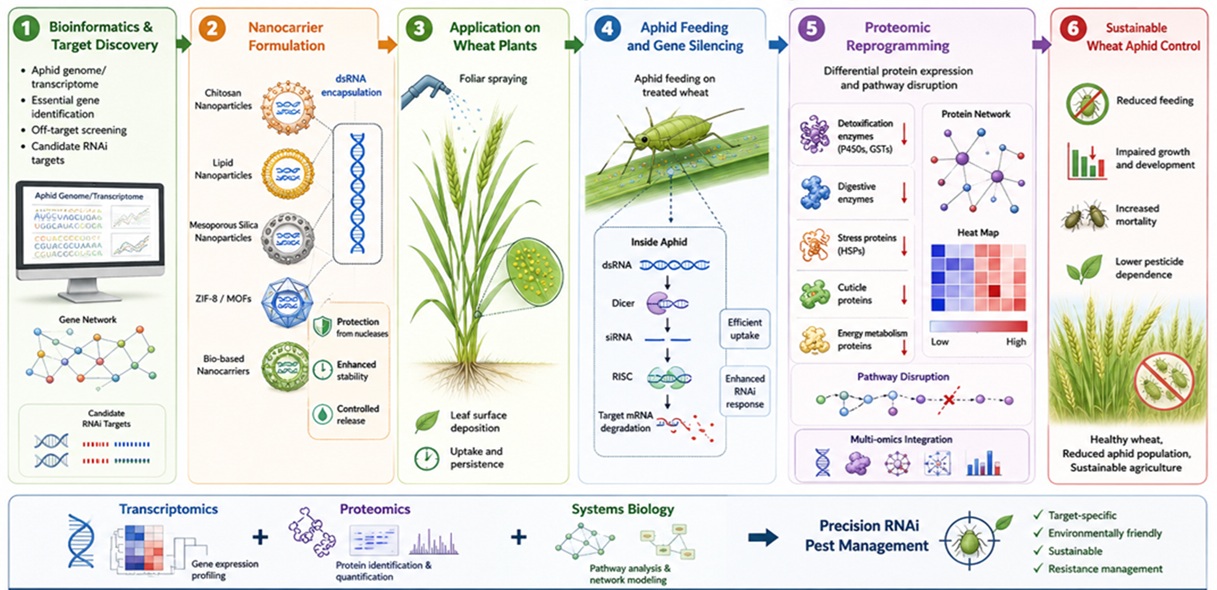
Wheat aphids, particularly Sitobion avenae, are among the most destructive insect pests affecting wheat production worldwide, causing substantial yield losses through direct feeding damage and virus transmission. Conventional chemical pesticides remain the primary control strategy; however, their extensive use has led to insecticide resistance, environmental contamination, and concerns about non-target effects. RNA interference (RNAi) has emerged as a promising and highly specific alternative for aphid management, enabling the targeted silencing of essential genes involved in survival, development, and reproduction. Nevertheless, the practical application of RNAi in field conditions is constrained by the instability of double-stranded RNA (dsRNA), susceptibility to nuclease degradation, and inefficient cellular uptake. Nanocarrier-based delivery systems have been developed to overcome these limitations by enhancing dsRNA stability, protecting it from environmental degradation, facilitating cellular internalization, and enabling controlled release. Various nanoplatforms, including polymeric nanoparticles, lipid-based carriers, mesoporous silica nanoparticles, metal–organic frameworks and bio-based nanomaterials, have demonstrated significant potential for improving RNAi efficiency in insect pest management. Beyond delivery enhancement, increasing evidence suggests that nanocarrier-mediated RNAi can induce substantial molecular and physiological changes that extend from transcriptomic alterations to downstream proteomic responses. This review provides a comprehensive overview of nanocarrier-assisted dsRNA delivery strategies for wheat aphid control, with particular emphasis on the integration of proteomic and multi-omics approaches for evaluating RNAi outcomes. We discuss advances in bioinformatics-guided target gene selection, engineering principles of nanocarrier systems, mechanisms of dsRNA uptake and release, and the protein-level consequences of gene silencing. Furthermore, the review highlights the importance of combining transcriptomic, proteomic, and systems biology analyses to achieve a more comprehensive understanding of RNAi-mediated pest suppression. By bridging nanotechnology, RNAi, and proteomics, this review provides a systems-level perspective for the development of sustainable and precision-based strategies for aphid management.
- Open Access
- Review
Engineering Nanocarrier-Mediated dsRNA Delivery Systems for Aphid Control: From AI-Based Target Discovery to Proteomic to Systems-Level Responses
- Amber Afroz 1,*,
- Sunmbal Awais 1,
- Irsha Asghar 1,
- Hamyal Awais 2,
- Ghulam Abbas 3 and
- Nadia Zeeshan 1
Author Information
Received: 30 July 2026 | Revised: 20 October 2026 | Accepted: 16 November 2026 | Published: 25 November 2026
Abstract
Graphical Abstract
Keywords
RNA interference | dsRNA | proteomics | AI | grain aphid | BAPC
References
- 1.
Gu, D.; Andreev, K.; Dupre, M.E. Major Trends in Population Growth Around the World. China CDC Wkly. 2021, 3, 604–613. https://doi.org/10.46234/ccdcw2021.160.
- 2.
Mao, H.; Jiang, C.; Tang, C.; et al. Wheat adaptation to environmental stresses under climate change: Molecular basis and genetic improvement. Mol. Plant 2023, 16, 1564–1589. https://doi.org/10.1016/j.molp.2023.09.001.
- 3.
Rafique, A.; Afroz, A.; Zeeshan, N.; et al. Production of Sitobion avenae-resistant Triticum aestivum cvs using laccase as RNAi target and its systemic movement in wheat post dsRNA spray. PLoS ONE 2023, 18, e0284888. https://doi.org/10.1371/journal.pone.0284888.
- 4.
Shafqat, J.; Afroz, A. RNA interference of Sitobion avenae voltage-gated sodium channels for improved grain aphid resistance. Int. J. Trop. Insect Sci. 2024, 44, 1679–1689. https://doi.org/10.1007/s42690-024-01261-1.
- 5.
Diaz, A.A.G.; Wang, F.; Feng, H. Aphid Management in Crop Systems: Current Strategies and Future Perspectives. Agriculture 2026, 16, 924. https://doi.org/10.3390/agriculture16090924.
- 6.
Shekhar, C.; Khosya, R.; Thakur, K.; et al. A systematic review of pesticide exposure, associated risks, and long-term human health impacts. Toxicol. Rep. 2024, 13, 101840. https://doi.org/10.1016/j.toxrep.2024.101840.
- 7.
Yamamoto, T. Engineering of Bacillus thuringiensis insecticidal proteins. J. Pestic. Sci. 2022, 47, 47–58. https://doi.org/10.1584/jpestics.d22-016.
- 8.
Head, G.P.; Carroll, M.W.; Evans, S.P.; et al. Evaluation of SmartStax and SmartStax PRO maize against western corn rootworm and northern corn rootworm: Efficacy and resistance management. Pest Manag. Sci. 2017, 73, 1883–1899. https://doi.org/10.1002/ps.4554.
- 9.
Mahmood, I.; Afroz, A.; Malik, M.F.; et al. RNA interference-mediated knockdown of odorant-binding protein 2 and MP58 gene causes mortality in Myzus persicae. Int. J. Trop. Insect Sci. 2022, 42, 315–326. https://doi.org/10.1007/s42690-021-00546-z.
- 10.
Liu, S.; Ladera-Carmona, M.J.; Poranen, M.M.; et al. Evaluation of dsRNA delivery methods for targeting macrophage migration inhibitory factor MIF in RNAi-based aphid control. J. Plant Dis. Prot. 2021, 128, 1201–1212. https://doi.org/10.1007/s41348-021-00464-9.
- 11.
Zhong, X.; Yu, X.; Zhang, J.; et al. RNAi technologies for insect control in crop protection. Crop J. 2025, 13, 1009–1021. https://doi.org/10.1016/j.cj.2025.05.006.
- 12.
Marillonnet, S.; Grützner, R. Synthetic DNA Assembly Using Golden Gate Cloning and the Hierarchical Modular Cloning Pipeline. Curr. Protoc. Mol. Biol. 2020, 130, e115. https://doi.org/10.1002/cpmb.115.
- 13.
Afroz, A.; Aslam, S.; Rashid, U.; et al. Intron-containing hairpin RNA interference vector for OBP8 show promising mortality in peach potato aphid. Plant Cell Tissue Organ Cult. 2022, 148, 155–166. https://doi.org/10.1007/s11240-021-02174-4.
- 14.
Koch, A.; Krczal, G. The firstRNAI-based biopesticide approved in the United States: Regulatory implications for the European Union—The case of Ledprona (Calantha™). Pest Manag. Sci. 2026. https://doi.org/10.1002/ps.71219.
- 15.
Avila, L.A.; Chandrasekar, R.; Wilkinson, K.E.; et al. Delivery of lethal dsRNAs in insect diets by branched amphiphilic peptide capsules. J. Control. Release 2018, 273, 139–146. https://doi.org/10.1016/j.jconrel.2018.01.010.
- 16.
Carroll, E.; Kunte, N.; McGraw, E.; et al. Gene silencing in adult Popillia japonica through feeding of double-stranded RNA (dsRNA) complexed with branched amphiphilic peptide capsules (BAPCs). Front. Insect Sci. 2023, 3, 1151789. https://doi.org/10.3389/finsc.2023.1151789.
- 17.
Wang, Q.; Li, C.; Yang, R.; et al. Nanocarrier-Mediated RNAi: Breaking the dsRNA Delivery Bottleneck in Crop Protection. J. Agric. Food Chem. 2026, 74, 19326–19348. https://doi.org/10.1021/acs.jafc.6c04952.
- 18.
Li, Z.; Liu, Y.; Liang, Y.; et al. RNA interference-based pesticides: Mechanism, application, and commercialization in sustainable pest management. Pestic. Biochem. Physiol. 2026, 219, 107034. https://doi.org/10.1016/j.pestbp.2026.107034.
- 19.
Cedden, D.; Güney, G.; Rostás, M.; et al. Optimizing dsRNA sequences for RNAi in pest control and research with the dsRIP web platform. BMC Biol. 2025, 23, 114. https://doi.org/10.1186/s12915-025-02219-6.
- 20.
Horn, T.; Boutros, M. E-RNAi: A web application for the multi-species design of RNAi reagents—2010 update. Nucleic Acids Res. 2010, 38, W332–W339. https://doi.org/10.1093/nar/gkq317.
- 21.
List, F.; Tarone, A.M.; Zhu-Salzman, K.; et al. RNA meets toxicology: Efficacy indicators from the experimental design of RNAi studies for insect pest management. Pest Manag. Sci. 2022, 78, 3215–3225. https://doi.org/10.1002/ps.6884.
- 22.
Zhang, Y.; Fan, J.; Sun, J.; et al. Transcriptome analysis of the salivary glands of the grain aphid, Sitobion avenae. Sci. Rep. 2017, 7, 15911. https://doi.org/10.1038/s41598-017-16092-z. Correction in Sci. Rep. 2020, 10, 11445.
- 23.
Li, Q.; Fu, Y.; Liu, X.; et al. Activation of Wheat Defense Response by Buchnera aphidicola-Derived Small Chaperone Protein GroES in Wheat Aphid Saliva. J. Agric. Food Chem. 2022, 70, 1058–1067. https://doi.org/10.1021/acs.jafc.1c07046.
- 24.
Nicholson, S.J.; Hartson, S.D.; Puterka, G.J. Proteomic analysis of secreted saliva from Russian Wheat Aphid (Diuraphis noxia Kurd.) biotypes that differ in virulence to wheat. J. Proteom. 2012, 75, 2252–2268. https://doi.org/10.1016/j.jprot.2012.01.031.
- 25.
Mittapelly, P.; Rajarapu, S.P. Applications of Proteomic Tools to Study Insect Vector–Plant Virus Interactions. Life 2020, 10, 143. https://doi.org/10.3390/life10080143.
- 26.
Dawar, P.; Adhikari, I.; Mandal, S.N.; et al. RNA Metabolism and the Role of Small RNAs in Regulating Multiple Aspects of RNA Metabolism. Non-Coding RNA 2024, 11, 1. https://doi.org/10.3390/ncrna11010001.
- 27.
Cedden, D.; Güney, G. Small RNAs in insects: Emerging classes and functions. Curr. Opin. Insect Sci. 2026, 73, 101458. https://doi.org/10.1016/j.cois.2025.101458.
- 28.
Poudel, S.; Quito, K.; Mondal, M.; et al. Potential for gene silencing by piwi-interacting RNA in three lepidopterans. Front. Insect Sci. 2026, 6, 1869174. https://doi.org/10.3389/finsc.2026.1869174.
- 29.
Wang, D.; Shi, X.; Liu, D.; et al. Transcriptome Profiling Revealed Potentially Critical Roles for Digestion and Defense-Related Genes in Insects’ Use of Resistant Host Plants: A Case Study with Sitobion Avenae. Insects 2020, 11, 90. https://doi.org/10.3390/insects11020090.
- 30.
Daud, M.; Intizar, M.U.; Intizar, M.S. Artificial Intelligence in integrated pest management: A technological paradigm shift. Artif. Intell. 2026, 1, 1–22.
- 31.
Wang, J.; Chen, Y.; Huang, J.; et al. Leveraging machine learning for advancing insect pest control: A bibliometric analysis. J. Appl. Entomol. 2025, 149, 293–308. https://doi.org/10.1111/jen.13223.
- 32.
Mandelli, C.; Crippa, G.; Jali, S. Machine Learning Reveals Intrinsic Determinants of siRNA Efficacy. bioRxiv 2025. https://doi.org/10.1101/2025.08.11.667724.
- 33.
Xu, J.; Zhang, W.; Liu, X.; et al. BeetleFormer: A Sequence Transformer for Identifying Effective Double-Stranded RNAs in the Red Flour Beetle, Tribolium castaneum. Insects 2026, 17, 1096. https://doi.org/10.3390/insects17111096.
- 34.
Chen, Y.; Shi, Y.; Wang, Z.; et al. dsRNAEngineer: A web-based tool of comprehensive dsRNA design for pest control. Trends Biotechnol. 2025, 43, 969–983. https://doi.org/10.1016/j.tibtech.2025.01.002.
- 35.
Wang, Z.G.; Qin, C.Y.; Chen, Y.; et al. Fusion DSRNA designs incorporating multiple target sequences can enhance the aphid control capacity of an RNAI-based strategy. Pest Manag. Sci. 2024, 80, 2689–2697. https://doi.org/10.1002/ps.7975.
- 36.
Xie, X.; Shang, F.; Liu, Y.; et al. Identification of RNAI efficiency-related gene in the green peach aphid, MYZUS PERSICAE (Hemiptera), based on comparative transcriptomics. Pest Manag. Sci. 2025, 81, 4463–4470. https://doi.org/10.1002/ps.8804.
- 37.
Li, J.; Tan, Y.; Lu, R.; et al. Artificial intelligence for RNA–ligand interaction prediction: Advances and prospects. Drug Discov. Today 2025, 30, 104366. https://doi.org/10.1016/j.drudis.2025.104366.
- 38.
Dhandapani, R.K.; Gurusamy, D.; Palli, S.R. Protamine–Lipid–dsRNA Nanoparticles Improve RNAi Efficiency in the Fall Armyworm, Spodoptera frugiperda. J. Agric. Food Chem. 2022, 70, 6634–6643. https://doi.org/10.1021/acs.jafc.2c00901.
- 39.
Kumari, A.; Suhag, A.; Jaiwal, Y.; et al. RNAi-mediated silencing of Vitellogenin receptor and Ryanodine receptor, key genes, by using carbon nanotubes for management of whitefly (Bemisia tabaci). Physiol. Mol. Biol. Plants 2026, 32, 509–518. https://doi.org/10.1007/s12298-025-01697-w.
- 40.
Mannaa, M.; Kil, E.J.; Park, I.; et al. Spray-induced gene silencing for plant disease control: Mechanistic basis and deployment-oriented design. Front. Plant Sci. 2026, 17, 1829123. https://doi.org/10.3389/fpls.2026.1829123.
- 41.
Hu, S.; Yan, C.; Fei, Q.; et al. MOF-based stimuli-responsive controlled release nanopesticide: Mini review. Front. Chem. 2023, 11, 1272725. https://doi.org/10.3389/fchem.2023.1272725.
- 42.
Abdalkarim, K.A.; Tofiq, D.I.; Hamarawf, R.F.; et al. MOF/Chitosan Composites: An Emerging Class of Multifunctional Materials for Diverse Applications. J. Inorg. Organomet. Polym. Mater. 2025, 35, 4189–4241. https://doi.org/10.1007/s10904-024-03572-9.
- 43.
Scarpin, D.; Nerva, L.; Chitarra, W.; et al. Characterisation and functionalisation of chitosan nanoparticles as carriers for double-stranded RNA (dsRNA) molecules towards sustainable crop protection. Biosci. Rep. 2023, 43, BSR20230817. https://doi.org/10.1042/bsr20230817.
- 44.
Alghadab, R.A.; Velasco, L. Nanoparticle-enhanced multi-target RNAi in Myzus persicae: Molecular mechanisms, cross-kingdom sRNA transfer, and efficacy for sustainable pest management. Pest Manag. Sci. 2026, 82, 8338–8357. https://doi.org/10.1002/ps.70888.
- 45.
Martínez-Cano, B.; Mendoza-Meneses, C.J.; García-Trejo, J.F.; et al. Review and Perspectives of the Use of Alginate as a Polymer Matrix for Microorganisms Applied in Agro-Industry. Molecules 2022, 27, 4248. https://doi.org/10.3390/molecules27134248.
- 46.
Moorlach, B.W.; Sede, A.R.; Hermann, K.M.; et al. Interpolyelectrolyte complexes of in vivo produced dsRNA with chitosan and alginate for enhanced plant protection against tobacco mosaic virus. Int. J. Biol. Macromol. 2025, 306, 141579. https://doi.org/10.1016/j.ijbiomac.2025.141579.
- 47.
Sheikhi, A.; Hayashi, J.; Eichenbaum, J.; et al. Recent advances in nanoengineering cellulose for cargo delivery. J. Control. Release 2019, 294, 53–76. https://doi.org/10.1016/j.jconrel.2018.11.024.
- 48.
Ma, Y.; Yu, M.; Wang, Y.; et al. A pH/cellulase dual stimuli-responsive cellulose-coated metal–organic framework for eco-friendly fungicide delivery. Chem. Eng. J. 2023, 462, 142190. https://doi.org/10.1016/j.cej.2023.142190.
- 49.
Yang, W.; Wang, B.; Lei, G.; et al. Advances in nanocarriers to improve the stability of dsRNA in the environment. Front. Bioeng. Biotechnol. 2022, 10, 974646. https://doi.org/10.3389/fbioe.2022.974646.
- 50.
Su, C.; Liu, S.; Sun, M.; et al. Delivery of Methoprene-Tolerant dsRNA to Improve RNAi Efficiency by Modified Liposomes for Pest Control. ACS Appl. Mater. Interfaces 2023, 15, 13576–13588. https://doi.org/10.1021/acsami.2c20151.
- 51.
Kim, Y.; Kwak, J.; Lim, M.; et al. Advances in PCL, PLA, and PLGA-Based Technologies for Anticancer Drug Delivery. Pharmaceutics 2025, 17, 1354. https://doi.org/10.3390/pharmaceutics17101354.
- 52.
Khosrojerdi, S.; Gholami, L.; Khazaei, M.; et al. Synthesis and evaluation of gene delivery vectors based on PEI-modified metal-organic framework (MOF) nanoparticles. Iran. J. Basic Med. Sci. 2024, 27, 203–213. https://doi.org/10.22038/ijbms.2023.71892.15644.
- 53.
Liu, C.; Zhang, P.; Zhai, X.; et al. Nano-carrier for gene delivery and bioimaging based on carbon dots with PEI-passivation enhanced fluorescence. Biomaterials 2012, 33, 3604–3613. https://doi.org/10.1016/j.biomaterials.2012.01.052.
- 54.
Ni, Q.; Tomalia, D.A.; Wu, J.; et al. Precision chemical engineering of dendrimers for nucleic acid delivery. Nat. Rev. Chem. 2026, 10, 620–636. https://doi.org/10.1038/s41570-026-00855-2.
- 55.
Gulfishan, S.; Alam, M.W.; Pandey, P.; et al. PAMAM dendrimers as efficient drug nanocarriers of natural compounds in breast cancer therapeutics. Front. Oncol. 2026, 16, 1809604. https://doi.org/10.3389/fonc.2026.1809604.
- 56.
Jian, J.; Cong, Y.; Lu, X.; et al. Star polycation nanoplatform improves dsRNA stability and delivery for RNAi-Based control of Meloidogyne enterolobii. Adv. Agrochem 2026, in press. https://doi.org/10.1016/j.aac.2026.06.001.
- 57.
Zhang, C.; Wei, G.; Wu, L.; et al. Utilizing Star Polycation Nanocarrier for the Delivery of miR-184 Agomir and Its Impact on the Life History Traits of the English Grain Aphid, Sitobion avenae. Insects 2024, 15, 459. https://doi.org/10.3390/insects15060459.
- 58.
Yang, J.; Yan, S.; Xie, S.; et al. Construction and application of star polycation nanocarrier-based microRNA delivery system in Arabidopsis and maize. J. Nanobiotechnol. 2022, 20, 219. https://doi.org/10.1186/s12951-022-01443-4.
- 59.
Liu, C.; Ning, X.; Zhao, P.; et al. Nanocarrier-mediated RNAi targeting glutamate decarboxylase synergizes with neonicotinoids for aphid control. Chem. Eng. J. 2026, 529, 172452. https://doi.org/10.1016/j.cej.2025.172452.
- 60.
Rana, S.; Kang, C.; Ryu, S.; et al. Assessing nanoparticle-enabled dsRNA delivery for oral RNAi in two orthopteran pests: Schistocerca gregaria and Melanoplus sanguinipes. J. Insect Physiol. 2025, 163, 104825. https://doi.org/10.1016/j.jinsphys.2025.104825.
- 61.
Xu, S.; Hu, Z.; Song, F.; et al. Lipid nanoparticles: Composition, formulation, and application. Mol. Ther. Methods Clin. Dev. 2025, 33, 101463. https://doi.org/10.1016/j.omtm.2025.101463.
- 62.
Xu, Z.; Wang, X.; Shao, X.; et al. Utilizing cationic liposome to co-deliver poly-siRNA and chlorantraniliprole complexes: A new strategy for overcoming insecticide resistance in Plutella xylostella (Lepidoptera: Plutellidae). Adv. Agrochem 2026, 5, 108–119. https://doi.org/10.1016/j.aac.2025.08.001.
- 63.
Lv, N.; Zhang, X.; Li, R.; et al. Mesoporous silica nanospheres-mediated insecticide and antibiotics co-delivery system for synergizing insecticidal toxicity and reducing environmental risk of insecticide. Sci. Total Environ. 2024, 926, 171984. https://doi.org/10.1016/j.scitotenv.2024.171984.
- 64.
Ji, H.; Wang, J.; Xue, A.; et al. Chitosan–silica nanocomposites induced resistance in faba bean plants against aphids (Acyrthosiphon pisum). Environ. Sci. Nano 2023, 10, 1966–1977. https://doi.org/10.1039/d3en00234a.
- 65.
Sangwan, A.; Gupta, D.; Singh, O.W.; et al. Size variations of mesoporous silica nanoparticle control uptake efficiency and delivery of AC2-derived dsRNA for protection against tomato leaf curl New Delhi virus. Plant Cell Rep. 2023, 42, 1571–1587. https://doi.org/10.1007/s00299-023-03048-z.
- 66.
Zhu, L.; Chen, L.; Gu, J.; et al. Carbon-Based Nanomaterials for Sustainable Agriculture: Their Application as Light Converters, Nanosensors, and Delivery Tools. Plants 2022, 11, 511. https://doi.org/10.3390/plants11040511.
- 67.
Wang, F.F.; Huang, Y.Y.; Qin, P.; et al. Imidazole-Modified Graphene Quantum Dots Enhance RNAi Efficiency in Spodoptera litura (Lepidoptera: Noctuidae): A Study Using Cuticular Protein Gene Silencing. Arch. Insect Biochem. Physiol. 2026, 122, e70176. https://doi.org/10.1002/arch.70176.
- 68.
Delgado-Martín, J.; Delgado-Olidén, A.; Velasco, L. Carbon Dots Boost dsRNA Delivery in Plants and Increase Local and Systemic siRNA Production. Int. J. Mol. Sci. 2022, 23, 5338. https://doi.org/10.3390/ijms23105338.
- 69.
Liu, X.; Liang, X.; Cai, Z.; et al. BioCNTs Mediated Delivery of Systemically Mobile Small RNAs via Leaf Spray to Control Both Tomato DNA and RNA Viruses. Adv. Sci. 2026, 13, e04889. https://doi.org/10.1002/advs.202504889.
- 70.
Esmaeilpour, D.; Sivakumar, P.M.; Khosravi, A.; et al. Polysaccharide-functionalized gold, silver, and iron oxide nanoparticles for siRNA delivery: The role of artificial intelligence in design and optimization. Mater. Today Bio 2026, 37, 102981. https://doi.org/10.1016/j.mtbio.2026.102981.
- 71.
Laisney, J.; Gurusamy, D.; Baddar, Z.E.; et al. RNAi in Spodoptera frugiperda Sf9 Cells via Nanomaterial Mediated Delivery of dsRNA: A Comparison of Poly-L-arginine Polyplexes and Poly-L-arginine-Functionalized Au Nanoparticles. ACS Appl. Mater. Interfaces 2020, 12, 25645–25657. https://doi.org/10.1021/acsami.0c06234.
- 72.
Cheng, X.; Zhou, Q.; Xiao, J.; et al. Nanoparticle LDH enhances RNAi efficiency of dsRNA in piercing-sucking pests by promoting dsRNA stability and transport in plants. J. Nanobiotechnol. 2024, 22, 544. https://doi.org/10.1186/s12951-024-02819-4.
- 73.
Suhag, A.; Kumari, A.; Jaiwal, P.K.; et al. Foliar and root absorption of LDH nanosheets loaded with dsRNAs efficiently silenced the expression of whitefly Bemisia tabaci Laccase 1 and Vitellogenin Receptor genes for their effective control. Biotechnol. Lett. 2026, 48, 82. https://doi.org/10.1007/s10529-026-03753-1.
- 74.
Niño-Sánchez, J.; Sambasivam, P.T.; Sawyer, A.; et al. BioClay™ prolongs RNA interference-mediated crop protection against Botrytis cinerea. J. Integr. Plant Biol. 2022, 64, 2187–2198. https://doi.org/10.1111/jipb.13353.
- 75.
Worrall, E.A.; Bravo-Cazar, A.; Nilon, A.T.; et al. Exogenous Application of RNAi-Inducing Double-Stranded RNA Inhibits Aphid-Mediated Transmission of a Plant Virus. Front. Plant Sci. 2019, 10, 265. https://doi.org/10.3389/fpls.2019.00265.
- 76.
Yin, J.; Su, X.; Yan, S.; et al. Multifunctional Nanoparticles and Nanopesticides in Agricultural Application. Nanomaterials 2023, 13, 1255. https://doi.org/10.3390/nano13071255.
- 77.
Xu, J.; Zheng, H.; Gao, Y.; et al. The Application of Metal–Organic Frameworks as Drug Delivery Systems: From the Perspective of Molecular Dynamics Simulations. MedComm 2026, 7, e70692. https://doi.org/10.1002/mco2.70692.
- 78.
Feng, P.; Chen, J.; Fan, C.; et al. An eco-friendly MIL-101@CMCS double-coated dinotefuran for long-acting active release and sustainable pest control. J. Clean. Prod. 2020, 265, 121851. https://doi.org/10.1016/j.jclepro.2020.121851.
- 79.
Yu, C.; Li, J.; Zhang, Z.; et al. Metal–Organic Framework-Based Insecticide and dsRNA Codelivery System for Insecticide Resistance Management. ACS Appl. Mater. Interfaces 2023, 15, 48495–48505. https://doi.org/10.1021/acsami.3c09074.
- 80.
Wang, W.; Ghafar, M.A.; Liuyang, L.; et al. Nanoscale Metal–Organic Frameworks for the Co-Delivery of Cycloxaprid and Pooled siRNAs to Enhance Control Efficacy in Diaphorina citri. J. Agric. Food Chem. 2025, 73, 3353–3362. https://doi.org/10.1021/acs.jafc.4c08172.
- 81.
Wan, M.; Song, S.; Feng, W.; et al. Metal–Organic Framework (UiO-66)-Based Pesticide Delivery System for Effective Deltamethrin Loading and Sustained Pesticide Release. ACS Appl. Eng. Mater. 2023, 1, 1079–1085. https://doi.org/10.1021/acsaenm.2c00105.
- 82.
Ye, C.; Hu, X.S.; Wang, Z.W.; et al. Involvement of clathrin-dependent endocytosis in cellular dsRNA uptake in aphids. Insect Biochem. Mol. Biol. 2021, 132, 103557. https://doi.org/10.1016/j.ibmb.2021.103557.
- 83.
Carolan, J.C.; Caragea, D.; Reardon, K.T.; et al. Predicted Effector Molecules in the Salivary Secretome of the Pea Aphid (Acyrthosiphon pisum): A Dual Transcriptomic/Proteomic Approach. J. Proteome Res. 2011, 10, 1505–1518. https://doi.org/10.1021/pr100881q.
- 84.
Afroz, A.; Zahur, M.; Zeeshan, N.; et al. Plant-bacterium interactions analyzed by proteomics. Front. Plant Sci. 2013, 4, 21. https://doi.org/10.3389/fpls.2013.00021.
- 85.
Argandona, J.A.; Kim, D.; Hansen, A.K. Comparative transcriptomics of aphid species that diverged > 22 MYA reveals genes that are important for the maintenance of their symbiosis. Sci. Rep. 2023, 13, 5341. https://doi.org/10.1038/s41598-023-32291-3.
- 86.
Sharma, M.; Oraon, P.K.; Srivastava, R.; et al. Comparative transcriptomics of a generalist aphid, Myzus persicae and a specialist aphid, Lipaphis erysimi reveals molecular signatures associated with diversity of their feeding behaviour and other attributes. Front. Plant Sci. 2024, 15, 1415628. https://doi.org/10.3389/fpls.2024.1415628.
- 87.
Rao, S.A.K.; Carolan, J.C.; Wilkinson, T.L. Proteomic Profiling of Cereal Aphid Saliva Reveals Both Ubiquitous and Adaptive Secreted Proteins. PLoS ONE 2013, 8, e57413. https://doi.org/10.1371/journal.pone.0057413. Correction in PLoS ONE 2024, 19, e0304429.

This work is licensed under a Creative Commons Attribution 4.0 International License.
