
Transactions on Artificial Intelligence
Editor-in-Chief: Prof. Dapeng Oliver Wu, City University of Hong Kong, Hong Kong.
The Transactions on Artificial Intelligence (TAI) is a peer-reviewed, open-access journal dedicated to advancing trustworthy, explainable, and human-centered AI. The journal highlights emerging frontiers—including generative AI, autonomous systems, AI safety, and data-centric intelligence—while maintaining strong coverage of core AI theory and methodologies. Transactions on Artificial Intelligence is published continuously online by Scilight Press. More
- Open AccessArticle
Rethinking Attention: Entropy-Guided Iterative Refinement for Language Models
Subham Divakar, Rojalina Priyadarshini
2026, 2(1): 214-230. doi: 10.53941/tai.2026.100014
Download PDF5 Downloaded14 Viewed - Open AccessArticle
Human-Centric Clinical AI: A Structural Data Validation Approach for Human-Reliable Medical Inference
Marco Roccetti
2026, 2(1): 204-213. doi: 10.53941/tai.2026.100013
Download PDF33 Downloaded131 Viewed - Open AccessArticle
Contextual Bandit Routing for LoRA Experts
Miavaka Voninahitra Ambinintsoa Rakotovao Valisoa, Hobihery Matio Robinson
2026, 2(1): 190-203. doi: 10.53941/tai.2026.100012
Download PDF15 Downloaded64 Viewed - Open AccessArticle
LLM Wiki as a Living Constraint Oracle for Safe Offline RL: Evidence from Type 1 Diabetes Glucose Management
Bailing Zhang
2026, 2(1): 178-189. doi: 10.53941/tai.2026.100011
Download PDF20 Downloaded96 Viewed - Open AccessSurvey
Recent Advances in Autonomous Driving Safety
Shuguang Wang, Hongzong Li, Guanyi Zhao
2026, 2(1): 161-177. doi: 10.53941/tai.2026.100010
Download PDF55 Downloaded318 Viewed - Open AccessReview
A Comprehensive Survey of Multimodal Fake News Detection: Datasets, Methods, and Challenges
Guoyong Cai, Zhipeng Qiu, Guoxin Bi, Qinghua Liu
2026, 2(1): 131-160. doi: 10.53941/tai.2026.100009
Download PDF84 Downloaded378 Viewed1 Cited - Open AccessArticle
Federated Continual Learning for Privacy-Preserving, Reliable and Interpretable Multi-Center Corneal Diseases Diagnosis
Hongming Piao, Dapeng Oliver Wu
2026, 2(1): 119-130. doi: 10.53941/tai.2026.100008
Download PDF48 Downloaded234 Viewed - Open AccessArticle
Safe Offline Reinforcement Learning for Sepsis Treatment: A Two-Stage Framework Combining Constraint-Aware Learning with Runtime Safety Filtering
Bailing Zhang, Yuwei Mi
2026, 2(1): 103-118. doi: 10.53941/tai.2026.100007
Download PDF60 Downloaded293 Viewed - Open AccessReview
T-Cell Receptor Repertoire in Autoimmune Diseases and Their Machine Learning-Based Prediction Analysis
Tongfei Shen, Miaozhe Huo, Shuaicheng Li
2026, 2(1): 78-102. doi: 10.53941/tai.2026.100006
Download PDF102 Downloaded414 Viewed - Open AccessReview
Recent Advancements of Transcranial Direct Current Stimulation and Machine Learning: Methods, Challenges, and Opportunities
Junfu Cheng, Tara Sahni, Zeyun Zhao, Skylar E. Stolte, Chenyu You, Adam J. Woods, Aprinda Indahlastari, Ruogu Fang
2026, 2(1): 54-77. doi: 10.53941/tai.2026.100005
Download PDF101 Downloaded687 Viewed2 Cited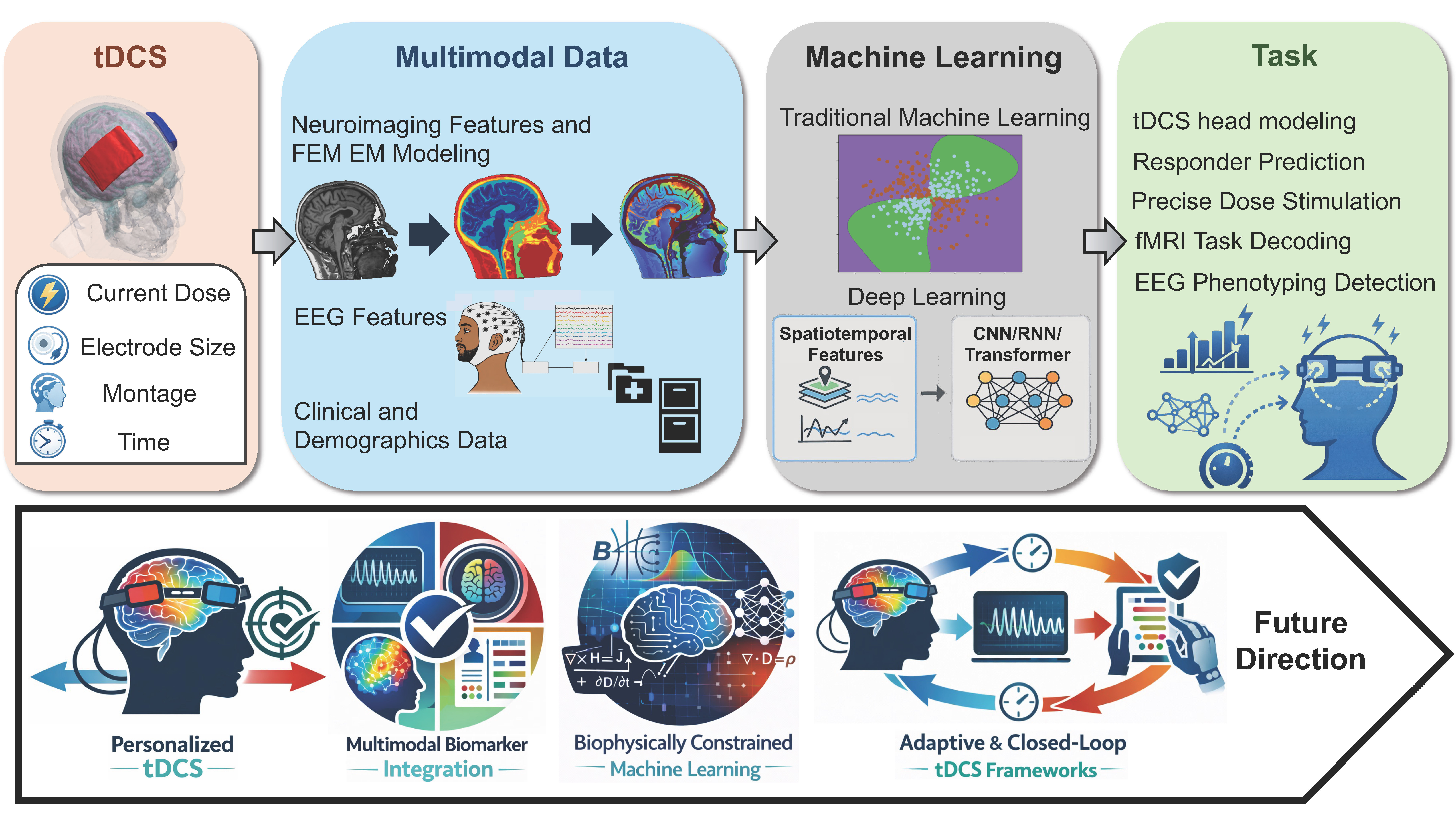
Announcements
More
Call For Papers
MoreArtificial Intelligence for Big Data and Software Engineering
The 7th International Conference on Big Data, Artificial Intelligence and Software Engineering ( ICBASE 2026 ) brought together academic scholars and industrial practitioners worldwide to exchange cutting-edge progress and emerging developments across the three disciplines. The event has now concluded successfully. Serving as an international forum for knowledge dissemination, the Transactions on Artificial Intelligence (TAI) highlights emerging frontiers—including generative AI, autonomous systems, AI safety, and data-centric intelligence—while maintaining strong coverage of core AI theory and methodologies. Taking into account the theme of the conference and the scope of the journal, we sincerely invite you to submit an extended version of your ICBASE 2026 paper to TAI on the topic of Artificial Intelligence for Big Data and Software Engineering. Academic Editors Prof. Tie Qiu ( qiutie@ieee.org ), Northeastern University, China. Prof. Jiayu Pan ( panjiayu@cse.neu.edu.cn ), Northeastern University, China. To submit your manuscript, please go to the Transactions on Artificial Intelligence journal website here and follow the procedures for manuscript submission. Author Submission Guidelines can be found at: Instruction for Authors. There is no Article Processing Charge for all submissions and accepted papers. All manuscripts will be peer-reviewed following the established policies and procedures of the journal. The final papers will be selected for publication depending on the results of the peer-review process and the reviews of the Academic Editors and Editor-in-Chief.
Transactions on Artificial Intelligence
Deadline: 30 Sep 2026Distributed Intelligence of Underwater Agents: Learning, Coordination, and Emergent Behaviors
Underwater environments are becoming increasingly important for ocean observation, marine resource exploration, environmental monitoring, offshore infrastructure inspection, disaster response, and autonomous scientific discovery. Recent advances in autonomous underwater vehicles, underwater sensor networks, marine robots, and multi-agent cyber-physical systems have created new opportunities for intelligent underwater missions that require groups of agents to perceive, learn, communicate, coordinate, and adapt in highly dynamic and uncertain environments. Unlike terrestrial and aerial domains, underwater systems face unique constraints, including severe attenuation of wireless signals, low-bandwidth and high-latency acoustic communications, GPS-denied localization, limited visibility, complex hydrodynamics, energy limitations, sparse supervision, and significant domain shifts between simulation and real-world deployment. These constraints make centralized intelligence difficult to deploy and call for distributed, adaptive, and communication-efficient artificial intelligence methods that can operate under partial observability, uncertainty, and intermittent connectivity. Distributed intelligence of underwater agents aims to enable multiple autonomous agents to learn from local observations, share knowledge efficiently, coordinate actions, and exhibit robust collective behaviors. This research direction spans multi-agent reinforcement learning, distributed optimization, federated and continual learning, graph learning, bio-inspired swarm intelligence, underwater perception, cooperative control, trustworthy AI, and emergent behavior analysis. It is also closely aligned with the broader goals of artificial intelligence: developing generalizable, explainable, safe, and autonomous learning systems capable of acting in complex real-world environments. This Call for Papers seeks high-quality original contributions that advance the theories, algorithms, architectures, and experimental validation of distributed intelligence for underwater agents. Submissions are expected to provide clear AI contributions, including new learning paradigms, coordination mechanisms, distributed decision-making frameworks, trustworthy autonomy methods, benchmark environments, or real-world demonstrations for underwater multi-agent systems. Topics of Interest Topics include, but are not limited to: 1. Distributed Learning for Underwater Multi-Agent Systems: Multi-agent reinforcement learning, federated learning, continual learning, self-supervised learning, and distributed optimization for autonomous underwater agents operating under limited communication, sparse supervision, and dynamic environments. 2. Coordination and Decision-Making under Underwater Constraints: Decentralized planning, co- operative control, task allocation, formation control, consensus, and decision-making under partial observability, delayed communication, uncertain localization, and energy constraints. 3. Emergent Behaviors and Swarm Intelligence: Learning, modeling, analysis, and interpretation of collective intelligence, self-organization, bio-inspired underwater swarms, robust group behaviors, and adaptive cooperation among heterogeneous underwater agents. 4. Intelligent Communication among Underwater Agents: Agent-to-agent communication protocols, semantic communication, goal-oriented information exchange, learned communication languages, intent sharing, negotiation, and interaction mechanisms for distributed underwater intelligence. 5. Communication-Efficient Intelligence and Knowledge Sharing: Learning and coordination under low-bandwidth, intermittent, and high-latency underwater communication links, including knowledge distillation, compressed learning, adaptive message passing, and communication-aware multi- agent policies. 6. Perception, Localization, and World Modeling for Underwater Agents: AI-enabled underwater perception, sonar and vision-based sensing, multi-modal fusion, cooperative localization, mapping, world models, and uncertainty-aware environmental understanding for distributed underwater autonomy. 7. Robust, Safe, and Explainable Underwater AI: Robust learning, sim-to-real transfer, domain adaptation, uncertainty quantification, explainable decision-making, safety-aware learning, fault tolerance, and trustworthy autonomy in complex underwater environments. 8. Benchmarks, Simulators, and Field Validation: Datasets, simulation platforms, digital twins, re- producible benchmarks, evaluation protocols, and real-world demonstrations for learning, coordination, and emergent behaviors of underwater agent systems. Authors are invited to submit original and unpublished manuscripts that are not currently under review elsewhere. Manuscripts should follow the formatting and submission requirements of T ransactions on Artificial Intelligence . All submissions will undergo the journal’s standard peer-review process. Submissions should clearly indicate their relevance to the topic on “Distributed Intelligence of Underwater Agents: Learning, Coordination, and Emergent Behaviors.” When submitting, authors should select the corresponding category in the journal’s submission system, if available. Submissions are expected to make a clear contribution to artificial intelligence, such as new learning algorithms, distributed decision-making methods, theoretical analysis, trustworthy AI frameworks, benchmark environments, or experimentally validated intelligent systems. Papers that only report routine engineering applications without sufficient AI novelty may be considered out of scope. Academic Editors Dr. Yusha Liu (yusha.liu@uestc.edu.cn), University of Electronic Science and Technology of China, China Dr. Jingxuan Chen (chenjingxuan@buaa.edu.cn), Hong Kong University of Science and Technology, Hong Kong Submission Guidelines To submit your manuscript, please go to the Transactions on Artificial Intelligence journal website here and follow the procedures for manuscript submission. Author Submission Guidelines can be found at: Instruction for Authors. There is no Article Processing Charge for all submissions and accepted papers. Important Dates Manuscript Submission Deadline: 31 August 2026 First-Round Review Notification: 15 October 2026 Revised Manuscripts Due: 31 November2026 Final Decision: 31 December 2026 Expected Publication: January 2027 All manuscripts will be peer-reviewed following the established policies and procedures of the journal. The final papers will be selected for publication depending on the results of the peer-review process and the reviews of the Academic Editors and Editor-in-Chief.
Transactions on Artificial Intelligence
Deadline: 31 Aug 2026

 Suite 4002 Level 4, 447 Collins Street, Melbourne, Victoria 3000, Australia
 General Inquiries: info@sciltp.com